









On East Road in the hamlet of Wallkill, the sights are typical of any rural Hudson Valley community: country homes, American flags, swaths of forest. But on its western end, motorists are suddenly confronted with a hand-painted sign: “DO NOT STOP IN ROAD.”
It’s a safety warning, but feels like a dare. Just beyond the sign is a scene so intriguing, it’s hard not to rubberneck: A smattering of vintage Volkswagen buses suspended in mid-air.
It’s the property of independent artist and illustrator Felix Sockwell. What started in 2019 as a place to store his buses has grown into a massive roadside art installation—which Sockwell hopes to open to the public as a camping and entertainment venue.

A Texas native, Sockwell began his career in the early ’90s as an art director for Dallas-area agencies. After a stint in San Francisco, he moved to New York in ’97 to start the brand integration arm of famed ad agency Ogilvy, where he worked with corporate clients like IBM and Starwood Hotels and Resorts.
In 1999, Sockwell set out on his own as an independent illustrator. He’s best known for his intricate, continuous single-line drawings and murals that have graced public spaces, concert posters, national publications, and even the lobby of Facebook’s headquarters.
He’s also an icon aficionado, having created logos and graphical user interfaces for Apple, the New York Times app, Facebook, and more. He authored a book on the subject, Thinking in Icons: Designing and Creating Effective Visual Symbols, in 2017.
Sockwell’s winding backstory is enough to fill its own book: He’s a descendant of Patrick Henry. He found human bones on his property. He garnered media attention after transforming his garage in Maplewood, New Jersey, into a neighborhood bar and performance venue dubbed “Garage Mahal.”
Throughout the Garage Mahal adventure, people kept telling Sockwell he reminded them of Mr. Plumbean, the protagonist of the 1977 children’s book The Big Orange Splot. Plumbean lives on a “neat street” where the houses look the same—until a seagull drops a bucket of orange paint on his roof. To his neighbors’ chagrin, Plumbean not only leaves the paint, but ups the ante: Stripes. Palm trees. A hammock. An alligator.
“He’s just having fun—he’s not doing anything to hurt anybody,” says Sockwell. “He was criticized by everybody, but then people started coming over and getting to know how fun it was to go over there and be in the creativity.”
Indeed, Sockwell has leaned into his Plumbean era. The exterior of his 19th-century house boasts vibrant colors, a clown’s face, and the words “Attractive Nuisance” (a tort law term describing “a dangerous condition on a landowner’s property” that could pose a safety risk to trespassing kids, according to Cornell’s Legal Information Institute). The inside, meanwhile, resembles a cross between a retro diner, farmhouse, and VW bus museum.
Before Sockwell arrived, the home was uninhabited for 40 years. “This was a scary, boarded-up nightmare,” says Sockwell. “I saw the potential in saving it and trying to revive it. I like resurrecting older things and making them purposeful.”
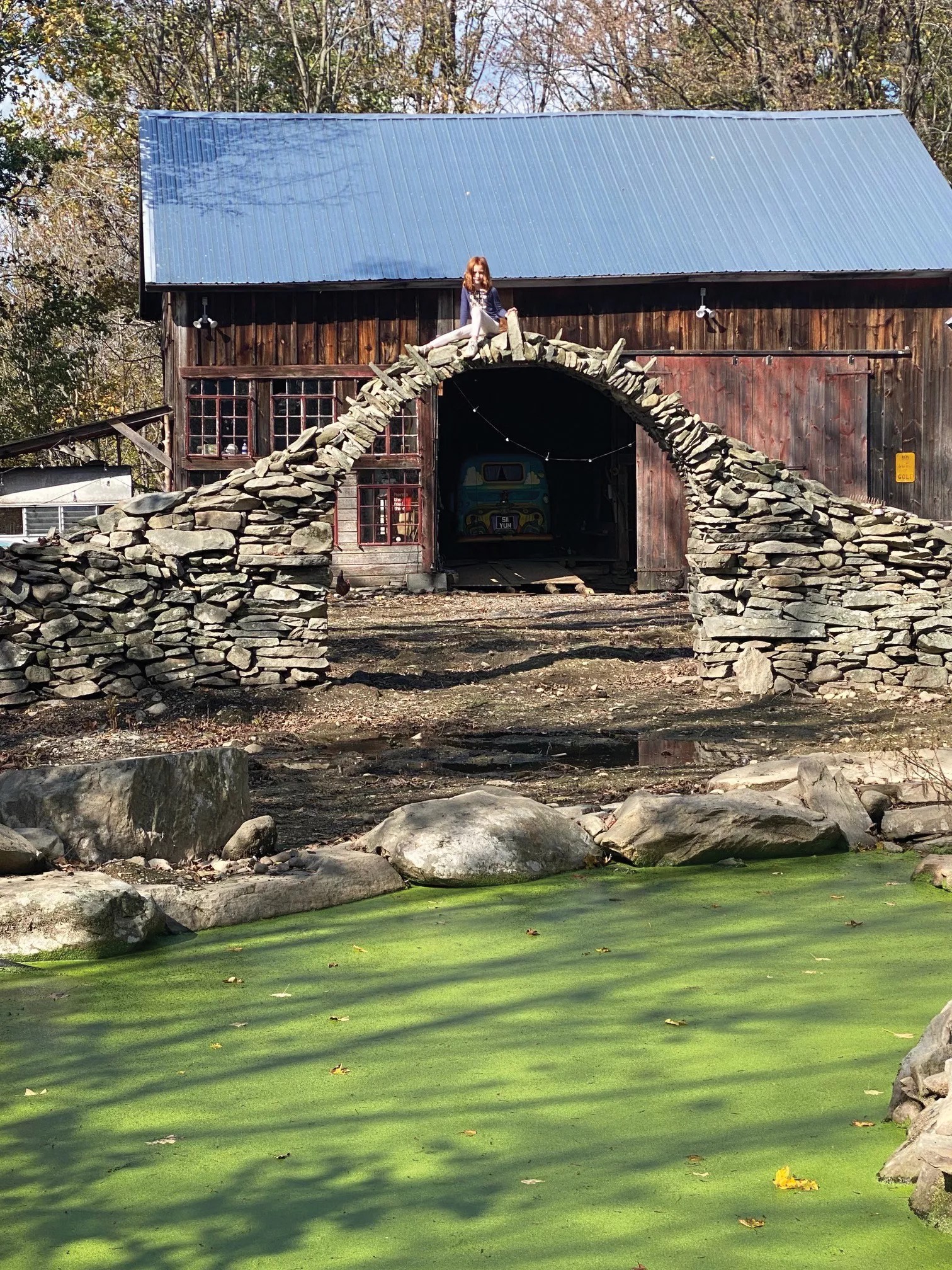
Across the street, a flock of hens and crowing roosters mill about. Beyond a stone archway and rustic barns, a geodesic dome looms among six suspended VW buses, and more on the ground.
His affinity for the buses began with a bus-shaped planter he bought in 2015 after his father died. After receiving an inheritance, Sockwell reinvented himself and stopped doing illustration work. “I just started doing creative stuff, without any end goal or any sort of goal,” recalls Sockwell.
After getting the planter, which he filled with ferns and kept in his kitchen, Sockwell “started coming into the idea that I could buy [a VW bus],” he says. After some research, he was the proud owner of a 1970s red-and-white 23-window bus. By the time he bought the Wallkill property, his collection had grown to four—nowadays, he’s got more than double that. “It’s a sickness, really,” he says. “Once you get into it, it’s hard to get out.”

His decision to put the buses on utility poles—which he says he convinced a power company to leave behind when they were replacing lines—was sparked by an old-fashioned small-town confrontation: A notice from the Town of Plattekill stating all vehicles visible from the road must be registered.
Sockwell’s response? He removed the motors and said he’d turn the buses into sculptures. After hiring a professional to ensure the poles were secure (Sockwell says they can now withstand hurricane-force winds), he mounted the buses with a forklift and welded them on. From afar, they look skewered, towering at different heights—creating a zagging pattern of hippie mobiles against a backdrop of woods and rocky cliffs.
It’s a jarring sight from the road, but looking ahead, Sockwell has bigger plans for his Plumbean paradise than just something to look at. The artist—a father of three—aspires to turn the property into a creative tech-free zone for family camping, music, comedy, and artistic collaboration.
“You’re going to have to meet with people,” says Sockwell. “We’re not going to be on our phones out here, doing TikToks.”
To complement the experience, he plans to develop a board game that mimics the property’s trails and landmarks, which visitors can follow as they traverse between different attractions. “We’re trying to encourage families to spend time with one another, learn the old way, and make moments that are not on their phones,” he says.
This article appears in January 2025.


