









Let’s say you’re a closeted gay man in postwar Clarksburg, West Virginia. You’re sharp, a little theatrical, and allergic to the 9-to-5. You love horror movies, ghost stories, and the occasional hoax. You’re a small-town showman with a big imagination, and you don’t quite believe in flying saucers—but you sure as hell believe in the people who want to believe. What do you do?
If you’re Gray Barker, you invent a genre. And if you’re Gabriel Mckee, you write the definitive book on the man who did. Mckee will be presenting “Saucer on a String: The UFO Hoaxes of Gray Barker” at Nerd Nite Hudson Valley at the Howland Cultural Center in Beacon on May 16.
Mckee’s The Saucerian: UFOs, Men in Black, and the Unbelievable Life of Gray Barker (Penguin Random House) is a deep, dishy, and unexpectedly poignant chronicle of a man who helped shape mid-century American conspiracy culture—before it metastasized into something darker. “He wasn’t a true believer,” Mckee, a Beacon resident, says. “He was a storyteller. A myth-maker. And he understood the market.”
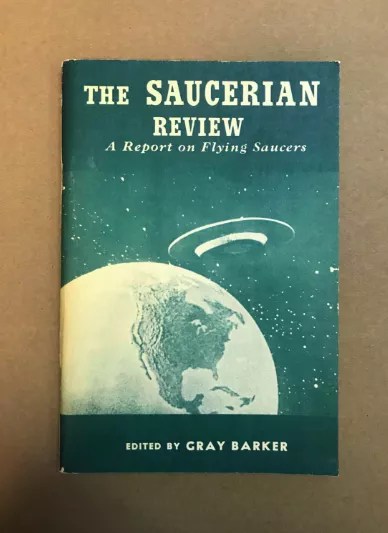
And what a market it was. Starting with his self-published The Saucerian zine in the 1950s, Barker built a small-scale publishing empire out of his living room, churning out books and pamphlets about Mothman, the Flatwoods Monster, and his biggest hit—the mysterious Men in Black. With their dark suits and darker motives, the MIB would go on to become pop-culture staples, most notably in the blockbuster Will Smith film series. But Barker’s original trio weren’t comic relief. They were figures of dread, standing in for the vague but very real feeling that someone didn’t want you to know the truth.

Barker, of course, loved a mystery. Solving it? Less important. “He didn’t want to close the case,” Mckee says. “He wanted to keep the story going.” That’s partly because stories were his business. As Mckee, a librarian at NYU’s Institute for the Study of the Ancient World, makes clear, Barker’s genius wasn’t in the facts he uncovered (or invented)—it was in how he circulated them.
Using tools more commonly found in insurance offices than printing presses, Barker mastered the art of low-cost publishing, scaling his print runs from 15 to 1,500 with equal aplomb. He even had one of the first home computer typesetting systems in the region. “He was part of this broader wave of DIY print culture,” Mckee explains, linking Barker’s innovations to the zine movements of both sci-fi nerds and downtown poets. “He repurposed commercial office tech for cultural production. And he did it decades before the internet democratized publishing.”
But what makes The Saucerian more than a fun ride through the back roads of UFO subculture is its sensitive rendering of Barker as a human being—a man who both reveled in and was trapped by the fictions he spun. A showman with a secret, Barker was also a closeted gay man who never left West Virginia. “He had opportunities to move to New York,” Mckee notes, “but he chose to stay. And that choice—deliberate or not—infused his work with a kind of rural gothic melancholy.”
McKee draws on extensive archival research (ten filing cabinets’ worth, housed in Clarksburg’s local history center) to trace Barker’s shifting persona. “He wasn’t a reliable narrator,” Mckee says. “There are letters where he claims the FBI investigated him for a hoax he pulled—but there’s no record of it. So was it real? Or did he just want to seem like someone the FBI would investigate?” Either way, Barker got what he wanted: mystique.
The irony, of course, is that Barker’s playful provocations—stories wrapped in question marks—would, decades later, harden into dogma. What started as a kind of cosmic improv comedy became, in other hands, the scaffolding for dangerous delusions. “In the ’50s and ’60s, conspiracy culture was politically diverse,” Mckee says. “There were right-wing conspiracies, sure, but also leftist ones, anarchist ones, just plain weird ones. It wasn’t until the ’80s and ’90s that things took a darker, more dogmatic turn.”
So was Barker a prophet of doom or just a prankster with a mimeograph machine? Mckee doesn’t pretend to resolve the tension. “He once told someone, ‘I believe everything and nothing,’” Mckee says. “That’s either the most honest answer possible—or the most evasive.”
And then there’s the cow story—West Virginia legend, drive-in folklore, or classic Barker baloney, depending on who’s telling it. The scene: a rural drive-in, 1964, a Western unspooling on the big screen. Onscreen: stampede. Offscreen: actual cows in a nearby pasture panic, break through the fence, and charge into the drive-in parking lot like they’re auditioning for Ben-Hur: Bovine Edition. Barker recounts the incident with glee in a letter that year—only problem is, he had already told the exact same story in 1949 to Box Office magazine. Same plot, same punchline, just with a new timestamp. Did it happen? Who knows. Probably not. But in true Barker fashion, he told it so many times you kind of want it to be real. Like a good UFO sighting, it’s the kind of story that improves in the retelling.
In the end, The Saucerian isn’t just a biography of one fringe publisher—it’s a study in how stories spread, mutate, and grow teeth. It’s also a cautionary tale for our age of algorithmic disinformation. “If you trace some of today’s conspiracies back far enough,” Mckee warns, “you’ll often find Barker’s fingerprints—alongside the literal strings in his faked UFO photos.”
Still, Mckee resists the temptation to make Barker into a cautionary tale. He sees him instead as a folklorist, a fabulist, maybe even—dare I say—a kind of artist. “He understood that belief is messy,” Mckee says. “And that sometimes, what people really want isn’t the truth. It’s a really good story.”
In that case, mission accomplished. And if the cows stampede onto the drive-in lot during the monster movie? All the better.
[eventarchive-1]
This article appears in May 2025.


