









Gen Z is fascinated by nostalgia; if you walked around the campus of SUNY New Paltz or the streets of Woodstock and took a shot every time you saw someone wearing a Rolling Stones or a Doors T-shirt, you’d probably have to get your stomach pumped. (And don’t ask them to name a single album, you’ll be both drunk and disappointed). They long for a simpler time, when seeing the Kinks at Madison Square Garden was $10 a pop and simply listening to the Velvet Underground was a form of rebellion against the status quo.
There have been a few bands that have formed over the last decade who aim to replicate the sound, style, and performance of their rock ‘n’ roll forefathers. Greta Van Fleet, for perfect example, is–essentially–a Led Zeppelin clone. While their guitarist Jake Kiszka isn’t smashing his Gibson SG at the end of a four-hour set way that Jimmy Page was known to do, GVF (more or less) gives their younger crowd an idea of what being at a Zeppelin show was like—on a tamer day.
What they’re missing, however, is poetic insurgence. They may mimic Zeppelin aesthetically, but the lyrics of “Black Smoke Rising”—“from the fires we’ve been told / it’s the new age crisis / and we will stand up in the cold”—will never be as socially radical as those of “Immigrant Song”—“how soft your fields so green, can whisper tales of gore / of how we calmed the tides of war, we are your overlords.”
True rock ‘n’ roll wasn’t performative, it was revolutionary. It was, and still could be, a rallying cry for vagabonds and champions of peace, with its zealous prophets taking inspiration from gospels of past generations and mixing their personal experiences with sociopolicial observations to say something timely and powerful in tandem with chords that satiate the cerebrum. Many contemporary “rock ‘n’ roll” artists are ignoring their civil duty to cause anarchy.
Enter: The Mystery Lights. A beacon of seditious hope for those that want to keep the tradition of musical mutiny alive in the age of passive participation.
“I was named after Michael the Archangel,” says Mystery Lights lead singer, Michael Brandon, who, outside of his musical career, has devoted his free time to studying psychology, philosophy, and theology–all of which seep into his clever lyricism. “On my desk I have a picture of Michael the Archangel defeating a demon, which I always found very symbolic to my own life. I always looked at the demon as a representation of my own inner conflicts and weaknesses, and to defeat it is to try to be a better person and rise above temptations.”
Upon first glance, the Mystery Lights’s self-titled album from 2016 resembles that of The Rolling Stones from 1963 and The Doors from 1967 in an uncanny way–the raw, blues-infused riffs mixed with a sultry, walking bassline, and the harmonious screech of a mod-cutted frontman could nearly transport you to the mid-century West Coast and sit you down at the dim-litted, hazy barstools of Whiskey a Go Go. To a well-tuned ear, however, there are some key, contemporary production elements that add slight—but significant—intricacies to their sound.

“Wayne Gordon is the perfect producer for us,” says Brandon. “He comes from a hip-hop background, so he puts a unique touch on the garage stuff. It adds a bass-heavy back beat, so when you listen to our songs it intuitively makes you bob your head.”
Gordon, chief studio engineer of Daptone Records and cofounder of their garage-rock subsidiary, Wick Records, is a Grammy Award-winning engineer–having won from his production of Bruno Mars’ “Uptown Funk.” Since joining the Daptone team as an intern in 2008, Gordon has worked with major artists such as Cee Lo Green and Amy Winehouse, smaller artists like Sharon Jones and the Dap-Tones, and is credited for The Budos Band. His very first signees under Wick Records, however, was the Mystery Lights; a well-calculated move that defined both parties’ inevitably successful careers in the years that followed.
“In 2015, we were playing a show at Union Pool in Brooklyn and some people from Daptone were brought to see us,” says Brandon. “That’s when things really changed. Wayne came up to us after the show and told us about his idea for Wick, and how he wanted us to be the first release. That same day, we got our first agent as well. Everything fell into place at the right time.”
Though their first record came out the following year in 2016, the Mystery Lights have been making music together since the early 2000s. Brandon and lead guitarist Luis “L.A.” Solano went to high school together in Salinas, California, and originally put their demos up on MySpace.
“We met at a skatepark when we were 15,” says Brandon. “At first, we were just making music for ourselves with the intention of having fun. We both grew up on punk, so we wanted to start a garage rock, Kink-eqsue style band with unpredictable songs that changed a lot. Back in the day, we used to play with Shannon and the Clams a bunch and Ty Segall when he was in Traditional Fools. We knew these bands as they were up-and-coming; John Dwyer from the Osees actually booked us our first San Francisco show at Amnesia. The difference was that they put out records with labels, and we were okay with our MySpace situation. We did that for a good 10 to 15 years and just flew under the radar, being our own worst enemy by not committing to our craft. But we were just being picky, waiting for the right label.”
Rather than shamelessly promote themselves online, Brandon and Solano committed slowly, in stages. In 2012, the pair moved to New York City, where they met bassist Alex Amini and decided to revive the Mystery Lights. For the most part, they continued to play their older songs, performing in the back of bars in Brooklyn in between restaurant shifts. However, once Gordon put them in the studio and ideas of grandeur and fame seemed more like plausible reality, their creativity burst at the seams with all of the resources they had available to them. The first three songs, “Intro,” “Follow Me Home,” and “Flowers In My Hair, Demons In My Head,” respectively, flow effortlessly into each other without pause, an unusually skillful feat for a band’s freshmen album.
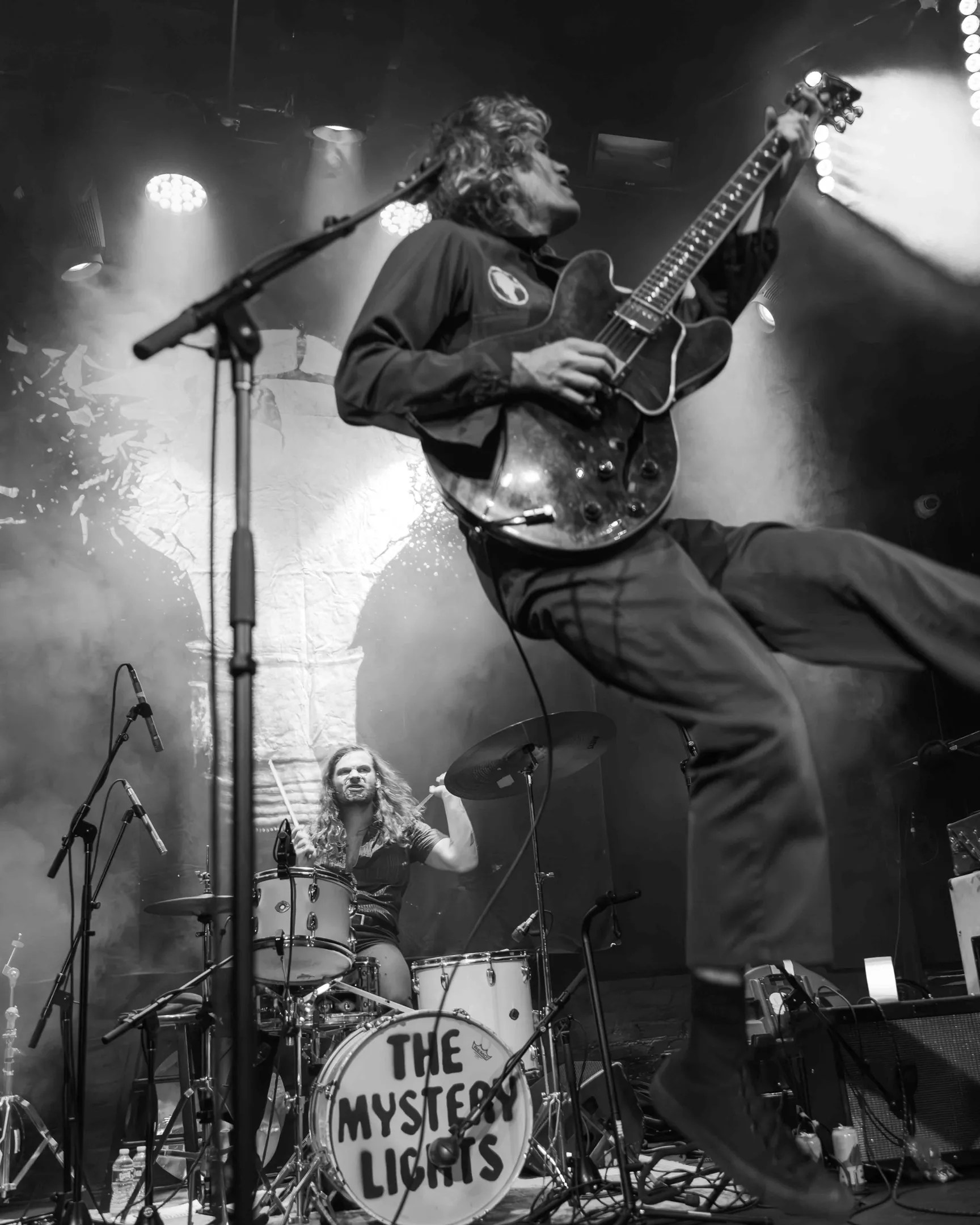
They fed the fruits of their labor to the streets of New York at the Mercury Lounge on June 24, 2016, immediately embarking on a near-continuous, five-month, cross-country tour, stopping for maybe a day or two in between shows. They kept touring for the next three years, straight through the release of their second album Too Much Tension! in 2019 and onward into 2020.
“After the second album and Covid, there was this huge stretch of time where I really wasn’t interested in playing music,” says Brandon, in an effort to explain the five-year gap between the band’s sophomore and junior records. “I was questioning whether I wanted to keep touring, and if this was something I wanted to continue doing. I wasn’t inspired at all, and I think we just burnt out for a minute there. Then, three years later, we reunited with Wayne and the mentality was ‘lets just get into the studio and have fun’ instead of ‘lets make another album because we have to make another album.’ It felt organic once we started to explore and experiment with new styles and things we heard during our time apart, and the idea of touring to show everyone our new stuff sounded exciting again. It feels like an ode to who we were when we first started.”
Inspired by ideas of Stoicism to mitigate a generation full of anxiety, righteousness in the face of hatred, and societal complicity, the Mystery Light’s newest album, Purgatory, is unmistakably theirs. Genre-bending, heart-pumping and thought-provoking; pulling from country licks, psychedelic tones, and punk rock enthusiasm, Purgatory is both an ode to the history of rock ‘n’ roll and a glimpse into its future. Their upcoming tour is bound to be their best yet. And better still—their final date is at the notorious No Fun in Troy on May 3. Sun Natives and Abyssmals will open.
“We’ve never played this venue all together before, so we’re really excited,” says Brandon. “The promoter is so excited to have us. You can tell this guy really appreciates our music. I’m looking forward to that show the most, in all honesty.”
[eventarchive-1]
This article appears in April 2025.


