









To commemorate our 30th anniversary, we’ve rummaged through the archives and picked out some choice bits to share from all 351 issues of the magazine, from the ridiculous (misspelling Febuary on the cover of the February ’97 issue) to the sublime (Alex Grey’s painting Praying, which appeared on the cover of the November ‘99 issue). Making this magazine over the past 30 years has been a labor of love and a labor of labor as well as a deep privilege. Thanks for reading Chronogram through all its permutations. Our evolution continues.
1993

“What qualified us to start a magazine? Nothing much other than the hubris and daring of youth.”
—Jason Stern, Chronogram cofounder
So It Begins
Chronogram launched as a bimonthly, calendar-driven publication with an October/November issue. Flip-book format (think Mad Libs), black and white, and 72 and 86 pages respectively. The two issues were mostly filled with calendar listings, including a performance of “The Pirates of Penzance” by the Hudson Valley Gilbert and Sullivan Society at the Bardavon Opera House, a concert by the Fighting McKenzies at the Rhinecliff Hotel, and a Wiccan Tradition and Ritual workshop with Rose St. Hilare at the Alternative Concept Center.
Editorial Stirrings
There were also a handful of articles: Film critic Jermiah Horrigan took a trip to the video store and recommended Citizen Kane; Johnny Weismuller and Maureen O’Sullivan in Tarzan and His Mate; and Anthony Minghella’s Truly, Madly, Deeply, starring the “radiantly homely Juliet Stevenson.” Joseph Campbell scholar Stephen Larsen reflected on the role of the shaman in society. There was also a meditation on backyard fauna, “The Return of the Wild Turkeys,” by Steve Lewis, who also contributed an essay for this issue.
A New Age Magazine
Cofounder Amara Projansky remembers the magazine’s birth this way: “When Jason suggested we start a New Age magazine, I let the idea settle in me for a minute. I liked magazines, and I liked reading, and I liked the area, and I even liked thoughtful, New Age kind of stuff. But I realized it was going to need more content than that—we should include arts and culture as well as the spiritual. We focused the magazine on helping people enjoy the area as much as we did.”
1994

“The reason we started Chronogram: To seek out the hidden cultural gems of the Hudson Valley, and make them known to all who would have an interest. To serve the little guys who don’t have the resources to spread their own word.”
—From an unsigned “Statement of Purpose” printed in the August issue
Art & Accessibility
Todd Paul, who would go on to serve as arts editor and contribute to the magazine for over a decade, profiled nontraditional art spaces in the region in the February/March issue: “One of the uplifting aspects of life in the Hudson Valley is that you don’t have to go to a gallery to find art,” Paul wrote. “There is a plethora of semi-gallery, nongallery, restaurant, and storefront venues showing quality work—work which is often more accessible than that carried by the old, established galleries.” One artist featured in the piece, Joel Griffith, would provide three covers for Chronogram.
A Change in Tempo
After three bimonthly issues and a warm reception from readers and advertisers, the magazine switches to a monthly publication schedule with the April issue, which featured a profile of ska band Perfect Thyroid.
A Night in June
Calendar listings continued to make up the bulk of the magazine’s content. On Friday, June 17, readers’ choices of events included a Freestyle Frolic dance in Rosendale, George Thorogood and the Destroyers at the Chance, Commander Cody at Tinker Street Cafe, and “Fifth of July” at Shadowland Theater.
Cultural Footing
The magazine really began to find its footing with its cultural coverage, previewing performances by notable local artists like Ed Sanders and the Fugs, the Hudson Valley Philharmonic, Claudia Bruce, Arm-of-the-Sea Theater, and Jay Ungar and Molly Mason.
1995

“Everything that’s present in the audible environment is part of the performance.”
—Pauline Oliveros, From a profile of the legendary composer and Kingston resident published in the April issue
Chronogram Personals
In the February issue, Chronogram Personals launched. Readers were encouraged to send in 40-word listings “saying anything you want about yourself and the person you’d like to meet.” Listings—about two dozen—were printed in the March issue, including this listing from a 40-year-old administrator from Hopewell Junction: “To be honest, without being egotistical, this tall, Italian, handsome, physically fit, romantic, dashing and charming man longs to meet a woman whose beauty and charms he can complement.”
Debut of Poetry
Poetry was featured for the first time in the May issue, including Frances Donovan’s “Why Newt Gingrich and the Selfish Right Should Be Impeached.” To date, Chronogram has published over 3,000 poems.
Spill the Wine
In a review of Spanky’s, a Cajun restaurant in Poughkeepsie, our reviewer Megan Park looked favorably on the affordable wines: “We chose a pleasant ’93 Beaujolais, reasonably priced at $10 a bottle.”
Cover Lines
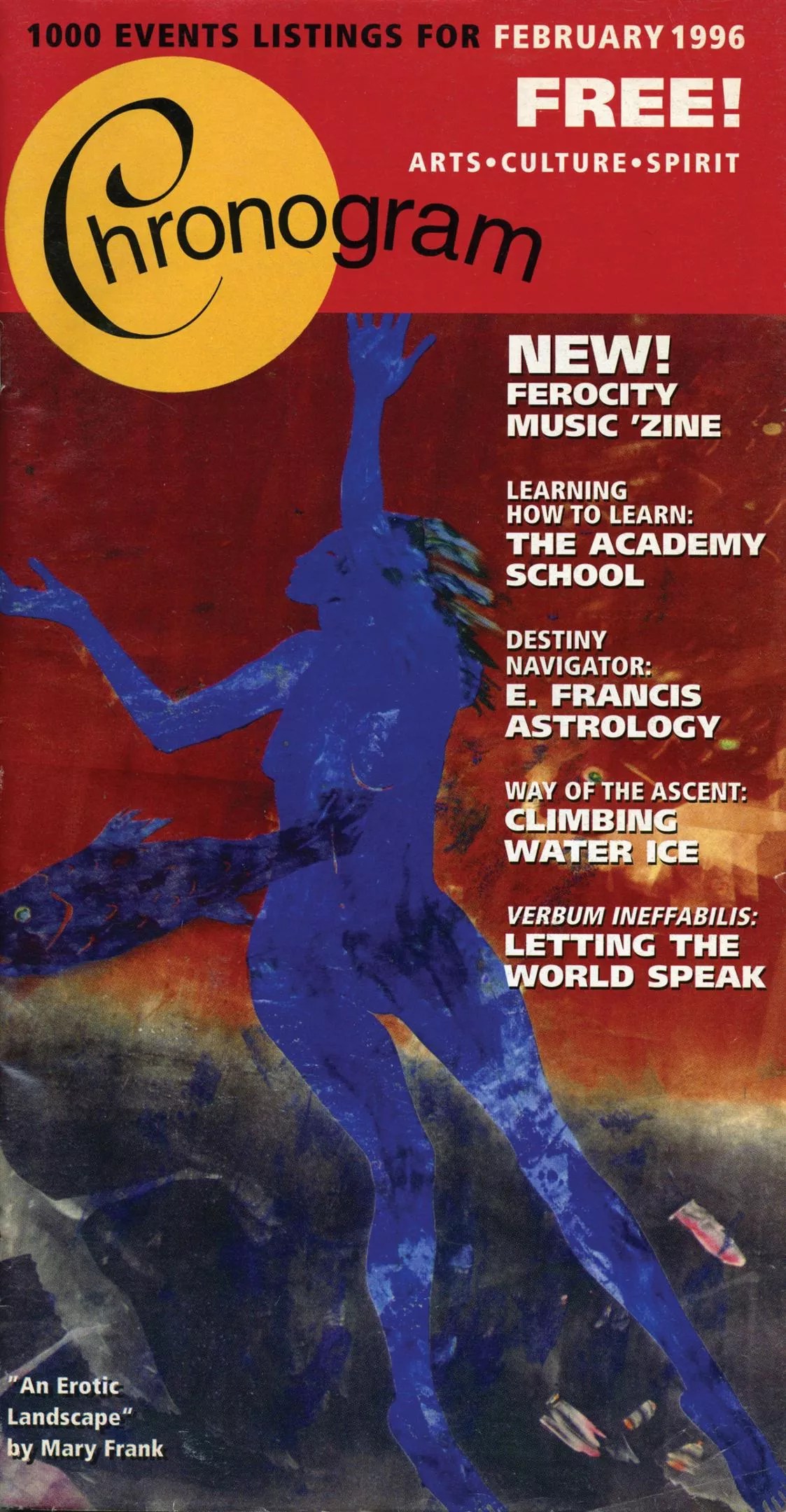
Our brief dalliance with cover lines began in March 1995 and continued through November 1998 when we banished any type other than our logo on the cover to better showcase the art featured there.
1996
“Sooner or later, one of these days, you will realize yourself. You will realize what the Buddha realized, and when you do—acknowledge it, throw it away, and keep going. This Dharma is boundless. It has no edges. Don’t create any edges with anything you realize. Most important of all: don’t put another head on top of the one you already have.”
—John Daido Loori, From “A Koan of the Way of Reality” by the abbot of the Zen Mountain Monastery
Missing Issue
No January issue was ever printed. It is rumored that the printer was unhappy about tardy bill payment. The February issue featured a format switch to a slightly larger 5 1/2” x 10 1/2” digest size with a saddle-stitch binding.
First Mag on the Moon
In April, Chronongram.com was launched. In the November issue, an article titled “Web Wanderings” by a writer going by the name of Guide Web opened with this sentence: “If you don’t know what the World Wide Web (WWW) is by now (or don’t want to know), then you may as well skip off to the next article in this magazine.” Most contributors were still faxing in their articles in 1996.
The War on the War on Drugs
The first overtly political article to appear in the magazine—“Cruel and Unusual Punishment: The War on Minimum Mandatory Drug Sentencing” by David Gracer—was published in April.
Growing Pains
A note of apology ran in the December issue, quoted here in its entirety: “Chronogram apologizes for the sometimes inappropriate humor printed last month in these pages and we regret any inconvenience caused to the artists and organizations involved, especially Stephen Busch, R&F Encaustics, Carrie Haddad Gallery, Camerata Chorale, Albert J. Blodgett, Cunneen-Hackett Cultural Center, and the SUNY New Paltz School of Fine and Performing Arts.”
1997

“Keep up the guts. The United States is built on a tilt and every loose marble rolls into the Hudson Valley.”
—Norman Schiffman, From a Letter to the Editor in the February issue
High Esteem
The January issue held the first installment of Jason Stern’s Esteemed Reader column, excerpts of which were published as the 2010 book Learning to Be Human. An excerpt: “We have forged another installment, deep in the drunken nights of December, which heralds the darkest days. We labored long, burning away the dross of stupefaction, and again we glimpsed the secret dimension.”
A Big Boo-Boo
The word February was misspelled (“Febuary”) on the cover of the February issue. It was also the first time Letters to the Editor were printed, including the following anti-mountain biking screed by Richard Leavitt: “This article [on mountain biking in the June ‘96 issue] is disgusting and vicious. The style is gushy, pretentious, and inflated. The phony mysticism is banal and silly. Considering Chronogram’s pretensions to ‘spirituality,’ this is a monstrous incongruity. And by dressing things up in phony mysticism it encourages even more people to go out and tear up the trails, annoy people who walk, frighten animals, and destroy plants.”
Christmas Special
In December, we published “Christmas Special,” Dennis Doherty’s meditation on the holidays: “The way it should be. I actually lived the idyllic Christmas seasons of greeting cards, the Never Never Land nostalgia of Hollywood stories. I could show you the preserved celluloid eight-millimeter procession of one waggy Labrador and eight children, our cheeks red and round as sentiment itself.”
1998

“To pay taxes for art and war, people seem to feel, is bad enough; to have to experience them firsthand is insufferable, often fatal. Even among artists, tolerance for art not their own is marginal. How many poets choose to read poetry, over say, going to a Giant’s game?”
—Todd Paul, From “Why Art?” in the September issue
Theme Issues
We tinkered with theme issues in ‘98, likely influenced by The Sun magazine and the recently launched radio show “This American Life,” which explores issues via a single theme each episode. Themes included sex, death, animals, work, health, travel, and religion.
Roswell Rudd Profile
In April, Todd Paul profiled legendary jazz trombonist Roswell Rudd (1935-2017), who had this to say: “You blow in this end of the trombone, and sound comes out the other end and disrupts the cosmos.”
Community Supported Agriculture
Thomas Wanning reported on the efforts of Dan Guenther, the director of Phillies Bridge Farm Project, one of the earliest community supported agriculture farms in the region. Today there are nearly 80 CSA farms in the Hudson Valley.
Best Of the Mid-Hudson Valley
We published our first “Best of the Mid-Hudson Valley” issue in September, having invited our readers over the previous months to take a survey printed in the magazine and mail it back in to us. Some of the winners included Cafe Pongo (Restaurant), Mikhail Horowitz (Poet), Rosendale Cafe (Performance Space), and Barner Books (Bookstore). We would discontinue this feature after two years. It would be revivied in 2020 with the launch of the Chronogrammies.
1999
“We think news is like the weather; it’s all connected. Too often, local papers present local issues as though we here in the Hudson Valley were totally disconnected from the rest of the world—as though we create and solve our problems in isolation. The truth is, we’re not, and we don’t.”
—From a Statement of editorial intent for “Room for a View” in the October issue
Very Tech Boom
Art director Molly Rubin chose a new logo font for Chronogram, Template Gothic Bold, starting with the January issue. (Wikipedia: “Template Gothic is considered one of the most defining fonts of the 1990s grunge aesthetic.”) It replaced the Art Nouveau-style logo originally designed by Amara Projansky.
Hauling Ashes
Some of the pieces we published in `99: An interview with Angela’s Ashes author Frank McCourt; a first-person account from the fires and destruction of Woodstock ‘99; an investigation into cost overruns in the building of the Ulster County Jail; and a day in the life of a local flower seller by Pauline Uchmanowicz, who would go on to write over 50 pieces for the magazine and help to define its prose style.
The Big Time
Our large-format debuted in October 1999 with a lurid pink birthday cake on Astroturf featured on the cover. Following the size change, one reader wrote in to complain the magazine “no longer fit on the back of the toilet.” Our ongoing apologies in that regard.
In addition to doubling in size, we also expanded our editorial coverage, hiring Beth Wilson to write monthly art reviews and Sparrow to pen a column of his quirky and wonderful poetic imaginings. A new section dedicated to news and commentary, Room for a View, also debuted, edited by Lorna Tychostup and Todd Paul. This kicked off a decade of muckraking journalism by the pair in Chronogram.
2000

“I’ve been blessed with delusions of grandeur. If someone ever picks up on it and wants to do something with it, I’ll be ready. One of my theories is, ‘True art is what you spend all your money on, fake art is what you make all your money with.’”
—Peter Head, From an interview in the December issue with the Pitchfork Militia frontman
Times Flies
Unsure of exactly what would happen when the clock struck midnight on December 31, 1999—anyone remember Y2K?—we commissioned a cover from illustrator Zak Pullen of Father Time plummeting. Local retailer Alan “Just Alan” Eisenson paid us the privilege of posing for Pullen’s illo.
Watching the Watchmen
In January, we published a first-person account of the protests against the World Trade Organization that occurred in Seattle in December ‘99 by Josh Robinson. While mainstream news outlets were reporting on what was termed a riot of youths burning and looting, Robinson told a story of a group of nonviolent protestors attacked by police.
The Digital Frontier
In March, we launched 8-Day Week, a weekly digital newsletter of cultural events in the region. Twenty-three years and many iterations later, we publish four weekly digital newsletters under the Eat.Play.Stay. banner.
Cohousing
We reported on Cantine’s Island, a cohousing community experiment in the November issue. We featured the Saugerties-based intentional community again in the May 2022 issue and found it thriving.
2001

“A difficult person is in your life for a reason. If you can come to understand the changes in your life that need to take place, the difficult person no longer needs to be in your life to make your life miserable.”
—Mark Rosen, From “How to Deal with Difficult People,” an article in the May issue by Sandra Gardner
Eerily Prescient
With George W. Bush recently inaugurated after some Supreme Court shenanigans regarding the vote in Florida, we decided to create a little game for the February issue we called “Pin the Tail on the World,” asking readers to tell us which country the US was most likely to attack now that Bush the Younger was president. A little over a year later, we’d be at war in both Afghanistan and Iraq.
Patriotic Backlash
We published an essay by Todd Paul the month after 9/11 that triggered an anti-Chronogram backlash, resulting in a number of nasty letters and a few lost advertisers. Instead of blindly waving the flag like so many were doing at the time, we dared to suggest that US foreign policy was complicit in the causation of 9/11, and that the US should choose its next course of action carefully. An excerpt: “We feel powerless. For a mighty country about to kick some major butt—just as soon as we decide whose butt needs kicking—we feel mighty powerless, don’t we? Why? Three reasons: 1) Deep down inside, we know we’d probably be safer if we refrained from kicking some major butt this time. 2) The major butt-kicking that’s about to commence is completely out of our control. 3) We can’t trust our government to kick the right butts, for the right reasons, and tell us the truth about it.”
2002

“The trampoline was actually invented by tramps. Hobos would find industrial rubber, pin it between branches, and bounce upon it—often after a swig or two of rotgut whiskey. One such tramp, Elbert Ruley, eventually settled down and became an inventor. He called his first creation the ‘trampoline’ in honor of his itinerant friends.”
—Sparrow, From “Etymology Report” in the February issue
Everything Old Is New Again
In January, we checked in with filmmaker Ralph Arlyck, who was then working on a follow-up to his documentary Sean, which portrayed the less-than-idyllic conditions of a child growing up with hippie parents in San Francisco’s Haight-Ashbury neighborhood. Arlyck, now 82, is about to release his latest film I Like it Here. Peter Aaron’s profile of Arlyck appears on page 78 of this issue.
ELF Off the Shelf
In March, we published an interview with Craig Rosebraugh, who had just stepped down after four years as de facto spokesperson for the radical environmental group the Earth Liberation Front (ELF), known for its direct action/eco-terrorism, depending upon your point of view. Rosebraugh is a documentary filmmaker currently living in Pasadena, California.
Life in the Balance
Susan Piperato wrote the initial entry for our Life in the Balance column for the April issue, which explored local and foreign sustainability projects and provided resources and tips for living sustainably before “sustainability” became one of the buzziest buzzwords of the decade.
Gray Area
Ahead of a performance at the Egg in Albany, monologist Spalding Gray sat down for an interview with Sparrow for the May issue, detailing his mental struggles following a car accident. Gray would be pulled out the East River—it is believed he jumped off the Staten Island Ferry—less than two years later.
This article appears in November 2023.


