









Howard Danelowitz is finally stepping back from his art—literally. He creates his playful oil on linen works exploring the interplay of shape, color, and scale by following his intuition and allowing his subconscious to process the imagery around him. Then he spontaneously splashes it back—in the abstract—onto the canvas. “I’m always planning but I don’t have a guide,” he says of his process. “Shapes and forms have always been a very natural way for me to express myself. I tend to use whatever is around me but I don’t think about it too much.”
We are in Danelowitz’s “barn-udio,” a second-floor gallery and studio space inside the classic country barn he and his husband Mark Fischer built behind their 1850 farmhouse. Around us now is Danelowitz’s work, some finished, some still in progress, where distinct themes of color and shape evolve from canvas to canvas. Viewed side by side, the paintings are like frames in a film, with a succession of circles, squiggles, trapezoids, and boxes flying through rich tones of red, blue, gray, or green. Oversized paned windows capture the dynamic, lush landscape. “I call it painterly geometry because it’s not hard-edged geometry but it is geometric.”
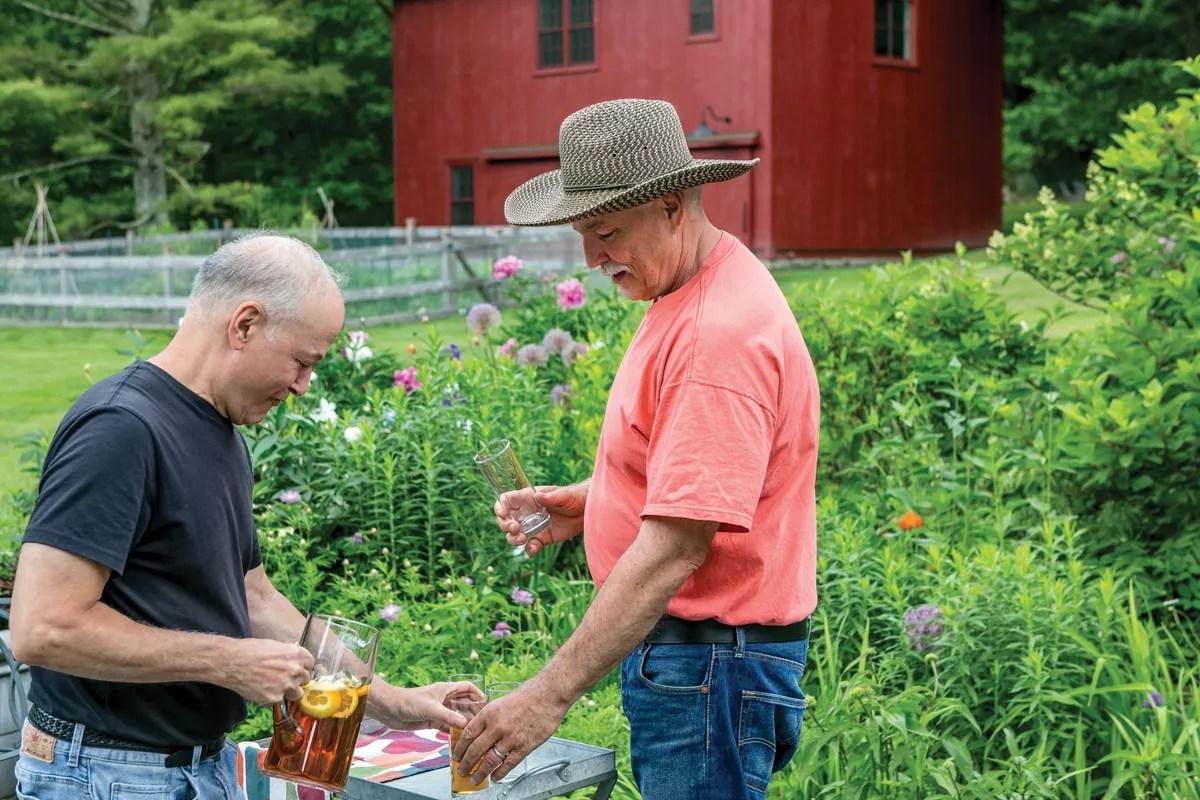
Outside, the geometry is less painterly, and more in the planning stages. At the back of the couple’s Colonial salt box, sitting perpendicular to a newer Federalist addition, the sunny brick patio is currently serving as a makeshift workshop where Fischer is plotting out a summer garden. Flats of tomato starts, which Fisher has been cultivating from heirloom seed, sit askew along the patio made of buckled stone squares. “This is ‘Mortgage Lifter,'” explains Fisher as he hands me a tiny square of soil with a bright green stalk. “It will produce huge, juicy tomatoes that are perfect sliced on bread—the man who developed it used the seeds to pay off his mortgage.” He hands me another square. “This is ‘Fireworks.’ “It will produce a ton of tiny orange tomatoes that just explode with flavor.”
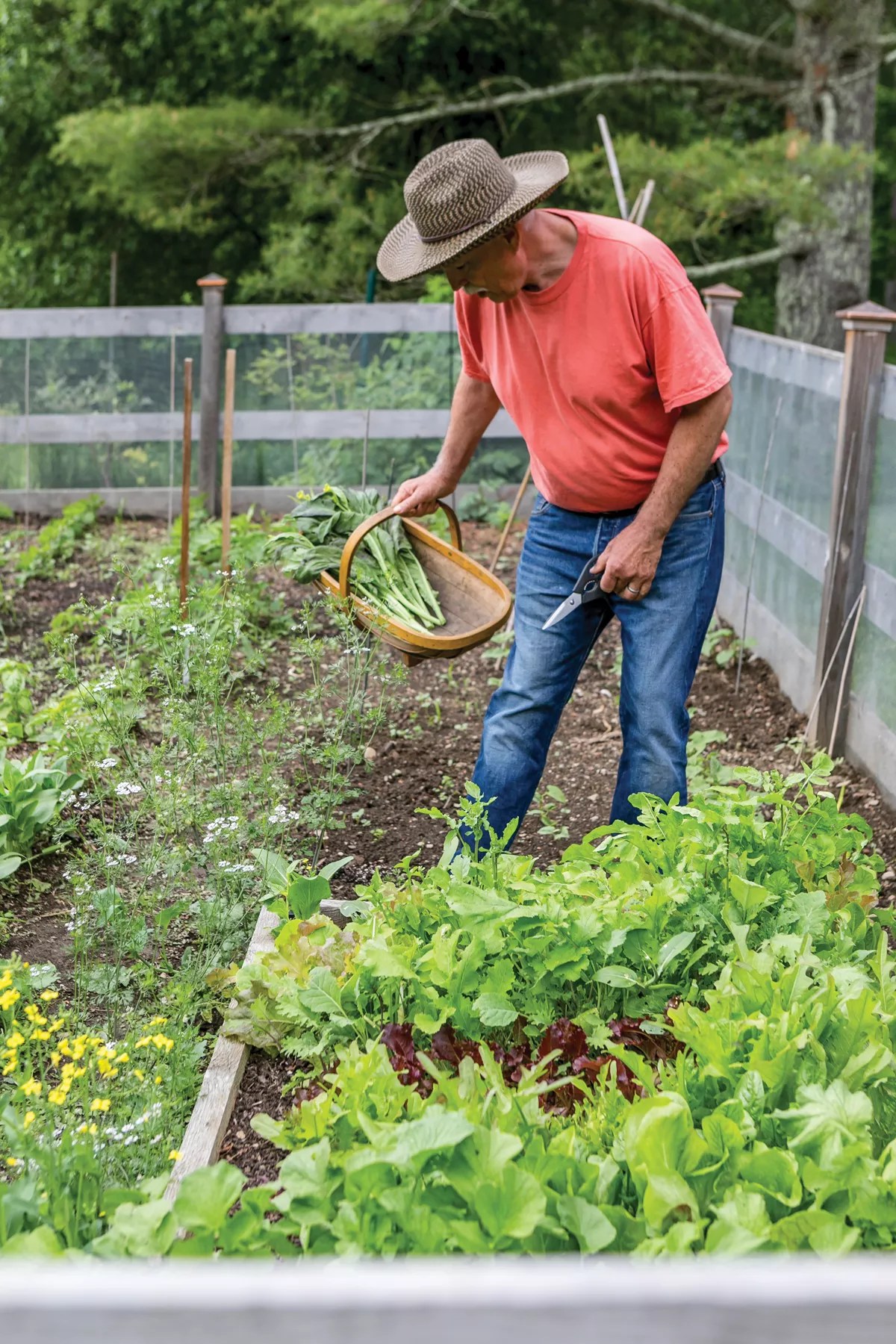
Skirting the back patio, the late spring flower garden is already bursting with shape and color. Triangular, deep blue iris heads are juxtaposed with a riot of fat pink peonies. Fisher, the former director of horticulture at the Brooklyn Botanic Garden, cultivated this garden, as well as the couple’s rectangular vegetable patch, carefully over the seasons, noting year by year what emerged. “I’ve planted a variety of vegetation including native magnolias and chestnuts,” he says. “I like to see what naturally thrives and keep things in a balance that benefits the environment and wildlife.”
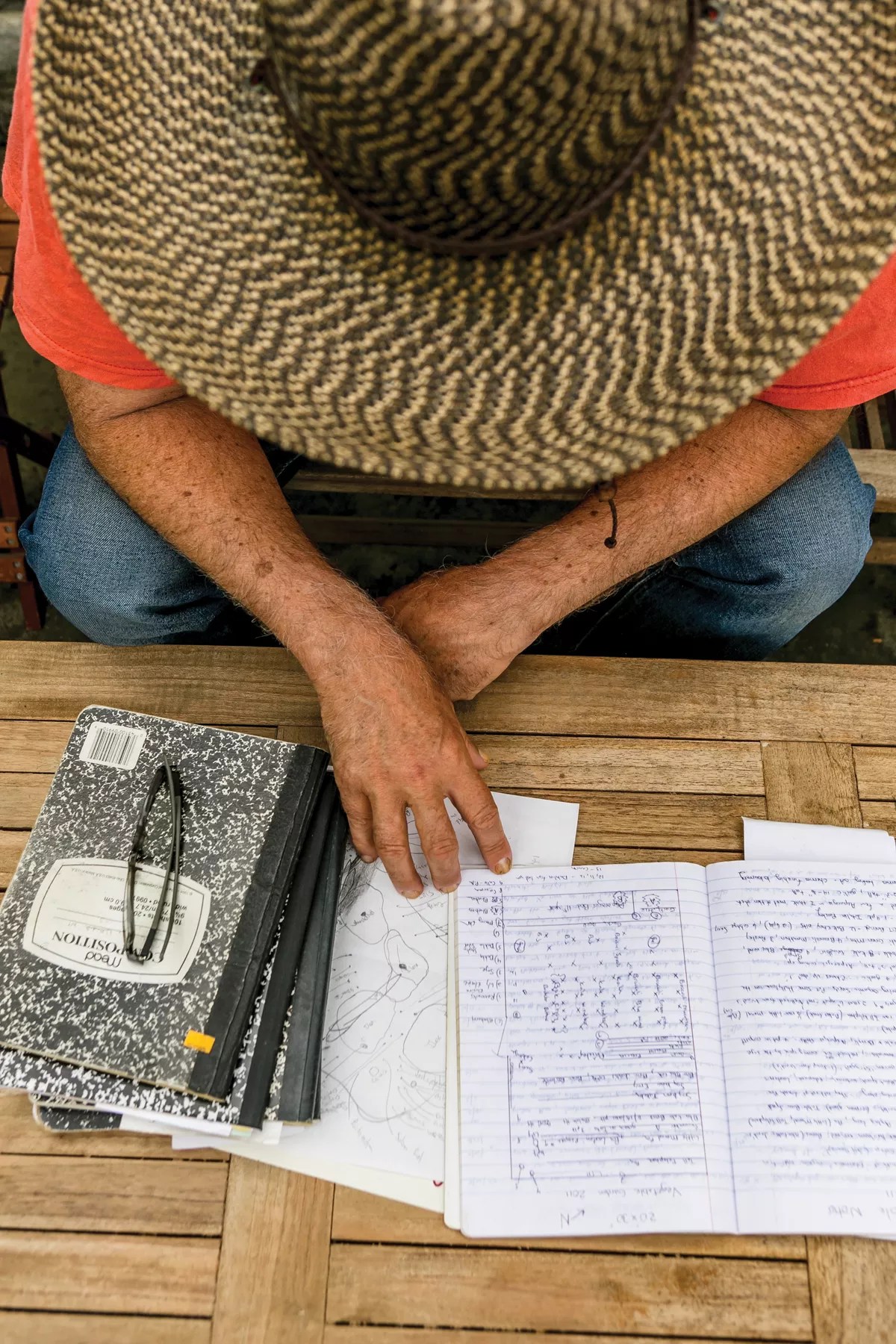
Both men have built a life—and a home—around their keen sense of observation. In 2021, after the two built their barn-cum-studio, those observation skills became particularly handy. “I saw him for years and years painting up close in tiny spaces,” explains Fisher of Danelowitz. “When he first started painting in the barn I went to watch him and he was still standing right up close to his painting. I had to remind him—you can step back.”
Go North, Young Men
Danelowitz and Fisher began searching for a home upstate in 1993 when the two were living in Manhattan. Back then, Danelowitz turned a corner of the couple’s kitchen into a tiny studio and took his inspiration from dinner plates and pot lids. Both were drawn to the natural world and went searching for a small upstate canvas. “At first we wanted to be just right outside the city,” says Danelowitz. “Because of our modest budget people laughed at us and told us to keep going north.”
They wanted a Colonial with an acre in a picturesque setting and were willing to do some, but not too much, work. To find something that fit their budget they kept traveling north, through Westchester, which was way out of their budget, and past the more expensive towns of Cold Spring and Rhinebeck, until they landed in sleepy Hillsdale. “We fell in love with the rolling hills of Columbia County,” says Danelowitz. “The winter before had been especially brutal, so there was lots of inventory in our price range.”
Nothing seemed quite right until the two found their Colonial style farmhouse on a country acre. Originally a dairy farm, the three-bedroom home had two full baths and a back porch with no direct access to the house. Quirks aside, it was everything they were looking for so they bought it that year, and spent their weekends doing most of the updating themselves. “We are both handy, and we’re ready to throw ourselves into the home,” says Danelowitz. “Often we spent the whole weekend working on the house, then we’d joke that we were going back to the city to our jobs and to relax.”
Mid-Century Federal
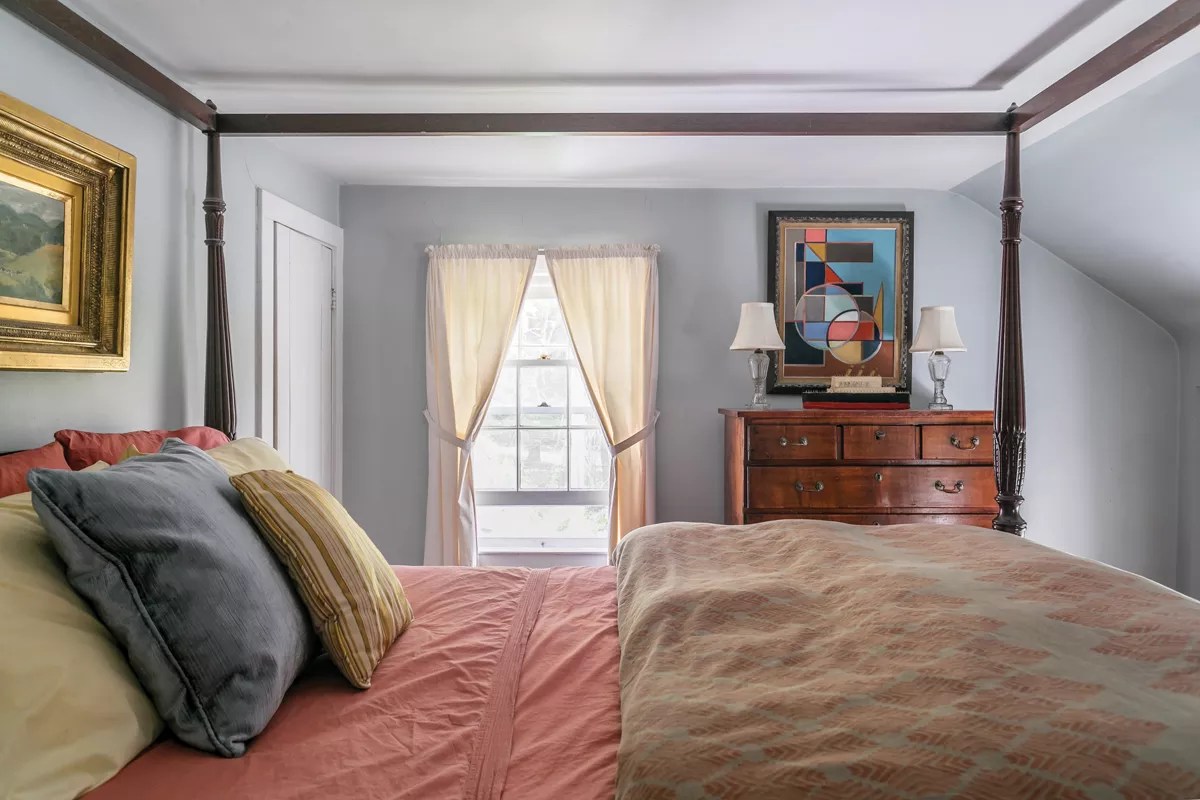
When they weren’t working on the home, the couple spent weekends learning about antiques and exploring the local auction houses. They were especially drawn to Americana for the history and aesthetic of the pieces they found, and they began to use the pieces to inform their renovation decisions.
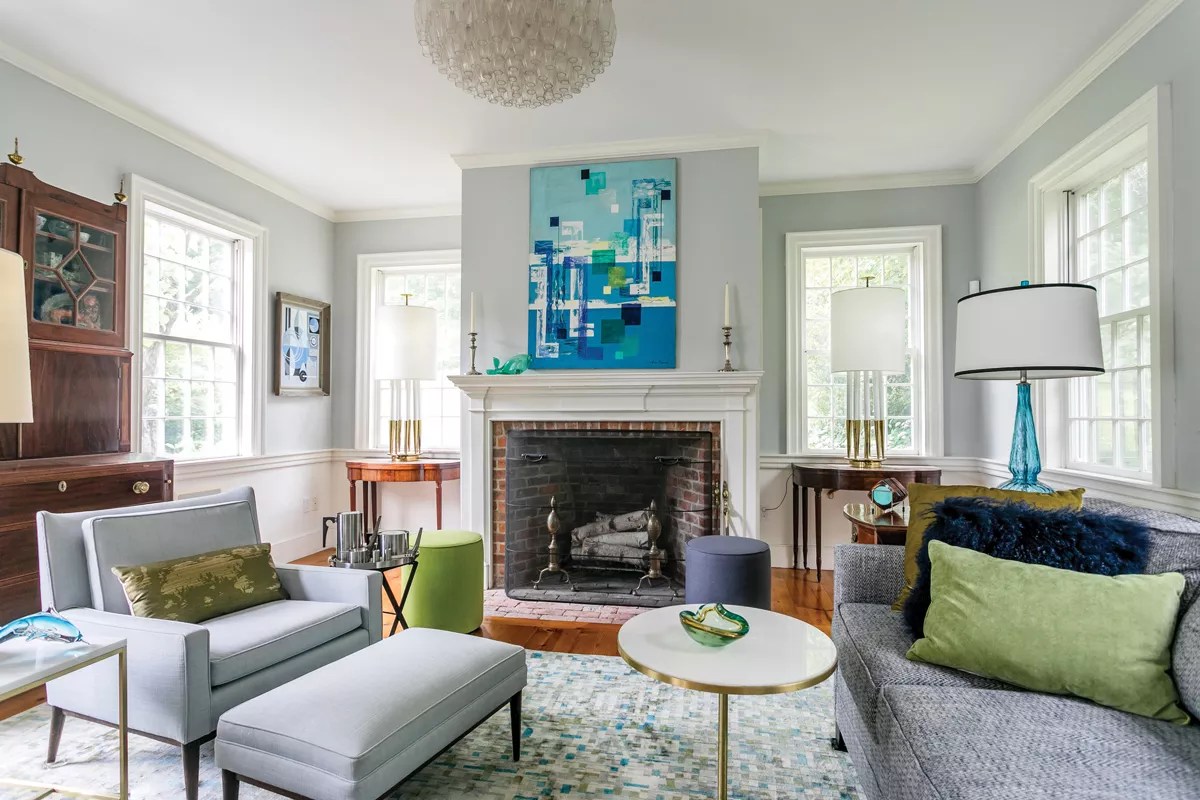
After salvaging a Federal-style fireplace mantel from a teardown in Washington County in 1999, they were inspired to build a family room adjacent to the home’s country kitchen. “We wanted one room that wasn’t off kilter, with a fireplace and high ceilings,” says Danelowitz of the renovation. “We loved the mantel and so designed the whole room around it.”
They matched the mantel with two federal doors from a dealer in Chatham, added large-paned windows on all three sides, and then painted the room smoky gray. A mix of federal and mid-century-modern furniture in green, grey, and blue fills the room with a range of circles and squares all carefully angled and placed. “Over the years my interest in modernist abstract painting began to reflect itself in the space,” says Danelowitz of the room’s design.
Room and Board
The couple also added antique touches to the corner kitchen. “We found two Federal doors from the same Washington County teardown,” says Danelowitz. They added them to the room’s pantry space. “Adding them really tied the design together and brought character and a piece of history into our kitchen.” Wide, 1820s floorboards bought from another dealer add more period charm to the room.
In 2004, the couple decided to convert the quirky outdoor porch into a studio space for Danelowitz. They captured extra space from a former bathroom and enclosed the outdoor space. The small back room with a view to the garden served as a studio for Danelowitz for years. He now uses it as an office to conduct online therapy sessions.
Art Imitates Life
Over the years, their postcard-sized canvas got larger. They bought the adjacent hay fields across the road, which they lease to a farmer. They were also able to buy neighboring forest land and a section of the Roeliff Jansen Kill behind their home. Eventually they turned their just-short-of-one-acre lot into 50 pastoral acres.
The “barn-udio” project came in 2021. Designed as a traditional barn on the exterior, the interior of the space was conceived to both create and display artwork. “We wanted the outside to look like a barn from this area,” says Fisher of the bright red building adjacent to the couple’s vegetable patch. “The idea was to create something that looked like it had always been here and worked aesthetically with our property but suited our modern purposes.”
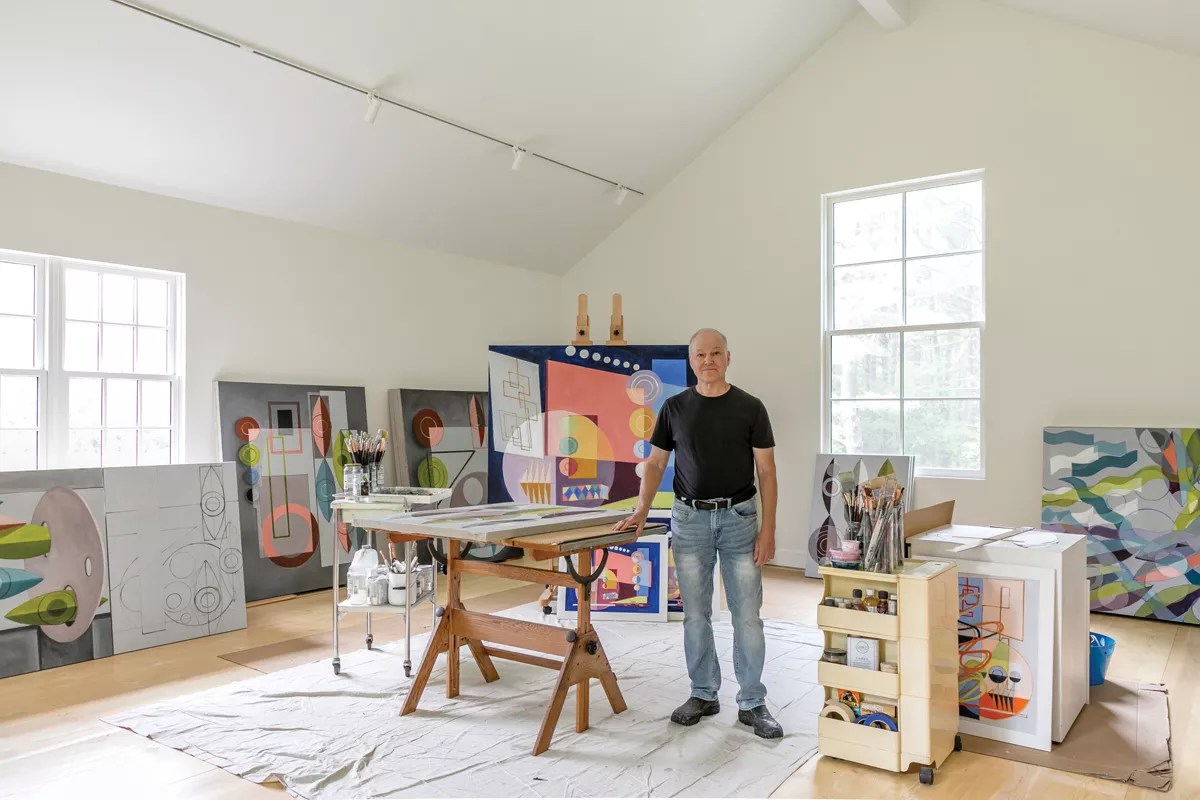
The first floor was outfitted with specialized storage and a garage that doubles as extra workspace. Upstairs, the interior design was inspired by MoMA, where Danelowitz often visits and which owns some of his early animation work. The couple first worked out the second-floor dimensions with a model, ensuring the angles, feel, and lighting would mimic both a gallery and a blank canvas, as well as mirror the surrounding property. They’ve been very pleased with the result. “It’s more than just a barn or studio,” says Danelowitz. “It celebrates history, fosters creativity, and marries heritage with modern design.”
Over the summer of 2024 the couple plan to share the barn-udio with fellow art lovers in a series of open studios. “We designed it to be versatile,” says Danelowitz. “We love the idea of people coming in and experiencing the art and atmosphere. Sharing the space makes it more than just a workspace; it becomes part of the community.”
This article appears in July 2024.


