









In these fiery and fiercely cultural times, art endures as the ultimate arena in which to explore the messiness of opposing forces. For artist Nina Chanel Abney, the black/white binary is a non-negotiable aspect of her forthright artistic world-building. Her blockbuster exhibition “Lie Doggo” at Jack Shainman Gallery, The School in Kinderhook through October 5 is a monumental, bold celebration of the complexities of certain blackness/whiteness realties that inform our American profile as expressed through paintings with collages, site-specific murals, digital art installations, and sculpture.
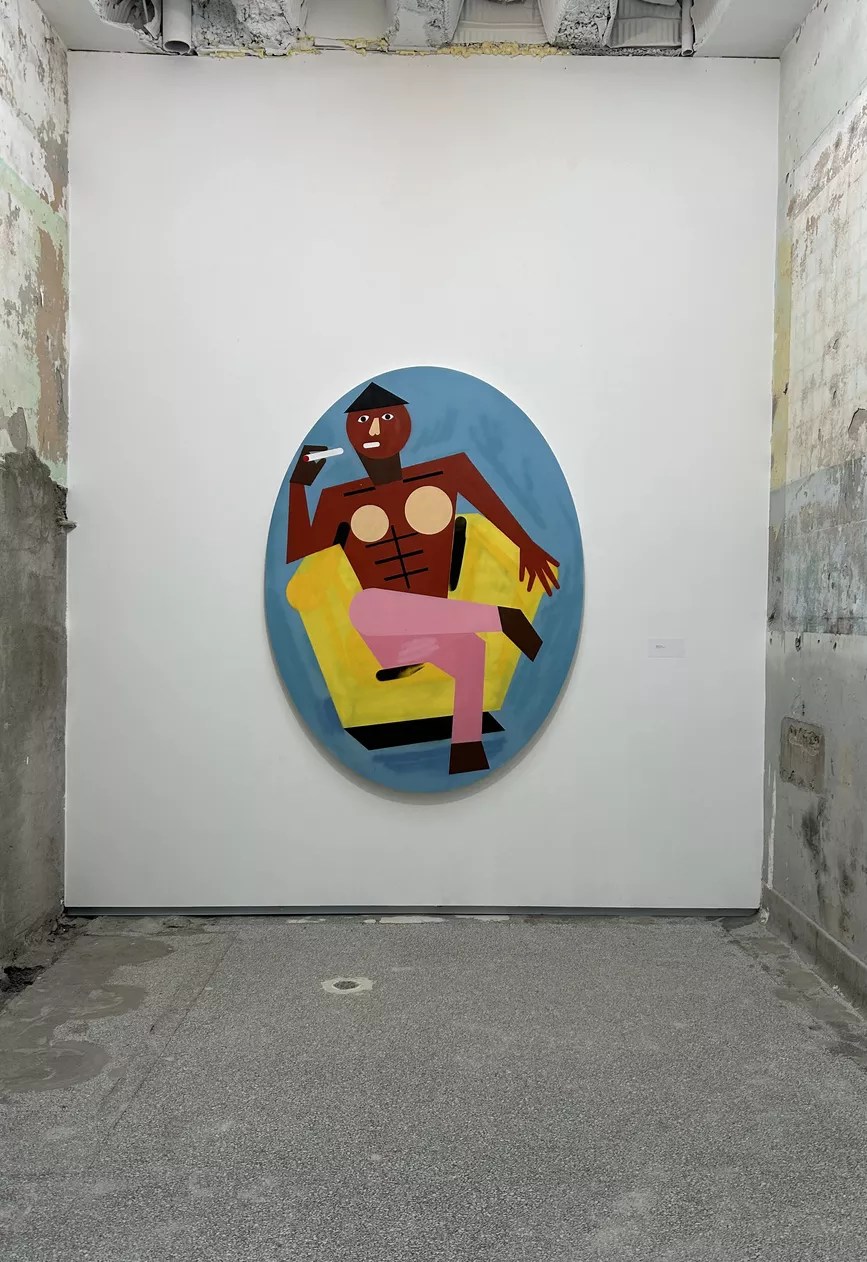
First the banner for this show: the phrase “lie doggo” means to remain motionless and quiet as to escape detection, hence a strategy of invisibility. This is a consciously chosen title-as-parody by Abney, given the highly visible and all-out lively ambiance of her approach. On the contrary: the entire exhibition resounds with a metaphorically robust noise, where characters engage in provocative conversations across the gallery rooms, across cultures, history, time, and place. Aside from the undeniable intensity of the thundering themes that underlie her work—including the ills of global imperialism, colonialism, homophobia, systemic biases, and racial inequalities as a short list—Abney’s highly geometric color-block Cubist-infused style is utterly joyous in its jest. Every area of her artistic practice tinkers with stratified meanings and social narratives, and does so in a way that, in her own words, welcomes the “tension between accessibility and challenge.” The oval-shaped painting Sheila (2023), for example, features an angular dark-skinned figure with round pale-skinned breasts casually smoking a cigarette on a yellow chair (installed in a room on its own, thus heightening the concentration of their gaze). They seem to be asking us: “What do you see and what do you think?”—indeed a recurring sentiment for anyone who is seeing the thinking behind this entire body of work.

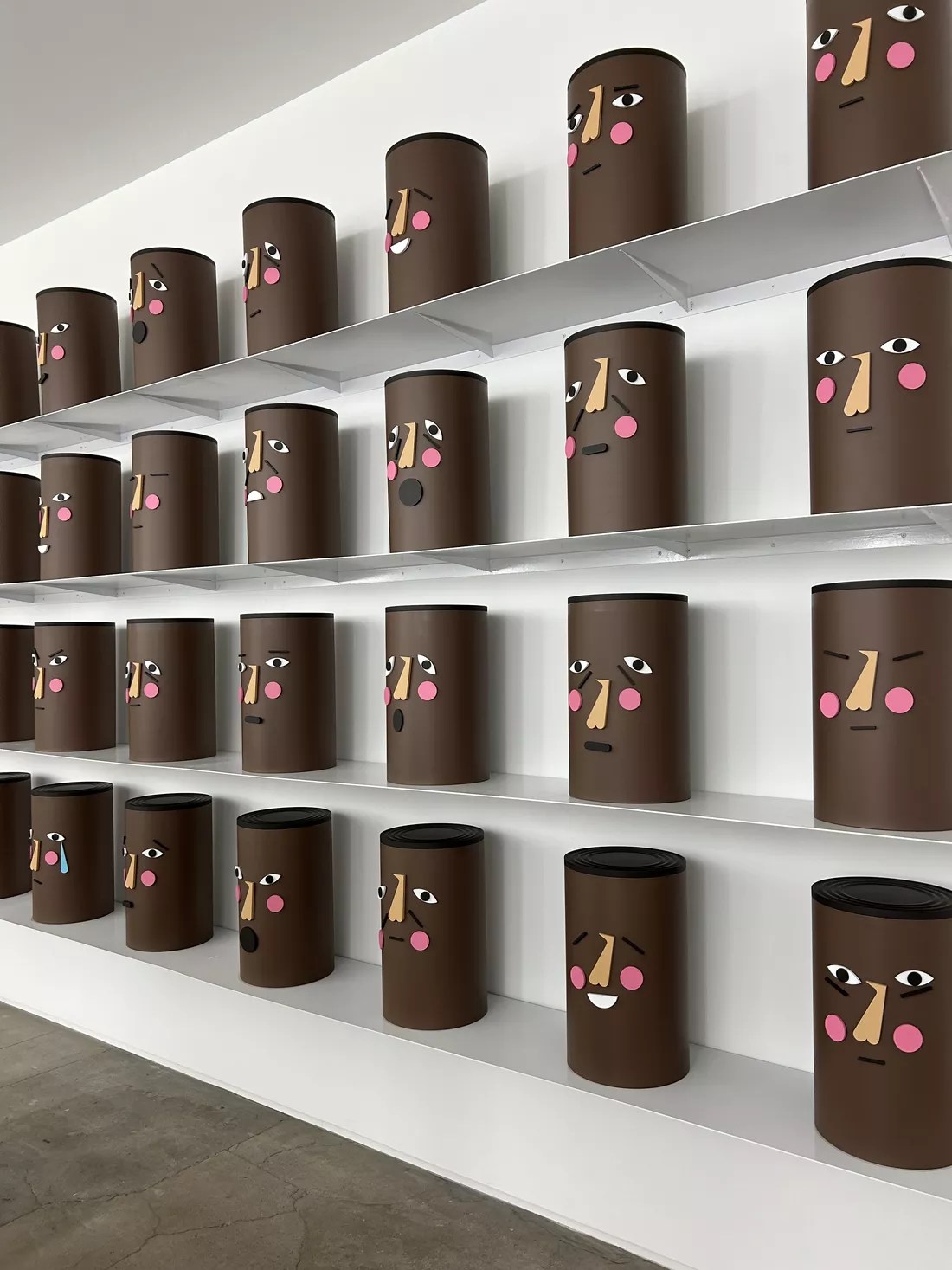
Abney’s sculptures act as emblematic flares that get to the heart of the matter with respect to heightened issues surrounding race. The series Soup Kitchen 1-32 (2024), for example, is a hearty dose of her wit. Arranged in uniform rows on four shelves, these stoic and loveable cylindrical faces painted on stainless steel and aluminum express universal emotions, but the title tells the real story, one that transforms these simple heads into variations of pang and hunger. Another series of four bright sculptures mounted on the wall titled Pig Out (1-4) (2024) consists of half figures from the waist up, three of them holding trays with dismembered heads and the fourth holding a set of perky missile tits.
While her sculptures pack a punch, Abney’s vibrant paintings with collage—a wonder to behold for their precise graphic layering—also comment on cultural stereotypes. The large-scale triptych Black People (BP) (2002) is particularly arresting. Featuring a group of men on a murky water engaging in various acts of fishing, the buoyant scene is tempered by two smaller paintings Fish Head (2022) and Sea & Seize (2022) on the adjacent walls, where frozen seafood sections at the supermarket include the severed heads of black men for sale alongside commercial fish. The exhibition takes us on a boisterous adventure in bodies, fashion, culture, and digital incarnations that do not relent in their magnitude. The culmination of all this is encapsuled in the lengthy vinyl wall mural titled Big Battle (2024) on the ground floor, where symbolic oversized black and white chess pieces embody the candid bigness of Abney’s commentary.
As stated in the press release for “Lie Doggo”: “Abney provokes the viewer to decode messages and confirm their own personal interpretations.” In the spirit of this, I will disclose that overhearing a white couple chuckle upon seeing a white police officer avatar doing a silly jig in the “Super Punk World” room—a special section of the show displaying 12 hybridized digital NFT Ethereum blockchain characters on screens that are the culmination of her artist-in-residence program with CryptoPunks—made me wince. Did they not understand the ulterior implication of this asinine animated figure? What does this say about the increased questionability between virtual and physical social interactions and power relations? Abney succeeds at pushing the conversation ever further in her presentation of the obvious, and one cannot resist the strength of her art in this regard. There is nothing subtle about decoding Abney’s reconfiguration of hard black-and-white truths, and thus this show is effectively not a “lie doggo” stance of stealth as such. Just the opposite: Abney’s art is a sophisticated and empowered voice of acknowledgement and renewal—it is a live wire that jolts us upright with wry humor and determined confidence.
This article appears in May 2024.


