









When the lights go out, there’s no sight as welcome as a truckload of electrical line repair techs, the heroes of the hour. And there are barely more than 120,000 of them in the United States, tending to somewhere between 160 and 180 million electrical poles amid increasingly frequent catastrophic storms.
Clearly, we need more linemen—as they are universally called, despite a sprinkling of women who’ve taken up the trade. And after over 30 years working hands-on with high voltage, Don Leiching decided that he’d spend some time spreading the skills that had provided him a comfortable (well, at least when he wasn’t dozens of feet in the air), fulfilling life. To that end, he and his family have founded the Linemen Institute of the North East on the grounds of the former Zena elementary school on Sawkill Road, closed in 2013 due to declining enrollment.

“We get all kinds of people,” says Brinnah Leiching, Don’s daughter, who serves as student liaison and communications coordinator for the school. “We get some who’ve studied at BOCES and been around blue-collar electrical stuff, and then other people who are just ready for a big change—we had an accountant who barely knew what a screwdriver was. Last summer, our youngest student was 18 and our oldest was 44. It’s really all kinds of people.” The school has a handful of women among its alumni, and recently welcomed journeyman lineman Marie Tarlecky as an instructor.

The 500-hour, 15-week pre-apprentice program is a requirement at most companies these days. Successful students graduate with certifications in digger truck operation, first aid and CPR, pole top rescue, and 10-hour OSHA safety certificate, along with a commercial driver’s license. As apprentices, they can expect to earn an average salary of around $60,000 a year in the North East; after 6,000 to 8,000 hours on the job, they can become journeymen earning a median salary of $95,384.
Before that, of course, they need to prove they have what it takes to handle aerial labor in any weather. At the Institute, they’re required to prove it every day in the pole yard. “The students do all the setting of the poles, the pulling of the wire, setting the transformers, using the bucket trucks, using the digger trucks, everything out in that yard is done by the students,” says Leiching.
With a maximum of 54 students in each course, the Institute is too small to get federal aid, but partners with Utilities Employees Credit Union and Meritize to help students find private loans for tuition and fees, which add up to about $29,000. In response to the area’s housing crisis, the Leichings have turned the second floor of the school building into suite-style dormitories for out-of-town students.
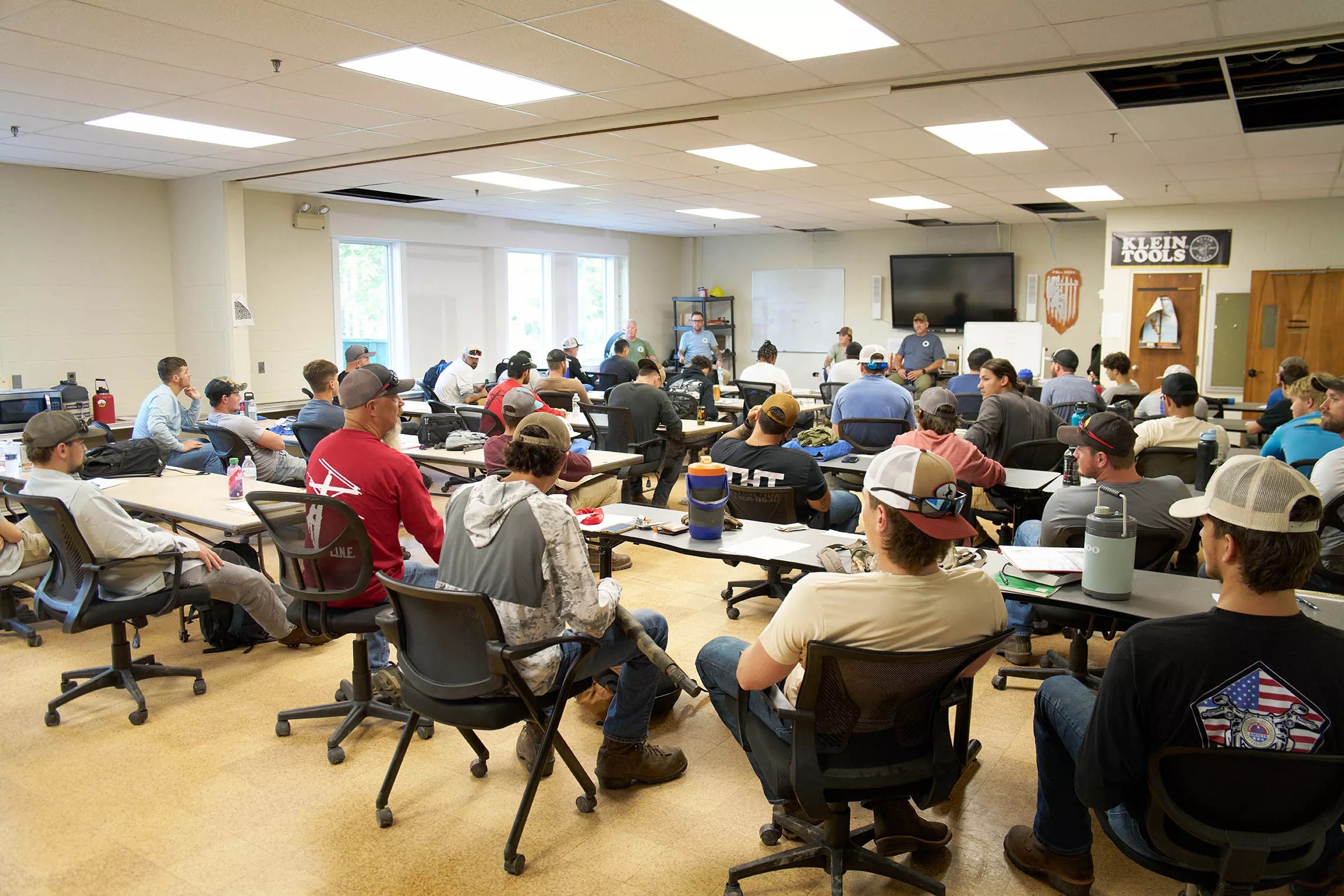
Typically, four or five students out of each entering class will realize it’s not for them and withdraw in the first few days. “Some people never realized they were scared of heights and then they try this,” says Leiching. Those who remain get intensive hands-on instruction, about an hour of classroom time followed by several hours of intense practice under the instructor’s watchful eye. “We teach them the safety procedures the first day, and the belt we use is 100 percent fall-proof when you use it correctly,” says Leiching.
“Our small class sizes—we have an instructor for every 10 students, plus my dad part-time—mean that instructors can oversee them very closely and make sure bad habits don’t get a chance to start. There’s no power in the pole yard, and when a student does something that could get them hurt or killed on a real job, the instructor is watching closely enough to take them off the pole right away, go over the technique again, and have them do it over until they get it exactly right. My dad likes to remind them they have it good; back when he started, you had to free-climb all the way up before you could belt off to the pole.”
“My father, my grandfather, my uncle—they all worked with power, either as electricians or linemen or substation guys. I was always interested, even as a young kid,” says recent graduate Todd Mailbon. To learn the family trade, he started with a two-year community college program that qualified him in electrical construction and maintenance, moved on to working with fiber-optic cables, and then turned to the Linemen Institute to level up. “I loved every minute of the school,” he says. “The time flew by. You get more one-on-one than you would at a bigger school, which felt very helpful. It’s not a job where you’d ever want to cut corners, and they won’t let you — they’re patient, thorough and really nice, and they make certain you know how to do it right.”
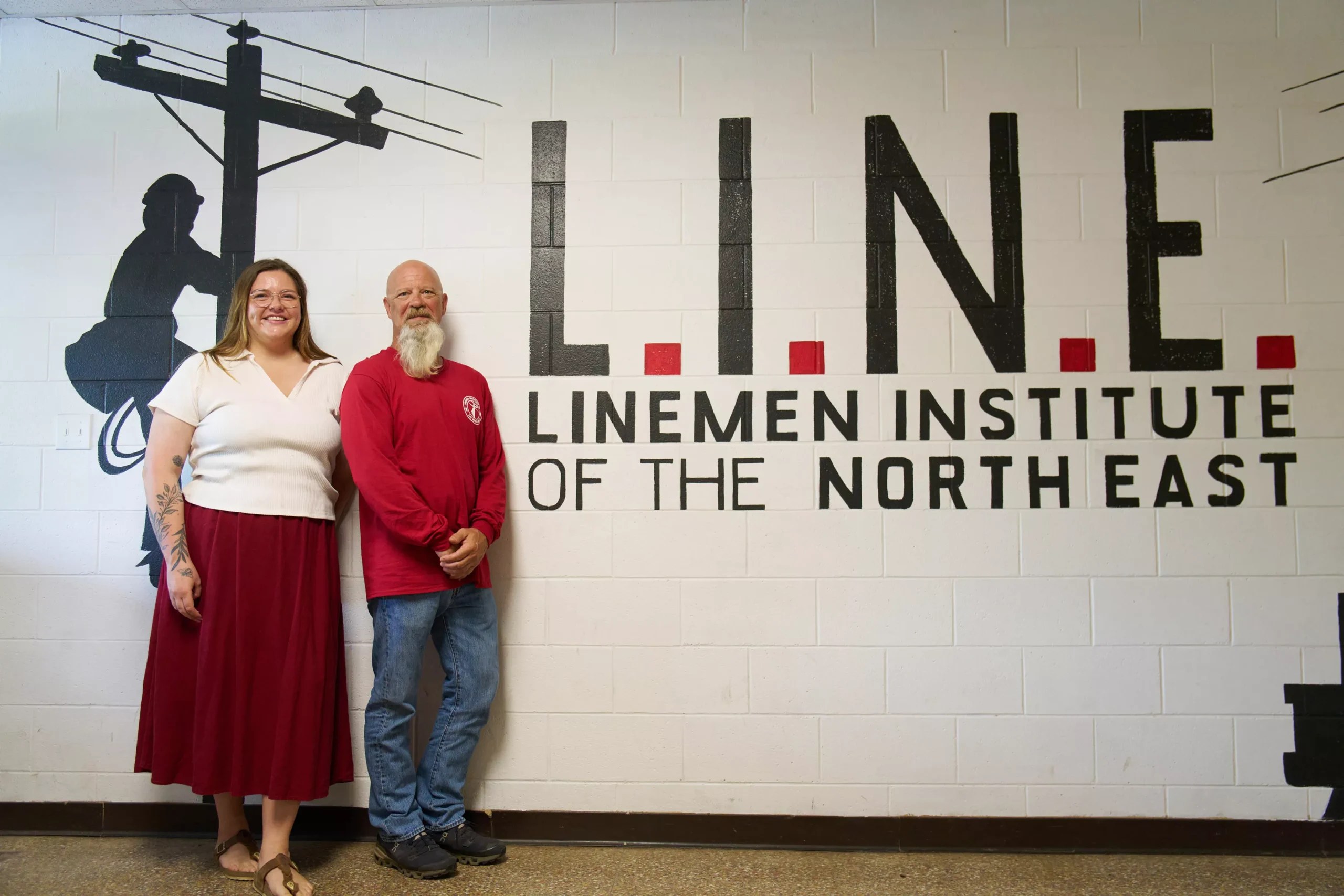
The new certifications Mailbon got in December are already paying off for him. “I’m a line mechanic helper with National Grid now—basically my dream job,” he says. “I use everything I learned there every day. It’s not a guarantee—you still have to apply yourself to actively looking for the right position and be ready to relocate for a while, get your foot in the door by any means necessary. But if you’re meant to do this in the first place, you’re probably not scared of working hard to get it.”
Graduation, says Leiching, is a blast. “Graduation morning, we hold a skills rodeo with three events that are pretty exciting to watch. People’s families and friends show up; we have food trucks and and raise money for one of the local animal shelters. After the competitions, they go get their suits on and look super, just really dapper, and we all gather in the auditorium to announce the winners and give out the trophies, and then we do the traditional graduation diploma, handshake and photo stuff. It’s a big celebration of a lot of hard work, and the ones that are willing to put themselves out there find it’s a serious step up in life.”
This article appears in August 2024.

The River is an independent news outlet that produces in-depth, quality journalism and analysis about the Hudson Valley and Catskills regions. Learn more about our mission and ethics.


From Bystanders to Lifesavers: Why CPR Training Must Be the New Normal” perfectly highlights how ordinary people can make extraordinary differences in critical moments. The message is clear—CPR training isn’t just a skill, it’s a social responsibility. Promoting awareness and accessibility can truly save lives. An important and timely call to action!