









Like the disadvantaged tooth fairy in his latest novel, hatched parentless in an old tin can, Gregory Maguire had a rough start. His mother died when he was born, and his father, widowed and unable to care for the three children he already had, placed the newborn in a Catholic orphanage in Albany. There Maguire stayed for some two years until his father recovered, remarried, and was able to collect his children back together.
So it comes as no great surprise that the related concepts of being orphaned and homeless—of feeling abandoned and always in search of one’s place in the world—are main concerns for many of the author’s characters. Orphans, stepchildren, and home-seekers pop up everywhere in Maguire’s books, juvenile and adult. In Missing Sisters, his children’s book from 1994, he tells of Alice Colossus, a 12-year-old orphan who learns she has an identical twin sister who lives in a nice house with loving parents, and sneaks away from the orphanage to find the family she has been denied. Lost, a modern-day adult ghost story that crosses A Christmas Carol with Alice in Wonderland and Jack the Ripper, features heroine and Maguire alter-ego Winifred Rudge, who sets off on a fateful journey to her lost ancestral home in London. Stepchildren are forced into appalling situations with cruel stepmothers in two of Maguire’s adult novels: Confessions of an Ugly Stepsister, his revisionist Cinderella tale set in tulip-crazed, 17th-century Holland, and Mirror Mirror, in which a Snow White replacement is threatened by Lucrezia Borgia.
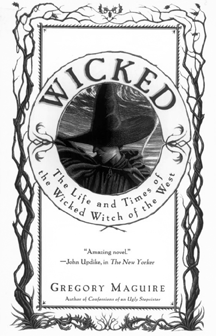
Maguire’s most famous book, Wicked: The Life and Times of the Wicked Witch of the West, is a study of evil set against our nostalgia for the The Wizard of Oz and Dorothy Gale, the Kansas orphan trying desperately to get home again. That tale has sold more than two million copies and been adapted into a hit Broadway musical.
Given the themes of his books, you’d think Maguire’s childhood was a nightmare, but in fact he remembers it as being a generally happy one. After he rejoined his three siblings, he lived in a middle-class neighborhood in Albany, and his family grew as his father and stepmother had three more children. His parents, who had grown up during the Depression, scrimped by giving the children hand-me-downs and home haircuts. Yet his parents were generous when it came to encouraging reading. His father was a journalist, his stepmother a poet, and Maguire remembers a house filled with books and a dictionary always on the kitchen table in case someone wanted to look up a word during a conversation.
“My mother had died when I was born, and so I think the family culture reflected a sense of forever-after that things could go wrong at any time,” Maguire told Schenectady’s Daily Gazette in an interview early in his career. “Consequently my father and stepmother were very protective of us, and the only direction in which we could expand without fear of danger was in reading.”
Reading and writing. An early influence on his future vocation was Louise Fitzhugh’s Harriet the Spy, the story of a girl who writes down everything she observes around her.
“[Harriet’s] obsession with journal keeping and her desire to be a writer was a real role model for me,” he says. “Instantly, after finishing the book (maybe for the fourth time, which doesn’t make it too instant), I got a journal of my own. I didn’t call it a journal—I called it a spy notebook—and I began to spy on my neighbors and family members in Albany.
That early surveillance became the foundation of journal keeping that persists to this day. “I still keep it, though I don’t call it a spy notebook anymore, but that’s essentially what it is. I’m on Volume 54.”
Really? He’s got them all?
“I have them all. They’re in a safe deposit box at a bank. I’m no Virginia Woolf, and I’m no Anaïs Nin, but I have kept a record of my life for the past 46 years or so. Not every day—increasingly, the last few years since I’ve been a father, it has been harder and harder to write even once a month in there.”
“My parents didn’t teach me to write,” Maguire has said, “but they sure demonstrated every day of their lives that words were of value and needed to be paid attention to.” Maguire elaborated on the connection between writing and childhood in an interview for the online book site Powells.com. “I’m not a writer because I want to make money. I’m a writer because I’m a very slow thinker,” he said, “but I do care about thinking, and the only way I know how to think with any kind of finesse is by telling stories. This is how I was raised to think. It’s how my family was raised to converse.”
Maguire’s latest book, What the Dickens, is a hard-to-categorize novel that serves up a muffuletta of missing parents, wrecked homes, and kid-stress calamity. The tale, set for release on September 11, is written in a gritty, slightly unsettling language: “From those streetlights whose bulbs hadn’t been stoned, a tea-colored dusk settled in uncertain tides. It fell on the dirty militias of pack dogs, all bullying and foaming against one another, and on the palm fronds twitching in the storm gutter, and on the abandoned cars, and everything—everything—was flattened, equalized in the gloom of half-light.”
The central tale is a whimsical fantasy about a rogue tooth fairy, born alone and outside of his pack, who tries to find his place in skibbereen (tooth-fairy) society. It’s a story set “in a Hurricane Katrina-type situation by a man who is very much a picture of me when I was singing at St. Vincent dePaul Church in Albany, when I was maybe 21 or 22,” Maguire reveals. “He’s a young man who has found himself suddenly having to take care of three nieces and nephews whose parents have disappeared, in a situation that is so desperate there’s no power, there’s no police, people have disappeared, and there’s a terrible storm. Mudslides have cut the highway in half. And I never explain what’s happening, or how it’s happened, or when it’s going to get better. He has no more food. There’s no news. And all this man has is his ability to tell a story about survival. So the tale itself is somewhat lighthearted, apparently, but the situation in which he’s telling it couldn’t be more desperate.”
Though the book is written for young adults, it will likely be a hit with adults as well. Adults have always read so-called children’s literature—witness J. K. Rowling’s famous boy wizard—and the tradition goes back for centuries, from the work of the Brothers Grimm and Hans Christian Andersen to Treasure Island and Alice in Wonderland and C.S. Lewis’s Narnia tales. In Maguire’s case, his juvenile books hold an adult’s interest in part because they are so frank. “I try very hard to be emotionally sound and honest in my writing for children,” he explains. “I try hard not to be sentimental and to suggest, both when you are in a dark time and also when you’re in a bucolic time, that there are more vagaries and ambiguities to any set of circumstances or emotions than one can possibly go into at any one time.”
Maguire’s adult novels simply take that complexity and compound it, with sophisticated language, ambiguous characters, and difficult moral concepts. “What prompts a story in my mind,” he says, “is some sort of knotty little philosophical question or social or moral question that I am struggling with, one that I then have to devise a plot around, partly so I can just see what I think about it seriously.” His work confronts concepts like “What is the nature of evil?” (Wicked), “Can we compare relative values of beauty?” (Confessions of an Ugly Stepsister), and “What are the costs of the fruit of knowledge, and of maturing as a person or a society?” (Mirror Mirror). But Maguire thinks his process might be changing.
“As I’ve moved on, I have to say—I am now writing my sixth adult novel, and I’ve finished the first draft—I do feel as if I’ve gone through the first semester of Philosophy 101. I’m running out of big concepts, in a sense, and I’m not a philosopher. And I’m trying, in my more recent work, to let character and plot drive the story first. Then, when it’s done, I go back and look at it and say, ‘Okay, now what is my subconscious telling me this is about?’”
“So that’s for the sake of keeping myself alive as an artist, and also as a way of encouraging myself to experiment,” he continues. “In my most recent book—it’s the third book of a projected four books in what will eventually, sadly, be known as the Wicked series (sadly, because I didn’t really set out to write a series)—which is called Deposition of an Oracle, I started out with a scene in which an elderly woman, an oracle, as it came her time to die, couldn’t die, and wouldn’t die. They even put her down in a crypt and she came up and said, ‘Sorry, it’s not taking.’ That was my first scene. It was meant to be a funny scene, and it was meant to kick-start something in me, but I really didn’t know what would come next. I knew some of what would come next, but I didn’t know what the book would all be about.
“Now I finally got to the end of the first draft and I now see that the book is really, in a large sense, about fate and the temptation, and perhaps the inability, as the last two words of the book put it, to ‘vex history.’ That is, to do something that fate has not prepared you for, and that is not necessarily to be deduced by everything you have ever done before or by every evidence of your character development that you have ever observed. That’s a slim premise on which to build a book, and it’s a slim book therefore.”
Perhaps Maguire’s oracle has just gotten used to life on Earth and is reluctant to leave. It’s her home, and she’s been so busy dispensing all that oracular information that it took her a long time to recognize she actually has an important purpose here. The same could be said for the author himself. Long a resident of Massachusetts, he is married to painter Andy Newman and the couple have adopted three children, which by all accounts Maguire dotes on. He has become one of the most acclaimed writers of our day. In his family and his art, the author has found the antidote to those early years as an orphan. As Dorothy said, “There’s no place like home.”

This article appears in September 2007.


