










“We’d never been to Woodstock before,” says former Manhattanite Jeff Cuiule.
“And we’d had no intention of ever coming to Woodstock,” says Audrey Cusson, his wife and business partner. “It was not really a draw for either of us. It wasn’t on our radar.”
Yet in spring 2000, the high-achieving, highly stressed couple—Cuiule was a senior vice president in advertising, Cusson a senior vice president of marketing at a large publishing house—left New York City and purchased Mirabai of Woodstock, a bookstore founded 13 years earlier by Anne Roberts for people interested in exploring different kinds of spirituality, with the ultimate goal of improving themselves and the lives of others.
The store’s mission dovetailed with the couple’s own “spirit journey,” a term that Cuiule uses. “I was, for many years, quite content,” he says. “But the more time we spent in our jobs in the city, the more I realized that what I was doing was not really meaningful to me anymore. It was accomplished, but it wasn’t really meaningful.”
Cuiule says that the process of “getting out of my head and into my heart” began in 1984, when he and Cusson adopted Lucy, a German shepherd that, as the result of a marital dispute between a couple in Pennsylvania, had been chained in a yard, set on fire, and left for dead. Although the dog had been helped by a veterinarian, she needed more surgery and constant looking-after to fully recover. The intense, selfless experience of aiding Lucy “sort of started us on the road to getting Mirabai,” says Cuiule.
Lucy’s presence also helped the couple reconnect in their marriage, along with the work they were doing with a marriage counselor who lives in Saugerties and commutes parttime to New Yotk City. On the last day of counseling, the therapist asked them to close their eyes and imagine what they wanted to do together, since they had already told him that they wanted to be business partners.
Cuiule said that they “imagined owning a bookstore, living above the store, being in a small town, being in the mountains, being within driving distance of New York, in case we missed it, because we’d lived there so long, but being far enough away, so that it was really a small town.” The couple imagined that the store would contain books that changed people’s lives.
Says Cuiule, it was “as if a little light bulb went off on top of his head, and his eyes lit up, and he said, ‘Oh my gosh, I know exactly the place that you’re talking about, because I live in the next town over. There’s a store in Woodstock that’s been for sale for two years.’”
A week later, Cuiule and Cusson traveled upstate. “A lot of people wanted to buy Mirabai, but they wanted bits and pieces of it,” says Cuiule. “Either they wanted to buy the store, but they didn’t want the building. Or they wanted the building, but they didn’t want anything to do with the business.”
Founder and owner Anne Roberts was planning to move to Vermont and “was making her own transition,” says Cuiule. “Anne waited for two years because it was very important to her that someone continue what she had established. The store really meant a lot to people.”
Roberts and the couple clicked, and soon Cuiule and Cusson became the new “curators” (Cuiule’s word) of the “co-created space,” referring to the contributions of Roberts, the couple, and the various readers, writers, and teachers affiliated with Mirabai.
Back in New York City, when the couple announced that they had bought a spiritual/holistic bookstore, they found many naysayers. “We were going to be in an industry for which the prognosis was not very good,” says Cuiule. “When we decided to buy the store, our lawyer and accountant thought that we were insane.” So did their coworkers in advertising and publishing.
The couple ignored them and took on the challenge of running a bookstore that had a core group of admirers but had seen declining sales. During the first year, Cuiule and Cusson infused their own money and did not draw an income. They slowly transformed the store, inside and out, and within the last three years, sales have doubled—quite an achievement when many independents are struggling or have gone out of business.
More than one bookstore has managed to survive in the small village of Woodstock, despite the rise of electronic retailing and the opening of a Barnes & Noble in nearby Kingston. The Golden Notebook has operated as a full-service bookstore for almost 30 years. The Reader’s Quarry, featuring used and rare titles (with an emphasis on literature and the arts), has been in business since 2003.
Cuiule and Cusson attribute Mirabai’s success to multiple factors, including the environment they have created inside the store (“not replicable,” says Cuiule, in the electronic marketplace) as well as the cooperation of the community. “There was already support,” says Cuiule. “We just needed more people to know about [the store]. Our mission was to get people to come to the store and for us to make it an inviting place.”
They advertised in publications and on the radio, “vehicles where we could get the attention of spiritual seekers,” says Cuiule. “And we tried to be as much a part of the community as we could, because a lot of people who lived in Woodstock had never been in the store.”
To encourage walk-in traffic, they changed the exterior of the building. They removed bushes, put in a garden, and redirected the walkway. Inside the store, they rearranged the order of the books to make it easier for shoppers to navigate.
“We added lighting so people could see what they were delving into,” says Cuiule. “We doubled the inventory in the first year so people had more to choose from. We started workshops. The workshops attracted people and created a beehive of activity in the store.”
Today, workshops generate about 10 percent of Mirabai’s income. Examples of workshops held at the store include “Reiki Certification”; “Sunwise: A Druid Teaching and Ritual for the Solstice”; and “Cultivating Loving Kindness: Buddhist Tonglen Meditation.” Mirabai also hosts two tarot card readers, who are available every weekend and by appointment, and a psychic medium, who provides individual channeling sessions on the first Tuesday of the month.
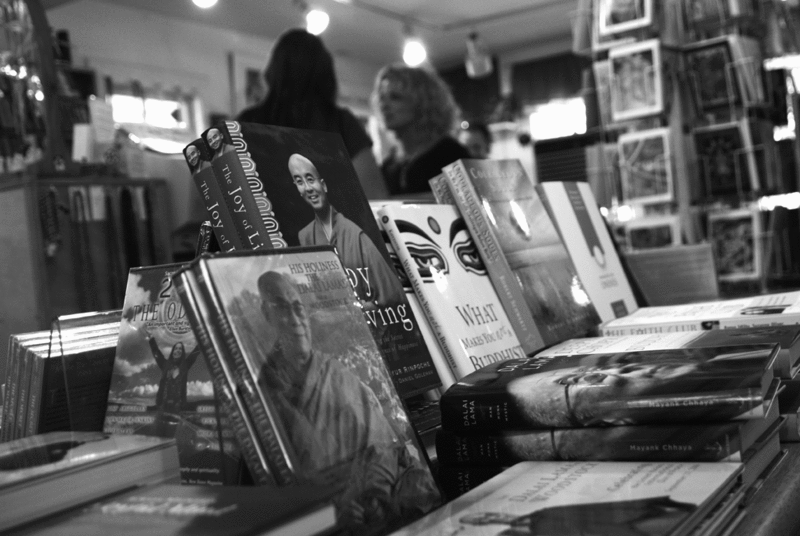
About 35 percent of Mirabai’s sales come from CDs, DVDs, and other nonbook items such as incense, candles, crystals, statuary, and essential oils. The remaining sales (a little more than half) come from books. Mirabai offers texts on sacred geometry, integrative and alternative medicine, death and dying, qigong, yoga, feng shui, and other subjects. Spiritual belief titles cover everything from angels and Wiccans to shamanism, Sufism, Tibetan Buddhism, and Christianity.
“There are books on Christianity,” says Cuiule, “but our particular spin on that is to acquaint people with the mystical aspects and the more esoteric aspects of Christianity. The same thing for Judaism. Or Hinduism. Most of the books are not orthodox in their approach. It’s the esoteric nature of those religions, or the mystical parts of those religions, that we feature.”
Cuiule adds, “We have no spiritual axe to grind. A lot of people who own stores like ours come from a particular ashram, or a particular faith, or a path.” When the couple bought Mirabai, he says, “We were open to everything. That’s the nature of where we came from. We were not in the spiritual world. We were in the material world. We just wanted to evolve into more spiritual beings, basically.”
While some people might object to the cafeteria approach to spirituality (an expression that Cuiule uses, but doesn’t particularly like), others might find it reassuring. Says Cuiule, “I think that’s the real attraction for a lot of people who shop here; that they’re not tied into one way of thinking. They can explore all sorts of different ways of thinking.”
When Cuiule is asked how he would respond to skeptics—those who might find many of the teachings and theories a lot of hocus-pocus (questionable, and even a little silly)—he responds, “I would say, ‘Don’t believe everything you know,’ meaning that I think a lot of people have that skepticism because they’re convinced that what they know is absolute. But none of us have absolute knowledge. I don’t think absolutes really exist.”
“You know, when someone says, ‘I absolutely know the way to enlightenment,’ that can be a little disturbing,” says Cusson. “It’s like, ‘My way or the highway.’ When it gets to that, then it’s time to read some other books.” She laughs and says, “It’s time to turn around and look at another shelf.”
In the future, Cuiule and Cusson hope to offer rare and signed books in the store and online. They may also introduce sacred travel, possibly with tours to Egypt, Ireland, and spiritual communities in the US.
On September 15, the staff will be celebrating the bookstore’s 20th anniversary with a performance, party, and 20 percent discount on merchandise throughout the day. From noon to 1:30pm, author and musician Shyamdas will translate and perform the devotional poetry of store namesake Mirabai, the 16th-century Hindu poet and mystic. The party will begin at 5pm. Both the performance and party are free.
Mirabai of Woodstock is located at 23 Mill Hill Rd. (Route 212) in Woodstock. (845) 679-2100; www.mirabai.com.


This article appears in September 2007.


