









In early January, I received a kind message from Scottish-American artist Scott Kilgour inviting me to visit his current exhibition at Green Kill in Kingston, which is on view through February 22. A delightful back-and-forth email chat ensued, sparked by our shared art world connectivity that kicked off with his mention of the late great curator Henry Geldzahler, who Kilgour met in 1982. Geldzahler encouraged him to visit New York City, which he did, and he stayed. In that correspondence, he also spoke of his first one-man show in 1987 with Bill Stelling (former director of the Fun Gallery with Patti Astor) and his status as artist working between Bushwick and Kinderhook, all the while honoring his artistic beginnings as rooted in his years at the Glasgow School.
After our lively epistolary exchange, I was keen to make the journey to Green Kill to encounter Kilgour’s work (and the gallery itself) for the first time. Founded by artist David Schell and his partner Yuriko Sasamoto, Green Kill is a multi-use art and performance space that functions as a peer-to-peer driven organization. Schell graciously welcomed me and spoke excitedly about the mission and format, explaining that Green Kill offers two programs throughout the year: a livestream/live audience program and an exhibitions program that is organized among artists in the Green Kill community who recommend each other for shows. With its hypno-swirl logo and proactive vibe, the organization is collaborative by nature. “Green Kill is understood by the artists that come here, artists have to realize their value with each other,” Schell says as we enjoyed the affectionate ambiance of Kilgour’s sunflowers as our mise en scene.
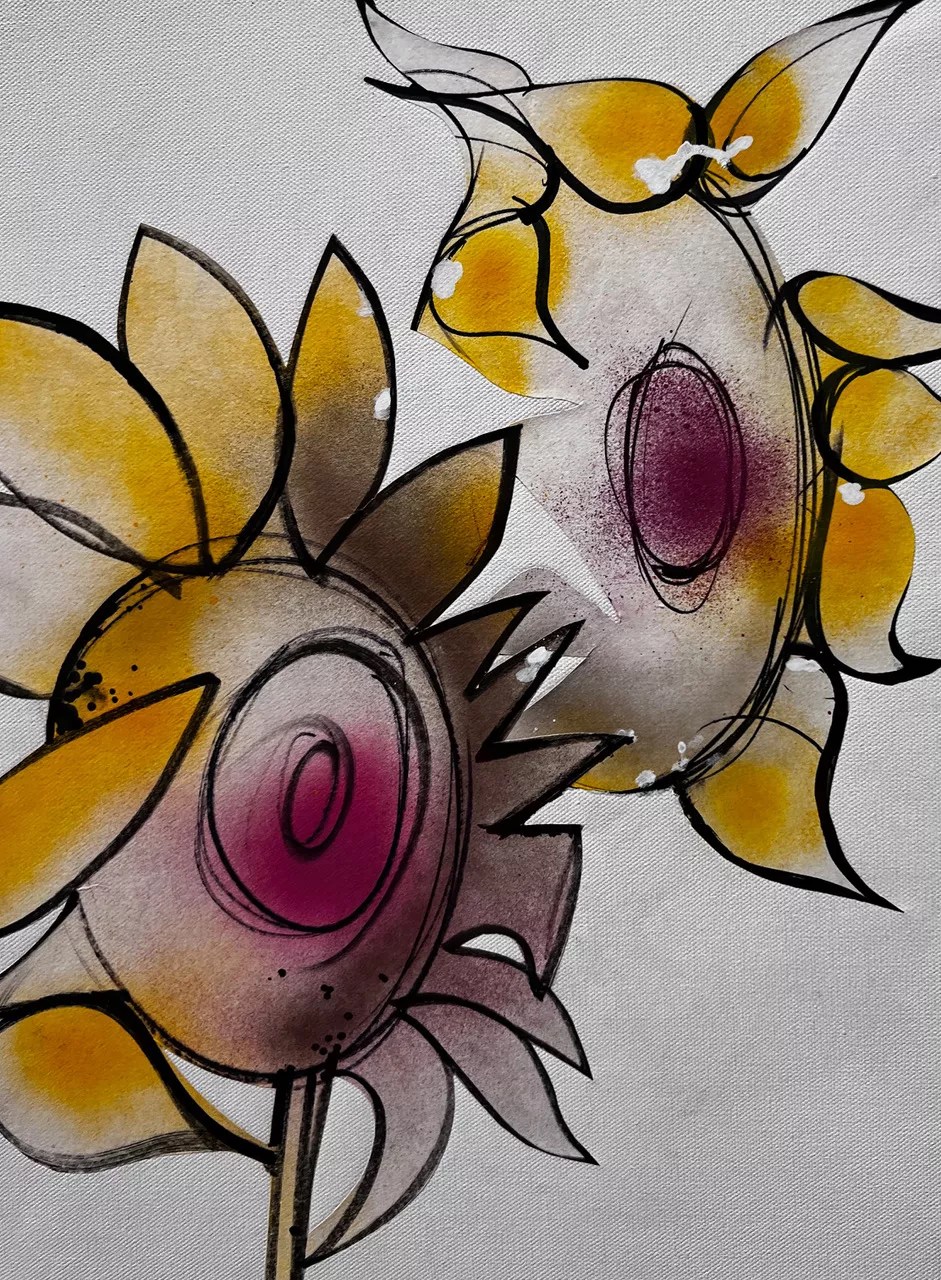
Sharing the space with fellow artist Dan Keegan’s black-and-white visions of the natural world, Kilgour’s Pop-inspired patch of radiant sunflower paintings is a delight to behold. Works such as Chasing the Sun (2024) and Duet (2024) extol the raw beauty and non-negotiable power of these verdant creatures. Kilgour’s enraptured beings seem to sing to each other from their various positions around the room, and their expressive biodynamic melody comes to a crescendo in works such as Talking Heads (2024) and Sunrise/Sunset (2024), where these sturdy golden-hued guardians of botanic bravery give us their all.
Kilgour’s two largest paper collages, Kansas (2021) and Sunflower Rhapsody (2021), are cacophonies of radiant sunflowers and carry the show with their wildly wonderful pile-on of blossoms. Amid this unabashed blow-out of sunflower glory, we can merely smile and appreciate the cheery magnitude of their charm. As described by the artist in a wall didactic: “I see anonymous flowers with humanlike dimensions expressing moods and personalities.” Indeed, the moody essence conjured by Kilgour’s rampant flora is one of utter jubilation.

On your visit to Green Kill, make sure to venture into the back to find additional enchantments aside from Kilgour’s bright bed of paintings: first is the unpretentious library of books that Schell describes as “the best collection of poetry in the Hudson Valley.” Then there are the two outstanding all-over paintings by Detroit-based artist Gary Mayer, another artist who, along with Kilgour, was active in the artistic milieu of 1980s East Village culture. Not only did Mayer fill every inch of the ceiling with a fresco-style painting replete with muscular humans cavorting in the nude, he also bombed out the entire bathroom with a chaotic red-fueled representation of Dante’s Inferno (one of the greatest art experiences in a bathroom, ever). As I departed into the darkness of a frosty evening in Kingston, Kilgour’s blazing sunflowers smiled back with a sunny dose of pure energy and ardor.
Related Stories

This article appears in January 2025.


