








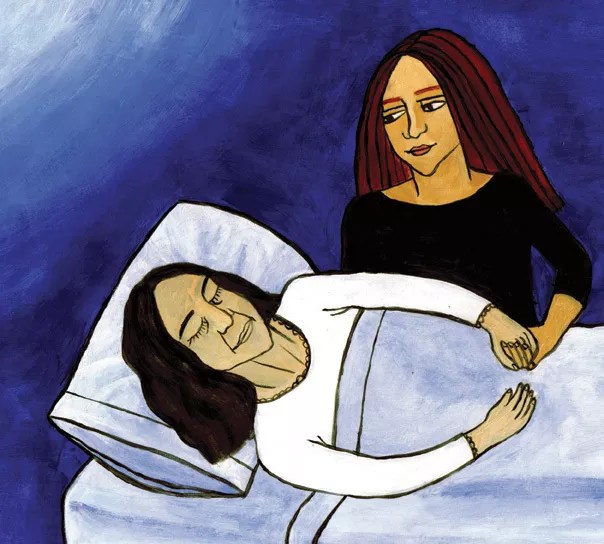
The following notes were sent to me recently by a friend. She wrote them during a 10-day period she and her father spent at her mother’s bedside, at home, after her mother had two strokes a month apart. After a hopeful and “miraculous” improvement following the first stroke, within a week of the second one it was clear that it was time to stop medical interventions and take her mother home for a natural transition from life to death. As a partial view into one person’s end-of-life vigil for a loved one, we hope these notes will be of meaning to others who will, or have already, done the same for someone, as well as to those of us who wonder what their own end of life transition might be like. In this woman’s case, a living will that specified no tube feeding was key to easing the decision to take her home. The family, aware and in agreement with that choice she had made years ago in sound mind, were more confident in the difficult choice to decline medical intervention to sustain her body artificially, and to bring her home for whatever natural process would ensue in the care of loved ones, aided by hospice guidance, and with comfort-focused medications as needed. —Lorrie Klosterman
SELF
As I lay to rest, shifting and trying to settle, each movement is something I’ve seen her do today. They say each of us more closely resembles our parents as we age, and now in our last days together, she and I take the same bent-arm clasp to our chests, or a forearm across the brow, and gaze at the ceiling in very different states of repose. The hand at her throat might not be pain but a gesture of self-reassurance, as I instinctively did once I lay back to rest.
We’ve carried our bodies differently for years, she the lovely and modest wife of a generation ago, me with long strides and casual postures that she long ago counseled me against. But here she is, her limbs unlady-like to her generation, but beautifully natural to mine.
When a mother’s advice so many years ago was to avoid the word “I,” so as not to appear self-centered, now what do you chat about through the long days as she views you, unable to speak but deserving a familiar voice talking of familiar things?
I’m not having onions on today’s salad, or tomorrow’s sandwich, or anytime while the vigil continues. No need to subject her to horrid breath.
This will be me, one day, sprawled in repose beyond what a self-conscious body would allow. Vanity is meaningless—your body is its true self without shelter. It does things in passing from life to death that most people have never witnessed. They are pure expressions of the human animal, beautiful in their way, but unfamiliar. I hope someone is there to attend me without judgment of what my body does. Judgment crumbles in knowing this fate awaits us all.
PEOPLE
Other daughters and mothers are out shopping together, two by two. I notice them like never before, and jealousy pricks at me. “Where is mine?” We have made a fun afternoon of shopping many times, me and Mom. So have I with my own daughter. As I recall the many adventures and misadventures, gratitude grows, jealousy eases, and I silently wish each mother and daughter joy in those precious times.
I notice white-haired women as never before. How old could they be? What have they endured? What are they enduring now? Why are they still here, and my mother leaving? At a crowded café I invite a woman to share my table, and she doesn’t need to say a word to melt my heart.
Out in the “normal” world, beyond the vigil in our livingroom, people watching becomes a surrender to poignancy. The pair of stylish high school girls laughing together evoke a sweet appreciation, for their innocence and youth, like that of my mom’s in her high school photo, though she is radiant in the `40s style of wavy, side-clipped hair, prim white collars, and bobby socks. An elderly woman, skinny and dressed oddly, nonetheless shuffles her aged frame across the street and evokes my admiration, but also love.
HOSPICE
A survey of Americans once showed that nearly everybody hoped they could die at home surrounded by loved ones. Statistics show that nearly everyone dies in the unfamiliar glare of a hospital. It takes courage to bring someone home to die. You are a ship setting out from harbor, with a shred of a map and a few frightened family members as crew, and probably nobody at the helm. A day or two out, a fog settles in and obscures familiar landmarks. The winds cease and even the sun is a wan question somewhere. But there is a buoy out there, with a lifeline tied to it of both literal and metaphorical sorts: hospice services. Hospice is not about death per se, but about comfort and dignity in life, up to the end of it. These services are one facet of the health-care system that is working right. It is even covered for elders by Medicare—paid for by the government.
HUMOR
Fatigue, thankfully, contributes to slapstick among us caretakers. All morning I’ve been mistakenly wearing two different slippers—one delicate white and one fluffy black—because there was no time to complete the slipper-change at the time. Later, while brushing my teeth and roving the house and checking in on mom, I discovered her eyes are open. I want to stay and talk with her, so I spit into the nearest handy container: a nearly empty coffee cup. Dad comments later on how awful his last swig of coffee tastes.
Laughter blurts out—a release valve accidentally knocked open as, nearby, screws that fasten grief’s door shut inexorably work themselves loose. Example: arranging the limbs of a sleeping person gently, hoping for a restful pose but finding an arm or leg oddly askew, like a Barbie doll in an awkward pose. It isn’t really laughable, but in a way, it is.
LEARNINGS
There are so many layers of family etiquette to peel away, before just “being real” with each other sets in. On a vigil, there is growing tension to become real, or to flee. Day by day, as we settle into the fog of the vigil and all the world becomes about being us, with her, the layers fray off and fall onto the dinner table, demanding explanation. Mom is transitioning, and so is the foundational mythology of our family. In this raw state I dare to say what has been unsaid, and we glance at each other as lost strangers united by our love for the one who keeps us sitting here, striving to find a better way, orchestrating our paths always back toward caring, as we care for her, when it would be easier in some ways to abandon each other in the debris.
DOUBT
Doubt washes in and out, over huge decisions as well as tiny details. Am I too close to her face? Too far away? Is it time to stop the intravenous drip that brings her the only fluids she can take in?
In the dim of night, does this familiar livingroom, beautifully appointed with collected treasures, become mysterious and puzzling for her? Does she wonder, “Why am I here at night? Why is my daughter sleeping on the couch?”
Is she looking askance at me now because I said too much? Too little? Am I boring because I am here every day and night, while my sister’s less frequent visits make her a dearer treat to behold?
Will having raised my own child, then caring for ailing parents, sandwich into just a few years the chance to make choices that consider myself only?
I know you so well in some ways, Mom, and in other ways, know nothing of you.
SOUNDS
Birds and squirrels find the new feeder in view of Mom’s bed—for our entertainment if not hers—and their voices, even sometimes raucous, are a sweet percussion of living things.
Saving and guarding lives becomes so very loud at night in the hospital: the electronic chirping of the IV drip, when another batch of sustenance runs out; the authoritative, calm voice over the intercom calling codes in the hospital as someone’s crisis is flaring; the whining alarm on Mom’s bed whenever I lean over the bar, closer to her.
Breathing changes over days, in cycles, but also in progression to the end: deep breathing of a deeply resting brain; feather-light breathing of a diminishing physical frame; apneaic staccato of a body in transition; gurgling wheezing you’ve heard about but have never heard a body make, until the final days.
Whispers in my mother’s ear, in the deepest nights of the vigil, seem as loud as shouts. But they are even more powerful—I hope—in the intention and care they speak to her.
A surprising sound: a shaky “hello” that my Mom utters one morning, carried on a flickering smile, when I greet her open eyes. It is her only word for days, tucked in the middle of long stretches of silence.
MONEY
Don’t talk to me about monetary assets now. Tell me all her other assets.
RELIEF
The healthy, hefty neighbor’s cat comes in to purr like an engine and offer his silky coat to my mom’s ever-slowing hand.
At the local café, a worker asks the usual “How are you?” and I find myself summing up the truth: My mother is dying. Etiquette broken, not giving the usual “Fine,” but he takes it with kind empathy and insists I dine for free.
Friends who have offered to be “on call” anytime for moral support are wise and warmer than I already knew them to be. One of them, now in her own struggle with serious illness, courageously reads me a frank yet luminous passage about the moment of death, so that I may imbue that crossing for my mom with the grace that she and I both hope for not just my mother, but this remarkable friend as well.
The “inconvenience” of taking a few weeks off to be fully in the transition from life to death is supported by coworkers, who take on the extra load that I should be doing.
DEEP PEACE
At her deepest resting times, Mom at 80 looks 20 years younger. I whisper compliments of her beauty to her and know she’d like to hear it in spite of her lifelong deflection of praise.
The overlay of personal carriage—the modesty and concern of appearances—dissolves as she deepens into unconscious rest, becoming simply the human animal at its common denominator: eager airways, diligent heart, limbs at angles neither feminine nor masculine. Beneath her demure self is the pure animal power I knew was in her all along.
It will be a long time before my father and I reach a deep peace in my mother’s passing, but we are soothed after her death, to my surprise, by continuing to play the same tender music, and lighting the same host of candles, that carried our little trio through this vigil for days, around the clock.
SACRED
The room in which a person is passing becomes a sacred space. Or, it should. Sometimes you have to fight to maintain that. You have to assert yourself over others who haven’t realized it yet. Certain conversations, ways of being, noises, people—they don’t fit anymore, in this sacred space.
You are a mother and a child at the same time, as you care for your mother in her last days, tending the helpless, wide-open soul that birthed you—ushering her back across the threshold she opened for you.
It is nauseating, literally, to have on your left the loved one dying, and on your right the surviving one talking afterdeath banking and taxes.
Candle flames, even in the 2010 technorich world, are still a magical sustenance for the soul.
When my mother finally stopped breathing, we lay next to her for an hour, in the same position as when we supported her last days of life. No tears for now, just silence, holding her hands, kissing her sometimes. Later, when hospice women come to bathe her and I join them, we are three women of today suddenly immersed in the sacred, ancient ritual of honoring one woman in the eternal lineage of women. The sloshing of washcloths in the water basin and the gentle tending to limb and face and hair is a farewell of another kind. I kiss her face and wish her eyes would stay closed, and tears pour out of me. But with this ritual, she is finally the goddess I’ve seen her as, in my new-agey ways, which she never would have allowed herself to be.
This article appears in January 2010.


