









If you’re looking for yoga, you’re in luck: It’s everywhere these days. You can find it in small, candlelit garrets with wall-high murals of blue-skinned gods. You can find it in airy, sun-flooded studios with flower-filled altars, and in yurts, barns, storefronts, and living rooms. The 5,000-year-old practice, imported from India, has infiltrated the nation. According to a 2008 poll by Yoga Journal magazine, spending on yoga classes and products in the U.S. mushroomed from $2.95 billion in 2004 to $5.7 billion a mere four years later. Even in these lean economic times we’ve seen a rise in “high end” yoga, with superstar instructors, designer activewear, exotic retreats, and $6,000 teacher-training programs.
Yet quietly, a countermovement has been stirring. Think of it as yoga’s answer to the new economy. Community classes, offered at about one third the price of regular classes (say, $5 instead of $15), have been proliferating at yoga studios throughout the Hudson Valley and beyond. I happen to teach one of these classes, and I’d like to share with you what this is all about.
The very word “community” is an invitation, suggesting an openness to students of all income levels and from all walks of life. It is also an offering—one that has been embraced by experienced and novice practitioners alike. “We’ve strayed from the idea of community as our society puts so much emphasis on individuation,” says Lea Garnier of Sage Center for the Healing Arts in Woodstock, who has been teaching a community class at Bliss Yoga Center (in the same building as Sage) for two years. “The group energy can be very healing. You don’t even have to say anything. With yoga, it just happens. You feel not so alone, less depressed. No one should be turned away from healing on any level.”
You’re Invited
On a recent Thursday night at Euphoria Yoga in Woodstock, I watched my community-class students come through the door with rolled-up mats and $5 bills in hand. Tara is an artist, Josh is a teacher, Amanda is looking for work. They are young and old, tattooed and conservative, diehard yogis and eager newbies. They are weekend dads, pierced twenty-somethings, multitasking mothers who get this one evening to themselves. Some have told me they wouldn’t be able to come without the community rate; others attend regular-priced classes too but appreciate getting a financial break one night a week. What we all have in common is a passion for this practice—for the chance to move and awaken, to sit in stillness, to discover our potential and sweat our prayers on an autumn night as the sun sets over the Catskills.
Ask 10 yogis what yoga is and you will probably get 10 different answers. Not just a physical discipline that builds strength and flexibility, yoga can also be a spiritual path—a way to connect to our innate joy and sense of divinity. Some people first start coming to classes in hopes of getting a “yoga butt,” yet what they find in time is that yoga has done something more important—it has opened their consciousness and made them more mindful, less reactive. It has taught them how to breathe better and worry less. It has made them feel at home in their bodies, and also in the cosmos.
Yoga is not a religion, though it comes with a dose of venerable philosophy. Most yoga teachers weave a bit of this wisdom into their instruction of the physical poses, or asanas, drawing upon ancient teachings that offer a blueprint for living a life of self-realization. At its etymological root, yoga means “union,” referring to a feeling of connection with all that is. We may have caught glimpses of this feeling of samadhi, or bliss—yet with disciplined attention the sensation can become more accessible and attainable than most of us dare to imagine.
Community classes are in some ways just like any other yoga classes, offering a sequence of asanas, body-alignment cues, breath instruction, and perhaps chanting and meditation. But in unspoken ways, the purity of the intention behind yoga comes into full relief in a community class. Key aspects of yoga philosophy flourish in this environment, such as the Sanskrit or Pali concepts of seva (selfless service), sangha (community), kula (family), and satsang (a gathering of likeminded seekers). Hovering in the sweat-moistened air is a sense of inclusiveness that naturally jives with the yogic ideals of unity and oneness with all beings. Ultimately, it’s about connection. Community classes allow us to reach more people—and more people doing yoga can only be a good thing.
Real Wealth
“I’m a big proponent of making yoga available to all,” says Linda Lalita Winnick of Shakti Yoga, which has classes in Woodstock and Saugerties as well as at MAC Fitness health club in Kingston. One of the first studio owners in the area to offer a cut rate, Winnick introduced her $5 Sanctuary classes in 2007, when the country teetered on the brink of recession. “We called it Sanctuary because we wanted to offer it to people who were affected by economic hardship or any hardship,” says Winnick. “We’ve attracted a lot of twelve-steppers, which is something I feel really great about, as I started out teaching classes to people in recovery.”
Winnick announced this fall that all classes at her Saugerties venue are now offered at the $5 Sanctuary rate. Asked how she can afford to keep a studio that brings in so little money, Winnick explained that her two other venues generate enough revenue for her to run the Saugerties studio as a nonprofit. Next spring, Winnick will be joining forces with the Kingston Land Conservancy to start a program called Yoga in the Park, which will offer free yoga at Cornell Park in Kingston’s Rondout neighborhood.
In our money-centric society, dirt-cheap and free yoga can be cause for confusion. Newcomers at my Euphoria Yoga class sometimes ask incredulously, “Is this really only five dollars?” Some students offer to pay more, yet with a bit of coaxing they accept the fact that they really don’t need to. It can be hard to let go of the strong cultural idea that money is the only way to place value on a product or service. Just as our minds and bodies relax on the yoga mat, our attitudes about money can relax too.
For the most part, though, local yogis have no problem accepting the low price point. A palpable sense of gratitude emanates from a loyal band of students, who often linger to chat and connect after class is over. Laura Weyeneth, a student of Lea Garnier and a resident of Hurley, says that community yoga with Garnier is her “sanity and reliable source of joy” as well as a place to fulfill a commitment she has made to her own personal transformation. Like many of her fellow students, she would go to class every day if she could. Says Weyeneth: “It’s a minivacation from the stresses of my life.”
Devaluing Dollars the Good Way
On a mild June morning this past spring, I scanned a large, sparsely decorated studio for a place to unroll my mat, not as an instructor but as a class member, in one of New York City’s latest hot spots: Yoga to the People, on St. Mark’s Place. The room was wall-to-wall bodies, and everyone was there for the by-donation classes that are the studio’s trademark—and sole offering. Once I had squeezed my mat into a slot marked out like a parking space, I looked for a place to put my cash at this pay-what-you-like studio. Set in the back of the room like an afterthought, an empty tissue box collected the optional donations of a diverse bunch of East Village yogis.
That class at Yoga to the People was good enough—but what I liked better was the rebellious spirit of this no-frills studio. I liked the way Yoga to the People did not promote teacher worship. (“No ego no script no pedestals” reads the manifesto stenciled on the studio’s wall.) I liked the simplicity of putting my cash into a tissue box, though I noticed that the box wasn’t exactly overflowing. Yet somehow, the sheer volume of students has kept this studio afloat—and has even allowed the brand to expand to cities like San Francisco and Seattle.
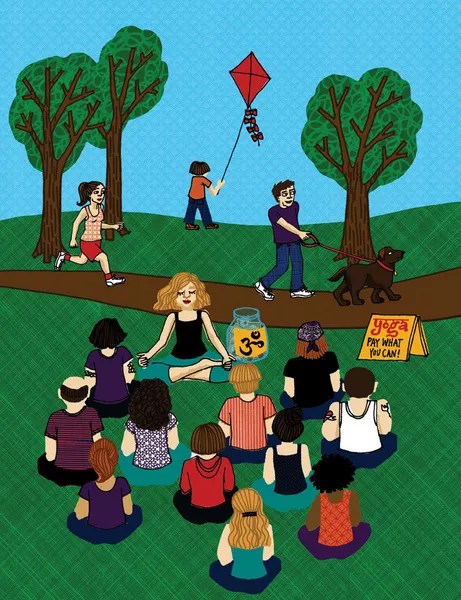
Yoga classes that let you set your own donation amount have become more ubiquitous lately, thanks in part to Yoga to the People, which opened in 2006. You’ll find them in large urban centers and beyond, including here in the Hudson Valley. The principle is basically the same as community yoga—though with no set rates, these by-donation classes can challenge even further our ideas about how to put a price tag on well-being and personal growth.
Spreading the Bliss, Practically
Better still, some yoga studios and teachers are taking the by-donation model to the next level: They’re using the proceeds from their classes to support a do-good cause or endeavor, such as a homeless shelter, food pantry, or orphanage at home or abroad.
Moira Dwyer, who recently completed yoga teacher training and works as a regional preparedness manager for the Red Cross, teaches a by-donation class at the Open Space Co-op in Rosendale. Paying rent for the space out of her own pocket, Dwyer donates all proceeds from her class to the Queens Galley, a Kingston nonprofit that runs a soup kitchen and offers nutrition programs. (She notes that her project is part of a larger movement called Yogis for Food, a local collective that raises money for the Queens Galley.) “I’m really grateful for the experience I’ve had with yoga, and for the work I’ve been able to do in human services,” says Dwyer. “It just made sense to me to combine the two. It’s my way of keeping the cycle of giving going.”
By-donation and community yoga classes are beautiful gifts—but somewhere, someone has to foot the bill. Studio rents must be paid, and yoga teachers need to make a living. Most community classes could not happen without the backing of a supportive studio owner and a thriving venue that offers plenty of full-priced classes on its weekly schedule. Thankfully, community classes attract new students drawn by the low price, and once these nascent yogis get a taste of yoga’s benefits they often become hungry for more. Many end up using community classes as a jumping-off point to frequent drop-ins at regular-priced classes. It’s this passion-driven commitment that allows the studio, the student—and via a ripple effect, the world—to blossom and flourish.
A listing of low-priced yoga classes in our region follows, though this is not a comprehensive listing. Call your local yoga studio to inquire about community or by-donation classes in your area.
Wendy Kagan is a freelance writer, yoga teacher, and mother of two girls.
She lives in Woodstock.
Resources:
Hudson
Sadhana Center for Yoga and Meditation, 403 Warren St.
Wednesday, 6 pm
$5
New Paltz
Ashtanga of New Paltz, 71 Main St.
Sunday 6:30 pm
by donation
Poughkeepsie
Kishna Yoga, 1820 New Hackensack Rd. (Rt. 376)
Sunday, 10 am (through Jan. 11, 2011)
by donation
Rhinebeck
Satya Yoga Center, 6400 Montgomery St.
Thursday 7 pm
$7
Rosendale
Open Space Co-op, 426 Main St.
Sunday 7:30 pm
by donation
Saugerties
Shakti Yoga, 67 Partition St.
7 classes/week
$5
Stone Ridge
Yoga at MAMA, 3588 Main St.
Tuesday 4 pm
by donation
Woodstock
Bliss Yoga Center, 6 Deming St.
Sunday 5 pm
$5
Euphoria Yoga, 99 Tinker St.
Thursday 6:30 pm
$5
Yoga Monkey, 2568 Rt. 212
Wednesday 5:30 pm
$5
This article appears in December 2010.