









The Tower of Victory stands in a corner of the sprawling lawn at Washington’s Headquarters State Historic Site, overlooking the Hudson River and Mount Beacon. The stone structure’s arches frame a bronze sculpture of George Washington, who made Newburgh his home for a year and a half toward the end of the Revolutionary War. The tower was completed in 1887 to commemorate the 100th anniversary of the war’s end. It’s the nation’s first, and perhaps only, Revolutionary War monument that symbolizes not the war itself, but the peace after it.
“The site stayed in the Hasbrouck family up until the 19th century,” says Elyse Goldberg, historic site manager of Washington’s Headquarters. “At which point it was put up for foreclosure.” But, according to Goldberg, the community wouldn’t allow for that. “They got together to save it, thus creating the first publicly owned historic site in the nation.” One hundred and sixty-three years later, the community continues to assist the site in the form of preserving the tower, whose masonry, original roof, and viewing platform have suffered from storm damage. The site is about halfway to its goal of raising $1.5 million for the restoration project, and they hope to have the full amount by the end of the year. Such an investment, though, may raise questions for those familiar with Newburgh’s struggles: Doesn’t the city have bigger fish to fry than weatherworn statues?
To many, Newburgh is synonymous with bad news. In April, while sentencing a gang leader from the city, US District Judge Colleen McMahon called Newburgh “the most pathetic place in the State of New York.” Its crime rate is just behind some of the country’s most dangerous cities, and dilapidated buildings still feature prominently on many streets. A closer look at the city, though, reveals a more complex picture. Daily headlines about Newburgh seem schizophrenic: one day there’s a new volunteer organization, the next a triple homicide. More and more, though, stories bearing good news are cropping up alongside the bad. If Newburgh is pathetic, it’s not in the sense that Judge McMahon meant it. It’s pathetic in the word’s original sense, as in relating to the emotions. Newburgh’s got heart—that much is clear in the push to save the Tower of Freedom, a symbol of peace that represents not only an important moment in the city’s history, but also a continued part of its identity. Right now, the people of Newburgh are in their own moment of revolution. “It’s time to focus on what is good about Newburgh instead of what is bad,” says Mayor Judith Kennedy. “If we keep focusing on what we want, not on what we don’t want, eventually we’ll create what we want.”
Good Neighbors
Washington’s Headquarters State Historic Site is first and foremost an arbiter of Newburgh’s rich history, which includes the feats that Washington accomplished during his stay there, like creating the badge of military merit, which was later reinstituted as the Purple Heart, and writing the Circular Letter, a 17-page note to the state governors that influenced the writing of the Constitution. Washington’s Headquarters is an important historic landmark for Newburgh, so much so that the site’s Hasbrouck House is the seal of the city. “We help the community by keeping that alive in people’s minds,” says Goldberg. The site, though, serves the community beyond its historical ties. In May, Washington’s Headquarters hosted its third annual volunteer fair, which brought approximately 30 community organizations together. “There’s a lot of hope here that the city and the people are worth investing in,” says Goldberg. “If nothing else, it says people are doing something, and people are here to support each other.”

The support system in Newburgh is widespread, with new community-oriented organizations being established or improved upon each day. The Newburgh Armory Unity Center is a volunteer-run community hub, with a basketball court, a new indoor soccer field, community gardens, and a slew of educational programs, including literacy and acting classes. Another recent community development is the NewburghFoodCo., a food co-op where members order food online and pick up their groceries at a designated meeting spot. In a city without a supermarket, alternative food options are invaluable, such as Huguenot Street Farm‘s new Newburgh CSA, which offers weekly distribution at Safe Harbors on Broadway, as well as a free U-pick selection for members.
Community outreach in Newburgh emerges in unexpected places, too. At the one-year-old Newburgh Brewing Company, Paul Halayko, Christopher Basso, and Charlie Benedetti look for ways to assist local nonprofits in the best way they know how: with beer. In addition to brewing 18 different styles of beer (with a new style every month) and running a beautiful, rustic tap room, Newburgh Brewing hosts a variety of community events, including their guest bartending series. On Sunday afternoons, the brewery opens its tap room to charities and organizations, and all tips raised go to the guest organization. Newburgh Brewing’s River Brew benefits the Michael J. Fox Foundation, and the brewery sometimes donates kegs to local restaurants to raise money for nonprofits, like Safe Harbours of the Hudson. Last month, a commercial real estate summit was held at the brewery, itself located in one of the city’s beautiful historic buildings, a former paper-box warehouse. “We’re trying to attract businesses to come back by highlighting why doing business in Newburgh is good,” says Halayko.
Niche Industries
The benefits of doing business in Newburgh have not been lost on people. A variety of distinctive businesses have found a home in the city. Atlas Industries, a high-end furniture and design company from Brooklyn, recently relocated to a warehouse on Spring Street. “We had been keeping an eye on the area for a while,” says Thomas Wright, co-founder/owner of Atlas Industries. “We love the architecture, both residential and commercial.” Their former office in Brooklyn was 6,000 square feet, and with woodworking and metalworking machinery, it was a tight squeeze. The three-story, 65,000-square-foot building that they bought in Newburgh fits their machinery and then some. What was a simple relocation became a development opportunity for Atlas Industries. “Our vision for the building,” says Wright, “is to create a destination-type facility where other businesses, artists, and design professionals can rent space from us.” Atlas Industries joins the ranks of other accomplished businesses in the area. Just next door is Thornwillow Press, an artisanal printing press whose handmade, craft products are collected and used by some of the world’s most elite institutions, like the Vatican, the Morgan Library, and the White House (Thornwillow published Barack Obama’s first inaugural address). Down the street are Caffé Macchiato, an authentic Italian café, and Karpeles Manuscript Museum, which houses precious manuscripts in a Greco-Roman building on Broadway’s wide, runway-like stretch.
Artistic Ambitions
Even recent strides in Newburgh’s arts community have resonating impacts for the city as a whole. Ted Doering, president of the Motorcyclepedia Museum, recently opened Umbra of Newburgh Sound Stage, Newburgh’s first film office. The massive industrial warehouse is now home to two state-of-the-art stages, as well as a slew of amenities for people using the facility, such as dressing rooms and a workshop to build set pieces. “Orange County had people coming through to use different locations for years,” says Doering. Umbra Assistant Jean Lara adds, “Producers were going through doing location shoots, but this has pulled it more together for Orange County and the city.” Oscar Rivas, who does video production for Umbra, sees the benefits of this kind of facility for the community. “When [film producers] come over here, sometimes they have to rent 30 hotel rooms to accommodate all their people. What they bring with the production is a big boom for the economy.” Beyond bringing people into Newburgh, Umbra hopes to serve the people who already live there by cutting out long commutes to New York City. “It’s going to improve the quality of life for the people who live here who are trying to make a living within this field,” says Rivas.
The visual arts are also thriving in Newburgh. Ann Street Gallery, a nonprofit contemporary art gallery, features culturally diverse exhibits, and PUG (pop-up gallery) Projects, which brings local art to nontraditional, transitional venues, hosted “Orange Alert 3D” in May at the warehouse of two Newburgh artists, Alice Vaughan and Ellen Sigunick. The Newburgh Mural Project develops large-scale murals within the city, including one on the south wall of the restored Ritz Theater and one on the South Street underpass at Downing Park. From June 21 to 23, the Newburgh Illuminated Festival will celebrate the culture and heritage of the City of Newburgh, home to the first Edison power plant and the second city to be lighted by electricity. The festival will showcase the cumulative impact of businesses and organizations throughout the city on Newburgh’s current renaissance, with countless venues throughout the community hosting events, from an Electric Music Concert and health fair in Downing Park to a run of classic motorcycles from Motorcyclepedia down Broadway. “It’s an example of people trying to show Newburgh in its best light,” says Elyse Goldberg.
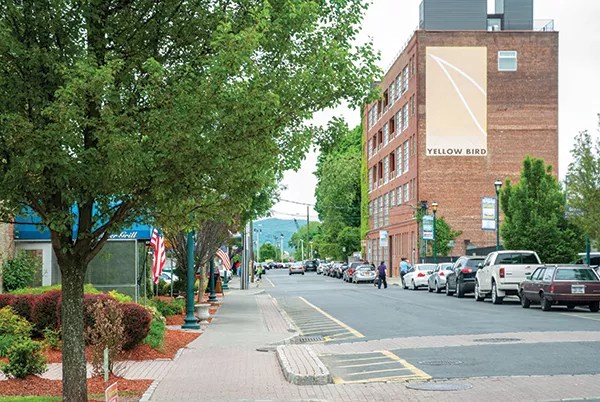
Walking through Newburgh, it’s common to experience glaring contrasts within a given instant. While strolling through the serene paths of Downing Park, the streets pulse with hip-hop thumping out of car windows. One porch will be decorated with hanging flower baskets, the next with yellow police tape. Like any great story of human struggle, Newburgh’s is one of ups and downs, highs and lows. Within the spaces of this dynamic push and pull, though, transformations occur. Vacant plots become green spaces; empty buildings become homes to new visions. “Maybe cities can be reinvented,” says Ted Doering, a Newburgh lifer. “The gritty part makes it interesting.”
Resources
Adams Fairacre Farms
Akasaka
Beacon Riverfest
Ethan Allen
The Granite Factory
The Hop
Imperial Guitar & Soundworks
Leos Italian Restaurant & Pizzeria
Motorcyclepedia Museum
Newburgh Historical Society
Newburgh Illuminated
Newburgh Mall
The River Grill
Windows on Main Street

This article appears in June 2013.



Good article, but why the random list of resources, many of them in Beacon. The article’s about Newburgh and its unique character. Try newburghrestoration.com for a fun and comprehensive portrait of this shabby beauty on the Hudson.
Terrible article. This is considered content? On what planet? Funny, somehow this mag forgets to cite crime figures and irrelevant opinions in other featured communities. Tired.
Monalisa: Thank you for your comment—I am happy to see that you are reading and engaging with our material even though you are displeased with it. I would like to point out that I do make mention of Newburgh’s crime rates, but choose instead to focus on the ways in which the city’s downsides have motivated and inspired many people to create positive changes. If you are looking for specific statistics on Newburgh’s crime rates, I suggest referring to one of the Hudson Valley’s daily newspapers, like the Times Herald Record. As Brian Mahoney notes in his Editor’s Note this month, “The newspaper faithfully records every drug bust, political misdeed, and triple homicide. But there’s another story to be told, of a city in chrysalis.”
Newburgher: Thanks for your suggestion to link to Newburgh Restoration’s website. While there are additional links to resources in the text of the article (mainly local businesses), Newburgh Restoration is a wonderful resource for people interested in the city’s revitalization. Here’s the link: http://newburghrestoration.com/
Thanks again for your feedback.
Jennifer Gutman
Once again the Monochrome, sorry–the Chronogram, spreads the hopeful message of gentrification/”benevolent White People from the City to save a decaying yet quaint river town from itself” sort of story. Mahoney’s right; if you want news about “every drug bust, political misdeed, and triple homicide,” i.e. the have-nots and the black and brown people who are only obliquely mentioned, then look elsewhere. {The artsy empty street “local color minus the color” photos speak volumes. } The Chronogram is Yuppie Porn. It is an extended advertisement for pretty things for pretty people.. “Chrysalis?!” Are you serious? George Washington, exquisite artisanal printing presses, loft space, cafes, reiki for your pets, etc.?
Come on.
would love to purchase copies of Dec.2013, issue for my friends who were Newburghers & now living elsewhere! Where can I do this?
I live in Newburgh.Can I acess these magazines without too much driving involved???