









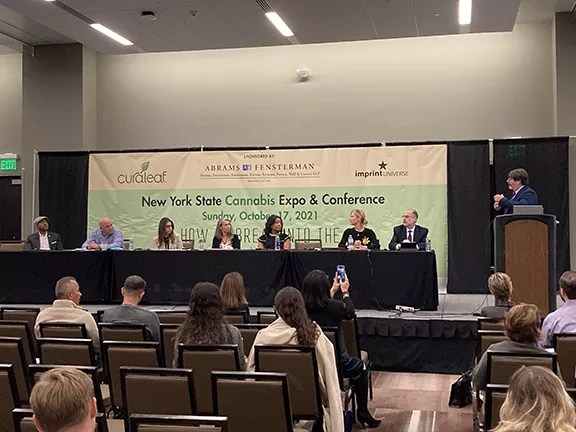
On Sunday, October 17, just about
everyone in the know and everyone who wants to be in the know about the
business of marijuana in the region met at the Albany Capital Center for the
New York State Cannabis Expo & Conference (NYSCEC). Subtitled “How to Break
into the New York State Cannabis Industry,” NYSCEC was a colorful mix of
experts of all types. Among the speakers were David Holland of the New York
City Cannabis Industry Association and Empire State NORML and Andrew Schriever of the Hudson
Valley Cannabis Industry Association, both lawyers by trade, and both experts
in cannabis law. The attendees were mostly entrepreneurs looking to break into
the emerging industry.
Early on in the day, attendees
learned that one of the biggest hurdles they are up against is undoing 90 years
of misinformation—”three generations of intentional fabrication. If the
speakers, who are activists, and the attendees, who are aspiring to break into
the industry, are to make any headway, they’re going to have to change people’s
minds.
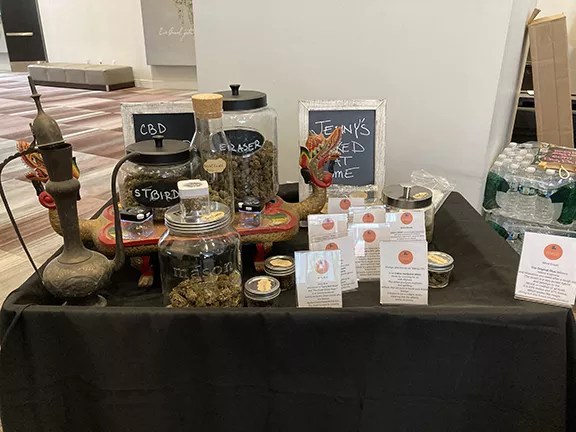
According to Kristin Jordan, a
panelist in the social equity seminar, and a lawyer and entrepreneur, drug
policy in the United States goes further back than you might think. It started
in the 19th century, with Chinese immigrants working on the railroads and bringing
opium with them. Although the immigrants were targeted, they weren’t the
primary users of the drug. According to Smithsonian magazine, white
women made up more than 60 percent of opium addicts in the late 1800s. Not
unlike today’s opioid epidemic, doctors prescribed it to them. The fact
remains, however, one population was treated with hostility, and one population
was treated with respect.
Even the term marijuana has
racial connotations. The term comes from Mexican slang, and was adopted for
that very reason. The US government wanted the public to associate cannabis
with Mexican immigrants. Demonization of the other is an old theme in America.
New York’s legalization bill, the
Marijuana Regulation and Taxation Act (MRTA), seeks to redress the negative
impacts of the War on Drugs on minority communities through its social equity
provisions. The MRTA also places a 50 percent priority on social equity
applicants. Social equity applicant categories are minorities (including
women), economic equity applicants, distressed farmers, impacted community
members (from the war on drugs), service disabled veterans, and justice
involved (applicants who went to prison or have a family member who is in
prison or went to prison). Indigenous and transgender people do not constitute
minorities in the MRTA.
Despite the law’s problems, it is
still the best of its kind so far according to attendees at the expo I spoke to.
“The MRTA is a commitment to trying to improve social equity programs and
horizontal licensing schemes, and trying not to oversaturate the market,” says
David Holland. No state has really gotten it exactly right thus far, but,
according to Holland, the MRTA could be a social equity model for other states.
It bears repeating, if the war on drugs put so many Black and brown people
unjustly behind bars, then the new legal framework for cannabis should prop
those groups up to attempt to offset some of the previous damage.
Horizontal licensing schemes separate
New York from many other states, which are vertically licensed. Unlike, say,
Massachusetts, New York will offer separate licenses to grow, process, package,
and sell cannabis. In Massachusetts, dispensaries often sell cannabis that they
grow themselves. These companies are vertically integrated. In promoting
a horizontal model over a vertical model, lawmakers aim to promote many small
entrepreneurs over fewer large companies.
As Holland mentioned, the MRTA
contains language aimed at preventing market oversaturation. There is a cap on
how many licenses the state will give out. This fact could also be interpreted
as a downside to the MRTA. Limiting the number of licenses is limiting the
opportunities given to entrepreneurs, potentially many of them being social
equity applicants who will not have the capital out of the gate to apply for
licenses once they become available.
As far as who will actually get the
licenses, it’s anyone’s guess. “They’re gonna get it wrong, it’s just a matter
of how wrong they get it,” says lawyer and cannabis law expert Kaelan
Castetter. Though there is the purported 50 percent priority to social equity
applicants, the question of what the owners of the dispensaries will look like
is still a mystery. However, it is worth noting that New Jersey has 25
dispensaries, and zero black owners. The trend that seems to have popped up is
that many white women end up opening dispensaries, utilizing their status as
social equity applicants.
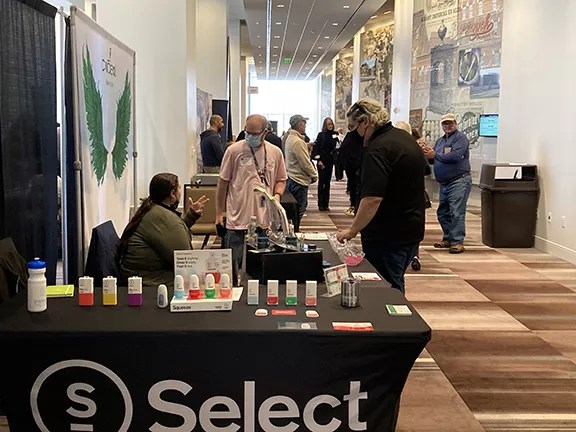
“The biggest problem is going to be
education,” says Carlos Montes, an attendee. Montes is a convicted felon, and
hopes to open up a growery. “No one knows where to get a license or how to get
a license.” If the past is any indication, those who can afford to hire people
to help them will get a license. But maybe this time will be different.
The price for a license has been a
matter of debate. It was rumored that they would cost $250,000, but that was
merely a re-reporting of the medical license price from five years ago.
According to Castetter, “Licenses should cost between $15,000 and $20,000.”
Who will get those licenses and how
many will be apportioned is up to the Cannabis Control Board, which will have
its second meeting on October 21 and is still early in the process of ironing
out regulations and application guidelines. Would-be entrepreneurs will have to
continue to wait.
This article appears in October 2021.


