








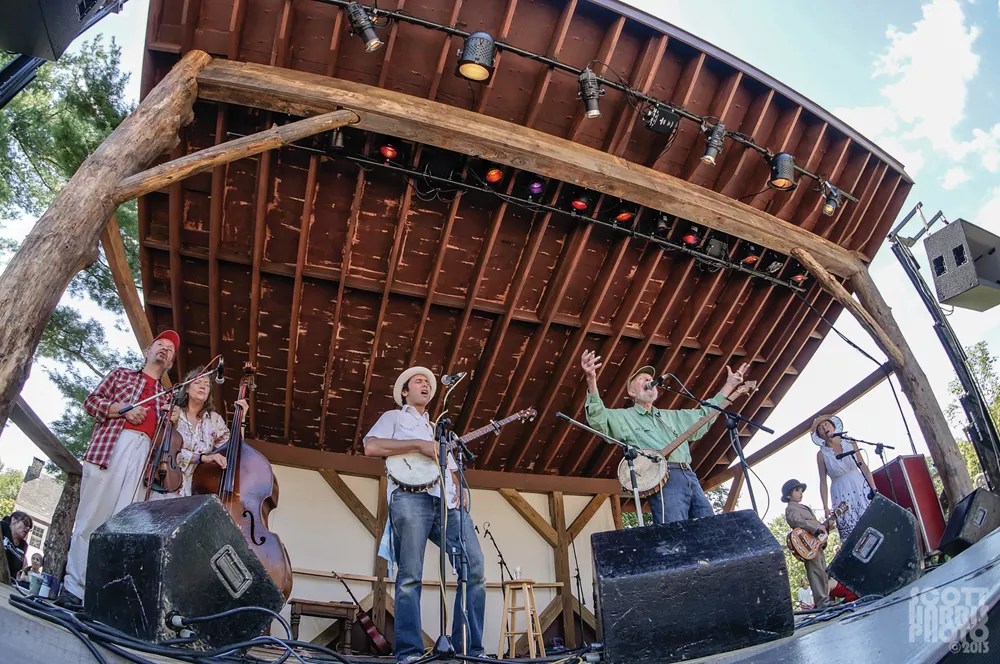
During a year that was so difficult for so many in so many ways, being without live, in-person music was truly a case of adding insult to injury. And the cancellation of the treasured tradition known as the Summer Hoot was a hit that really hurt. But now things are back—and so is the Hoot, which this month once again returns to roost at the beatific Ashokan Center. This year marks the ninth return of the beloved folk-and-family outdoor musical and performance festival, bringing with it appearances by the Mammals, the Big Takeover, Radio Jarocho, Le Vent Du Nord, the Shaker (featuring Simi Stone), the Restless Age, Elizabeth Mitchell, Jay Ungar and Molly Mason, Joan Henry, Evan Pritchard, Golden Shoals, Arm-of-the-Sea Theater, and much more. Organizers and Mammals members Michael Merenda and Ruth Ungar Merenda (AKA folk duo Mike and Ruthy) answered questions via email. The 2021 Summer Hoot will take place at the Ashokan Center in Olivebridge on August 27, 28, and 29.
—Peter Aaron
Due to the pandemic, this year’s event will no doubt hold an added resonance for you and the staff as well as for the other performers and the audience. How have you been faring during the leadup?
Michael Merenda: It’s true. People have been writing to us since March asking: “Is there gonna be a Hoot!? Is there gonna be a Hoot!?” We kept our cards pretty close to our chest, waiting to see how things unfolded. There’s still a lot of uncertainty around presenting live events. It’s still a moving target, but we were heartened by a recent music camp we attended in New Hampshire, where, after months and months of organizing, reconfiguring, and bending over backwards to follow various protocols, in practice the whole thing went off without a hitch and people interacted with each other in a—dare I say—normal manner. It made us feel better about proceeding with the Summer Hoot in the midst of so much cultural trepidation.
Ruth Ungar Merenda: We are overjoyed each time we play a live, on-the-ground show, and we’re grateful to have this large, spacious site in which to present great live acoustic music, nature hikes, and singalongs. I truly believe this type of multidimensional experience is going to be quite healing for the performers and attendees alike.
Last year, you adapted to the closures by staging the virtual Hoot from Home and the Winter Hoot online. What was that like?
Michael Merenda: We were lucky that we were able to broadcast from the Ashokan Center, and we incorporated a mix of artists performing live from the center with a few special guests piped in from abroad. The format afforded us the opportunity to present remote artists we most likely would not have been able to present in person, like Ani DiFranco from her home in New Orleans and musical friends from London, Vancouver, Michigan, Ecuador, and more. Those were obviously special moments, to not only assemble in person, to some degree, but to also make connections across the digital frontier. By the time we got to the Winter Hoot we were really dialed in on the technical end and simplified the way sound was captured significantly, creating a beautiful auditory experience.
The Summer Hoot website mentions that each of the bands will perform “bluegrass style” around a single microphone. How did that come about? What else is different for 2021?
Michael Merenda: It’s actually a concept we had discussed long before current events; to approach the sound more like, say, the Newport Folk Festival in the ’60s. In the interest of streamlining, we realized this would be the ideal year for such a setup. All acts, even bigger acts, will perform “unplugged” around a single stereo microphone. This simplifies changeovers considerably, eliminates nearly all backline gear, and will create an elegant-looking and -sounding musical experience. I imagine it will feel very much like an old-time radio show from the days of yore.
Ruth Ungar Merenda: We’re guessing most folks won’t be ready for an indoor square dance, which is normally late Saturday night at the Summer Hoot. Instead, we are scheming an Appalachian clogging performance followed by a freestyle dance party to a live string band in Ashokan’s open-air pavilion.
What makes the Summer Hoot different from other music festivals?
Michael Merenda: The Ashokan Center is an epic place to spend a couple days: 385 acres of gorgeous Catskill Mountain terrain with the Esopus Creek running right through. But, obviously for us, it’s all about the music and the community. Even though, over the years, we’ve played some big festivals, and have rubbed elbows and collaborated with some serious fucking luminaries, ultimately, we’re DIY and fly pretty far under the radar, partly by design, partly by default. So, we personally take an enormous amount of pride in presenting what feels like a world-class event that basically runs on karma. The Hoots benefit the Ashokan Center itself. Our performer pay scale is equitable across the board, and that resonates with people. I mean, in year one Pete Seeger made the same amount of money as our juggler! We decided early on to make the Hoot tickets sliding scale at the gate, to ensure that nobody felt left out or that they couldn’t afford the experience. There are many acts that we thus far cannot afford to hire. But as the years go by, and word of mouth spreads, we’ve found that sometimes those acts start coming to us. That’s how we know we’re on the right path.
Ruth Ungar Merenda: Some people hear “music festival” and picture something expensive, clique-ish, exhausting, and deafeningly loud. The Hoot strives to be the opposite of all of those. We make an effort to be welcoming to all, so you can really feel like yourself here. I’ve heard folks describe the Hoot as a real local treasure, and say that once you’ve attended once you want to come back and bring a friend!
Related Stories

This article appears in August 2021.



Sounds like you’re working hard to make it a safe space! Are you requiring attendees to be vaccinated? Do we need to show proof iron entry? -Gen Songs