









Over 25 years ago my introduction to Mary Ellen Mark’s photography was by way of her stoic series of twins (taken at the Twins Day Festival in Twinsburg, Ohio) and she won me over instantly (my identical twin sister is the paramount love of my life). Mark died in 2015, and her diverse explorations in the areas of portraiture, photojournalism, documentary photography, and advertising photography remain a benchmark for the entire field. Hence, in true fan-girl style, I hurried over to the recently opened new CPW (formerly known as the Center for Photography at Woodstock) building in Midtown Kingston on the lively opening night a few weeks ago to encounter Mark’s artistic intelligence again.
One of four inaugural exhibitions currently on view at CPW (three showcasing women photographers), “Mary Ellen Mark: Ward 81” is a superior presentation. To understand the backdrop for this show, rewind to 1975 when Mark was the set photographer for Milos Forman’s One Flew Over the Cuckoo’s Nest, which was shot at the Oregon State Hospital in Salem. During that gig she met several of the women living in the all-female wing of that high-security facility. A year later, she and Dr. Karen Folger Jacobs (a therapist and writer) returned to the ward for 36 days to immerse themselves among the women and document their lives at the hospital, including recorded interviews and photos of their intimate interactions and private realities.
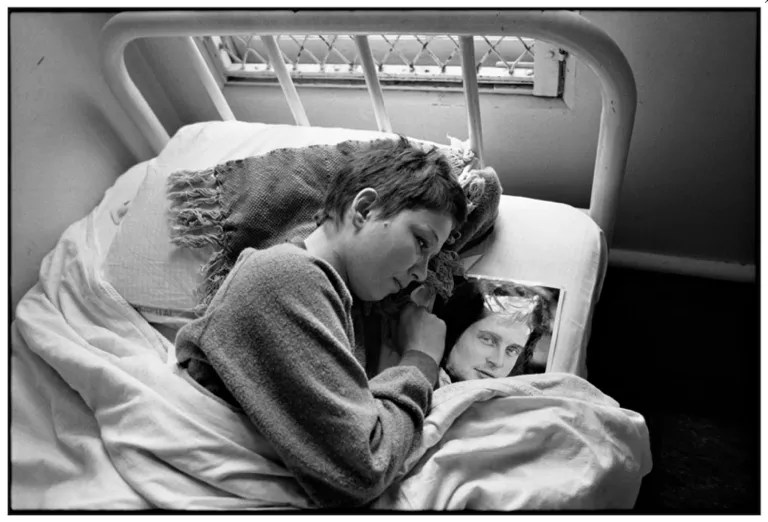
Consisting of salon-style clusters of black-and-white photographs arranged around the space, the exhibition takes us through a nonlinear narrative of moments that reveal personal psychologies. Mark used pseudonyms to preserve the privacy of these individuals, and the various sections of images highlight these women as the “leading ladies” of her series, including Mona, Beth, Laurie, Mary Iris, Verla, Susie S., and Carol T. as main characters.
Through these images, we can sense the erratic nature of the environment and the multifaceted personalities of these women, many of them with backgrounds of abuse and poverty. From one cluster to the next, there are several recurring motifs: A woman staring intensely straight into Mark’s camera or staring off woefully into outer space; a woman bathing in the tub; a woman in bed; a woman whose mouth hangs ajar, she with no place to go. In the photo Carol T. in the Mirror (1976), for example, Mark has positioned herself slightly behind Carol as she scrutinizes her face while the hazy bathroom ambiance swirls like a sunburst as reflected in the mirror that holds her fate. With Laurie in the Bathtub (1976), Mark has captured a moment of bathing intimacy turned silly with the image of Laurie’s severed head as she floats without a body in milky white tub water.
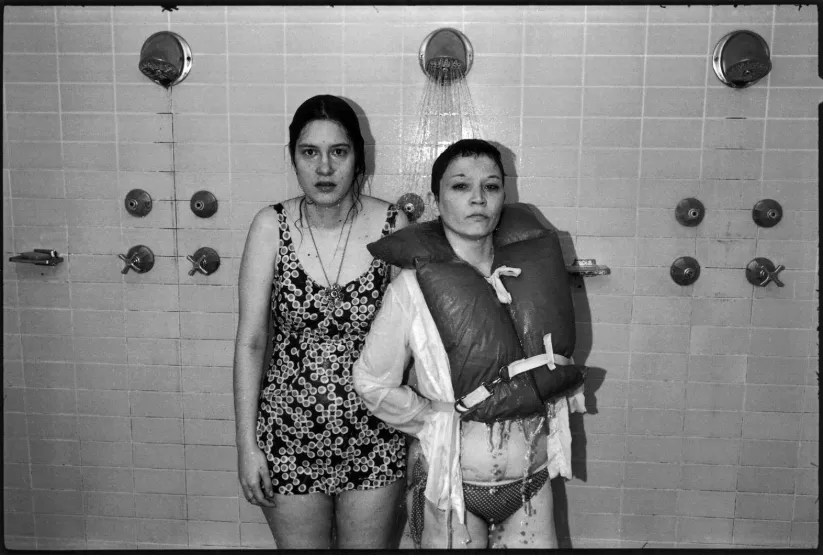
Through Mark’s considerate documentation we get the feeling that routine is vital and that volatile moments occur at random. In one particularly sweet image Mary Grace (1976), we see her in a state of jubilant expression as she beholds a lumpy clay object that looks like a cross between a sweet potato and a sex toy, and something about her laugh suggests that within minutes the same scene might have dissolved into bedlam. Among the more arresting images of this show are the strange scenes that capture affection among the women, such as “Mona and Beth in the Shower (1976). Here these two women are seen standing together in bathing suits soaking wet under a trickle of water in an institutional shower environment, Beth looking at the camera blankly and Mona posing defiantly with a chunky life jacket clinging to her body—is this what love looks like from the inside of trauma?

The overriding theme of “Mary Ellen Mark: Ward 81” is that of women and their complexity and power, and the compassion we feel for them, including Mark’s choice to honor an otherwise marginalized demographic. Mark was a gifted photographer who gave these (and other) women the dignity of their pure presence. In her lifetime Mark published 20 books and received 66 awards, a testimony to her outstanding output and creativity. Her artistic legacy is unwavering, and this show an exquisite rendezvous with the artist at her finest.
Related Stories


Center for Photography at Woodstock Moves to Kingston
This article appears in January 2025.


