










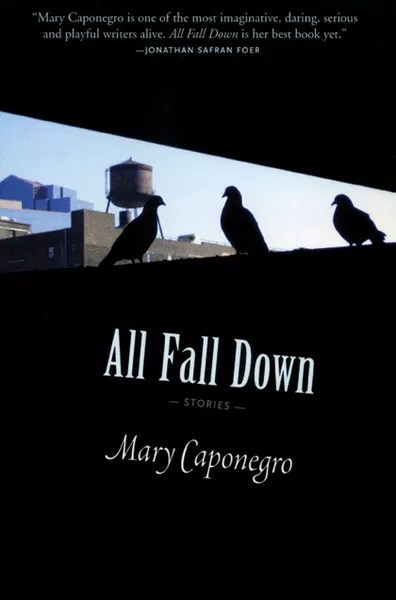
The characters in All Fall Down, the masterful new short-fiction collection by Bard professor and literary avant-gardist Mary Caponegro, are overburdened to the point of dropping, and the reader may also plunge into dismaying self-reckoning. Illness and spiritual crisis blend together, body and imagination come to cross signals, and epiphanies are like trap doors: A man who sleeps in the bed of his cancer-ravaged mother, so as not to wake his pregnant wife, rescues his young child after she has fallen from atop a stairwell. “‘Daddy, I’m bad.’ Daughter, I’m worse. I’m cursed, and by extension so are you.”
Rather than patiently unfolding, Caponegro’s stories are top-weighted with a relentless compounding of detail. Each sentence has a magnetic pull on our attention and ideas are fibrously interconnected. Her prose is wrought to the point of being almost distracting, and because of this, the revelatory zingers land with unexpected power.
Caponegro veers toward the comic at times, yet her humor is never sunny. At a creepy marriage therapy retreat, where a “cathartic” group activity is to pretend to murder one’s spouse and then write a eulogy, a husband cautions his wife not to choke lest he be deprived the satisfaction of “metastrangling” her. The wife, who long ago was wowed by her wisecracking husband’s college Lenny Bruce act, now is able to demolish him at every turn, “Subversive at 50 just doesn’t cut it, Norm. I hate to tell you.” In another story, one whose dark alterity might make Kafka seem like “Seinfeld,” Power Ranger-toting orphans run an abortion clinic—black “struction paper” covers the windows and “Scooby Doo” plays on the recovery room TV. One child asks the 12-year-old ringleader, “How come we never get to take Siamese twins apart or something cool like that?”
In Caponegro’s work, overarching metaphors govern the psyches of her characters in a fairly overt way, though at the same time, her attunement to the varied inflections of intimacy might seem to mark this writer as a closet realist. A woman remembers the “archival zone”—the initial months of a yearlong relationship that precede her athletic girlfriend’s falling victim to chronic fatigue—as a time “laden with long walks and protracted kisses, constant motion and surprises, unexpected but exciting gestures, every minute an adventure.” The sick partner in this novella-length story, titled “Ill-Timed,” is a Harvard-educated black woman who, when well, was a freelance instructor of recreational sports such as rock climbing and kayaking. For her, pre-illness is best recalled via her unfulfilled erotic fantasy of teaching her uncoordinated, albino lover to skydive. The cosmic correctness that this adrenalized embrace and motherly tethering suggest to her is overridden by her currently weakened state, that of “parachuting through viscid, grayish-brown hell.”
This couple, which has giddily sought to project its own “blatant” symbolism—“Our wedding cake has to be chocolate and vanilla, right? Don’t you remember?”—has been made all too aware of the master-slave reversal resulting from the alpha female’s declining health. Indeed, the multiplicity of oppositions the women themselves eagerly deconstruct may fatigue the reader.
The incarcerating clasp of language is a matter into which Caponegro obsessively delves, and readers are dropped down into the cell block. The book’s final story, “The Translator,” is a Nabokovian riff that mingles Lolita and “Pygmalion.” By a feat of exceptional erudition, it never strays into parody. A rococo afterward to the other stories, it bestows on them a radiant unity and delicate stasis that lingers.
This article appears in November 2009.


