









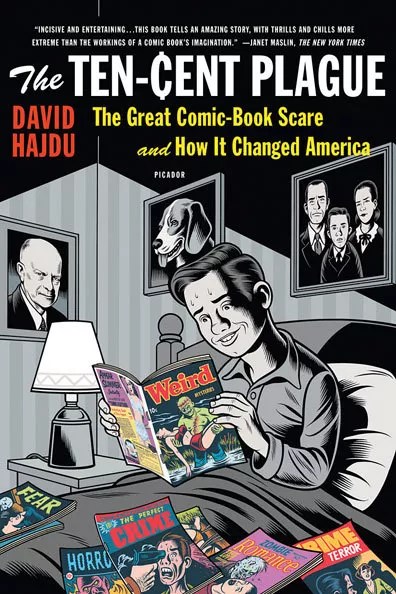
This surreal chapter in 20th-century American life is exhumed vividly and exhaustively by former Saugerties resident David Hajdu in the critically lauded The Ten-Cent Plague: The Great Comic-Book Scare and How it Changed America (Farrar, Straus and Giroux, 2008). For six years, Hajdu obsessively chased down legal documents, media evidence and surviving players in what he identifies as “the first battle of the cultural wars.” In exacting, lively prose, cultural historian Hajdu—a professor in the Graduate School of Journalism at Columbia University—recreates the era and its hysteria, as well as its cast of characters, with the same fetish for detail which distinguished his previous works: Lush Life: A Biography of Billy Strayhorn and Positively 4th Street: The Lives and Times of Joan Baez, Bob Dylan, Mimi Baez Farina, and Richard Farina.
Hajdu will read and sign The Ten-Cent Plague upstairs at Joshua’s Cafe in Woodstock on April 4 at 4pm. Sponsored by The Golden Notebook. (845) 679-8000.
David Hajdu: I used to live in Saugerties, so it’s kind of coming home to do this event, so I’m particularly excited about it. Full-time, Saugerties was my life for only about three years, but I happened to be working on this book the whole time. I did the bulk of the work on this book there, from 2001 to 2004. And before that, my wife and kids, we had a second home there. And what happened was that we realized we were idiots, and could not afford a second home. I don’t know what we were thinking, so – we moved up there full-time. Loved it there; it’s really very nice.
Jay Blotcher: Did your surroundings play a role in the writing?
I had a big old red farmhouse, right on the road on Old Route 32 in Saugerties. I had a little cottage behind the house that I rebuilt as a little writing studio. I got up every morning, drove down to the Hess station, got my coffee and the paper, and then drove back, so I simulated a commute. I looked out and there were deer and sometimes bears behind our house. That atmosphere – kind of warm, bucolic, peaceful atmosphere — really put me in a state of mind to have some clarity of thought to do this book. It was very important.
Did you come to The Ten-Cent Plague as much as a comic book fan as a journalist?
I’d make a distinction between a fan and a fan boy. The fist things I ever had published were illustrations; when I was a kid, I did cartooning. When I was in high school, I did illustrations for my hometown paper. I was raised in New Jersey. So I always drew and I always loved comics. But I wasn’t a completist or a collector by today’s standards. I wasn’t concerned if Issue No. 233 was missing of a run of a comic. But I loved the stories, so I really cared about comics; I always took them seriously. I have never felt that I was a part of the culture of comic book buffs; I don’t feel that when I go to a comic book store, and those guys were all talking about the current continuity in Marvel [Comics], I don’t really get that.
But I think that helped when I was doing this book, because the book is about a very different time when comics had a different kind of meaning. Everybody loved comics; comics didn’t appeal to an elite, as they do now. Comics weren’t an object of connoisseurship that they are now. The comics told great stories that touched everybody. This [book] is writing about a time were the most popular form of entertainment in the country.
How did telling the story of the crusade against comic books in America tax different skills as a journalist than writing Lush Life and Positively 4th Street?
Well, it’s a different art form. I wrestled [for] many years with the challenge of trying to do justice to one form of expression [of] music and another form of expression through writing the language. A lot of what I had learned about the imperative of trying to convey a sensory experience to the reader – the fact that you have to make it what it sounds like or what it feels like to experience the music – was useful in an abstract way. But in a more practical sense, it really wasn’t of much use at all, because music and comics have a completely different grammar and completely different aesthetics. There’s very little that carries over; music works one way structurally. So I had to learn how a whole new art form works, because comics are different from prose, and they’re different from drawings, and they’re different from movies. They’re a fourth thing; they work their own way. I really had to try to figure that out and try to do justice to it. That was one of the big reasons why I did the book: that it represented a challenge. It was an opportunity to do something that I didn’t know how to do. So there’s a kind of intellectual selfishness at work. Here’s an opportunity for me to learn something I don’t know. Something has to drive you for five or six years. I mean, I started this in earnest full-time around 2000. That’s when I finished Positively 4th Street. So I started; I made my first visits to Will Eisner [The Spirit], to Janice Valleau [romance comics artist] around then.
I have to tell you, there was someone I was trying to reach the whole time I was working on the book, who was in Woodstock. And I couldn’t get to her. I couldn’t find her. And she was literally a few miles away from me. It was maddening, because I had really taken pride over the years in interviewing people who were hard to find. I interviewed Thomas Pynchon for Positively 4th Street – it’s the only interview he ever did. I interviewed the guy who was driving the motorcycle that Richard Farina died on. Like the actual guy – the guy who was driving. For Lush Life, I found people who were working with Strayhorn in Pittsburgh before he met Duke, who nobody knew existed. And here, Virginia Hubbell, who’s the ghostwriter for [notoriously violent comic book] Crime Does Not Pay, was living in Woodstock. I didn’t find it out until she died. I was looking for someone named Virginia Hubbell, but I didn’t know she was down the road from me for years. It was heartbreaking.
But this persistence is part and parcel of your character?
Yeah, because I’m a journalist. I’m a journalist doing history. I don’t have any academic training in history. I apply the journalistic method to history. So I go out and try to find first-hand eyewitnesses of the events I’m writing about. That only works if you’re telling a story in recent history where witnesses are still alive. It’s a story in which the first-hand witnesses can tell you something that’s worthwhile; it’s not on the public record. So it’s not in the articles or in the books that have been written on the subject. For instance, for this book, you go a little further north – somewhere between Saugerties and Syracuse – and you land in Binghamton and you find this group of kids burning comic books [in the late 40s]. I spent quite a bit of time there. I went back and I found the location where the kids were burning the comics – to the grounds where the school was. I went to the site of the drugstore where the kids would get together and plot out their campaigns against comics. And I found a half-dozen of the kids that took part in the burnings, kids who were there. I did this a number of times. The comic-book burnings are hardly mentioned on the record in previous treatments of the debate over comics. They took place for ten years: from ’45 to ’55, all over the country. So one of my objectives was to really bring this horrific chapter of American history to life. And you can only do that [by] the journalistic method of finding the people and saying, What were you doing? What were you thinking? Why did you do this? What was it like? What did you see? What did you feel?
Then, there were other aspects of this story that had never been told, like the role of the Catholic Church in the early campaign against comics. And the legislation. I found there were 100 laws to restrict the sale of comics or to flat-out outlaw comics. A hundred laws! And news dealers were arrested for selling comic books.
So why the collective amnesia about this really dubious chapter in American life?
It’s funny; there’s not one answer. For a while, the answer was simple: that history belongs to the victors. For a good ten fifteen years, the full scale of the anti-comics crusade was forgotten because the bluenoses won at the end of the day. The losers’ side of the story was lost. That’s true in every war to a degree. Then the problem became later that the story was hidden in plain sight. There were hundreds of people who were driven out of comics, that had never worked in comics again, who felt so stigmatized that they were\ashamed to even admit they worked in comics. I open and close the book with this war memorial to people who never did comic books again. Hundreds of people who became ambulance drivers and dispatchers for the police force. His woman Janice Valleau never told her two kids she was a comic book artist. The reason we didn’t know this story is they never talked about it. In the end, they took up other lives. So they’re around. But because they’re not doing the comic book conventions, because they’re not doing interviews, nobody’s talking to them. So they’re all around us, but not talking about what happened. They were hidden in plain sight.
And the other issue was the documentation of the events. These events were very well documented in city council records, records of state legislatures. You know, who wants to go through those files? It’s a pain. And microfilms of old newspapers. None of this stuff was searchable; you couldn’t go up and search “comic book burnings” and see what you find. Or in state laws. Or even worse, municipal regulations against comic books. [They’re] a huge pain. This now gets into an area where I sound self-aggrandizing; I’m not trying to say that I did anything that was so special. All that it is old-school shoe-leather [journalism] – going through the files.
I have to tell you honestly: I didn’t use maybe 90% of what I got. I did about 150 interviews. And in some cases, I went back and spent days with people. I have thousands of pages of transcripts, and I didn’t even quote 7 or 8 out of ten people I interviewed. But I did all that just to try to fully understand the events so that I could write about this subject with some authority. I did a lot of it for my education.
In the course of interviewing some of the pioneering artists of the Golden Era, was there a memorable incident that simply did not make it into the book?
I heard in a public talk a comment from [Broadway composer] Stephen Sondheim – and I didn’t use this because this [concerns] an event that took place right after [the time frame] of my book. Otherwise, it would have been great. Sondheim talked about writing West Side Story, and his original idea for the opening scene was to have a musical number in the malt shop. And the opening number would be about them talking about comic books. They would sing a song about comic books. His idea was that would communicate immediately that they were juvenile delinquents. If they’re singing about comic books, they must be delinquents.
Were there any surprises along the way in your research that either undermined or strengthened your central thesis?
I didn’t go in with much of a thesis. There’s an interesting way to trace the history of this book: Go back and look at the writing I was doing while I was researching the book and read the little bio blurbs that ran for five years. They all describe a different book. They say: David Hajdu is working on a book about the early history of comic books. They never say that I was writing a book about the controversy over comics, or the hysteria over comics – that I didn’t really go into it thinking that’s what I was doing. I didn’t go in with conclusions in search of the evidence to prove them. I like to do something about this world that is very colorful and interesting and I would like to know more about. And what is there here that’s important. And then I found, after doing a few years of doing interviews, that this story about this hysteria I came to see was the first battle of the cultural wars. And it’s the forgotten battle of the cultural wars. And when I realized that, the book started to crystallize.
Comic book fans have an almost autistic command of minutiae. And they’re geeks. On your first book tour, were you verbally accosted by comic book fans that took issue with facts or opinions or the way you –
Yes! Well, yes and no. One – and I find this really disturbing – a lot of comic book fans come to hear me talk and don’t read the book. They feel like they don’t need to, because they’re such authorities that there’s nothing left for them to learn. So they come, wanting to pontificate, without any interest in reading what I’ve been trying to do, which is a little offensive. But now I sound like I’m knocking comic book fans. But then I had this awkward moment where I have a reading and someone asked me about Spiderman. What do you think about the translation of Spiderman to the big screen? And I said, To this day, I’ve never read a Spiderman comic. And there was this gasp. It was as if I had said, I’m from the planet Neptune. Or I’m Satan. I have a son who was 24 at the time, and he came up to me afterward and was shaking his head. And he said, Dad, you really blew it with that Spiderman question. And I said, Well, I don’t read Spiderman. And he said, Dad, Who was Superman’s double in the bottled city of Kandor? I said, Van-Zee, but there was a different double for Clark Kent. That was Val-don; there were two different doubles. So he said Dad, all you had to do was say: I don’t read Spiderman, I’m a DC guy. And then everybody would have understood.
You’ve said in interviews that for all his excesses in condemning comic books and their creators, Fredric Wertham had a measure of right on his side? Could you elaborate?
I absolutely refuse to be one additional person who makes Fredric Wertham the Lex Luthor of the comics [history]. I wouldn’t quite say he had right on his side. But I don’t think he was a person with malign intent. I think he did a terrible thing; he was not a sociologist, he was not a social scientist, he was a psychiatrist. He had a wrong methodology; he was not equipped methodically to make the kinds of conclusions he claimed to make. They were utterly dubious.
That’s the kind of ammunition that zealots always need; somebody who is a pseudo-scientist –
He wasn’t a pseudo-scientist; he was a scientist of the wrong kind. It’s like an astronomer talking about astrology. He was giving psychiatric treatment to a group of individuals, many of whom were troubled, and who read comic books. That is not reliable evidence to make the kind of sociological conclusions that he made. He didn’t have any control groups; he didn’t have a legitimate methodology. Also, he was an attention-grabber and much too sweeping in his criticisms of comics. He painted all comics as crime comics, no matter what they were; he brushed the tar much too broadly. He didn’t even consider that comics might have been an expression of the inner workings of their makers. He never gave that notion and credence in print. He did some terrible harm. That is not to say that he’s an evil guy. One of the reasons I resist making Wertham the big bad guy is that he was just on figure in a vast campaign against comics that mobilized the whole country. He didn’t even think about comics or write a word about them until 1948. That might seem kind of late because we have received conception of the comic books controversy; we think of it as a 50s thing. It was not; it ended in the ‘50s. But by ’48, it was well underway. The first major salvo of this war was 1940 – [children’s book writer and anti-comic crusader] Sterling North. Read what Sterling North wrote. All Wertham ever did was echo Sterling North. Then the church took up the fight; and there was another crusader by the name of Robert E. Southardt. But kids are burning comic books by November 1945. By 1948, there are 50 laws on the books against comics. Fredric Wertham doesn’t even come into the picture until then. By the early 50s, there’s one hundred laws on the books against comics, thousands of articles against comics. Fredric Wertham is just one guy. It’s a big mistake to reduce this whole thing to the workings of one misguided guy. That misrepresents the place that comics had in the culture and the place this debate had in the hearts and minds of America. The whole country was up in arms over this, and not just because of one guy.
Today’s graphic novels may not have the lurid aspects of Crime Does Not pay, but they can be extremely violent. Why is there no current hubbub on a par with the protests of the 40s?
When you compare the lurid content of comics to what else was available – not just for kids, but for young adults – there’s nothing so remotely lurid and graphic in any other medium in the 40s. Nothing was even close to it. There’s a lot of other stuff that violent and graphic and lurid today. So, graphic novels are of a piece with the culture today. “Last House on the Left” is about to be released. So what? They’re a part of a larger climate absorbed with violence and prurience today. Comics were practically alone in the cultural climate of their day. Much of the campaign against comics was couched as a way if protecting young people. It really wasn’t; it was really a way to protect grown-ups from their kids.
Comic books, heavy metal music, video games – all have been accused of undermining the moral fortitude of our kids. Why this cyclical demonization of the popular arts, taking them to task for our own social ills?
Yeah, right. It goes back to Plato. And Socrates was accused of the same thing. What we’re seeing is art doing its job; one of the functions of art is to challenge the status quo, to represent the shifts in moral and aesthetic values and to advance those shifts. That’s why the Athenians were all pissed off at Socrates: there’s always been an awareness on a deep level that art has a unique power. And that’s what’s so scary about it.
This article appears in April 2009.


