









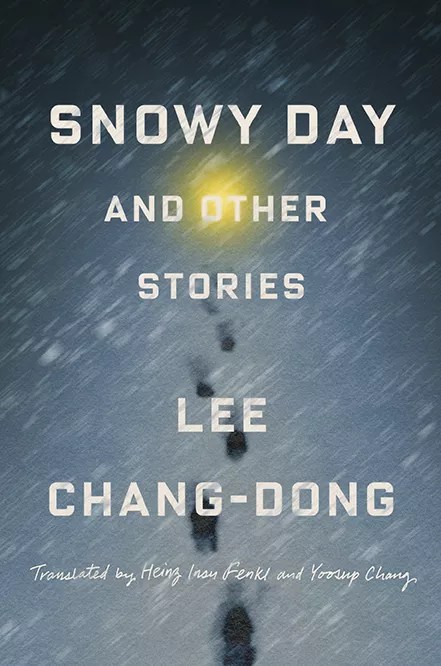
Heinz Insu Fenkl first read a story by Korean director Lee Chang-dong in the mid-80s. The director is best known for his award-winning films, which include Oasis, Peppermint Candy, Poetry and Burning (which was shortlisted for Best Foreign Language Film at the Oscars in 2019), but he also writes stories and novellas. Fenkl was so taken by the visceral quality of Lee’s imagery that he longed to one day translate the director’s written works. Accomplishing that goal would take a few decades. Snowy Day and Other Stories, Fenkl’s eloquent translation of Lee’s stories and novellas, will finally be published this winter by Penguin Press.
Fenkl, who speaks English, Korean and German, is a professor at SUNY, New Paltz, teaching graduate and undergraduate creative writing workshops in both fiction and memoir. He’s acquired a lengthy resume of scholarly translations and wrote the autobiographical novels Memories of My Ghost Brother and Skull Water. He did not publish his first translation of Lee’s work until 2007, when his translation of The Dreaming Beast appeared in Azalea: Journal of Korean Literature and Culture, published by Harvard’s Korean Institute. He finally met the director at a New York City retrospective of his films. Fenkl gave Lee one of his books and the director gave him a CD set of his films.
“I told him I would be interested in translating his work,” says Fenkl. “Lee Chang-dong is always really humble and he asked, why would you want to translate more of my stories? I’m so embarrassed that you translated that first one.”
For the next 12 years Fenkl was engaged in translating The Nine Cloud Dream, a 17th century Buddhist novel written in classical Chinese, which he learned as a graduate student at The University of California Davis. Lee and Fenkl met again at the premiere of Lee’s 2019 film Burning. This time Fenkl gave the director a copy of The Nine Cloud Dream.
“I told him I can finally translate your works,” says Fenkl. “He expressed both interest and also asked me again, why would you want to translate that stuff?”
The director gained insight into Fenkl’s motivation when he read a Korean translation of Memories of My Ghost Brother and a chapter of Skull Water, Fenkl’s novel about boys growing up around an American army base in Korea.
“Skull Water is set in the 70s,” says Fenkl. “He writes mostly about the mid-80s. So it took him back to his childhood days. After he read it, he understood why his work resonated with me.”
Fenkl hadn’t lived in Korea for years so he recruited former student Yoosup Chang to help keep the translation current and colloquial. They collaborated with Lee, who made suggestions.
“He was also very open to suggestions,” says Fenkl. “I think this is partially because he’s a film director. He understands the collaborative process.”
In both his films and stories Lee mirrors the fickle nature of fate, relaying the frailty of human nature with raw poetic imagery. Fenkl’s translation vividly captures the director’s cinematic narratives, stories shaped by Lee’s experiences during a turbulent era of South Korean history.
Translators have different styles, explains Fenkl. Some translate phrase by phrase, others sentence by sentence. He prefers to work on a paragraph at a time, but not before he’s read the entire book.

“The translation process is inherently interpretive,” says Fenkl. “You generally don’t know how to interpret a piece until you’ve read the whole thing.”
Staying true to an author’s intent can be a weighty responsibility and Fenkl says that after translating, writing is like “running without weights on your ankles.” He recently co-authored The Korean Myths: A Guide to the Gods, Heroes and Legends with his daughter Bella Myong-wol Dalton Fenkl.
“Bella and I divided up the sections, and oddly enough, she did the ancient stuff and I did the contemporary stuff,” says Fenkl. “She was not interested in Korean pop culture.”
Their book explores the role myths play in creating Korean culture, both in South Korea and North Korea. “It’s especially interesting because we can see culture actually being created,” says Fenkl. “Our mythology book covers North Korea, which other books don’t. A lot of these myth and folktales books pretend Korea is some monolithic culture or monolithic political entity, but we make a very clear distinction about the differences in culture.”
Fenkl is currently working on Baumholder, a memoir.
The Korean Myths: A Guide to the Gods, Heroes and Legends (Thames and Hudson) was released in the U.S. in November. Snowy Day and Other Stories will be released on February 18.
This article appears in February 2025.


