










I went to the very first movie of the festival, last Tuesday, an infectious documentary called 64 Days, directed by Nick Quested. The genesis of the film was the debate between Donald Trump and Joe Biden in 2020. The moderator asked Trump if he would denounce the Proud Boys, and Trump memorably announced: “Proud Boys, stand back and stand by.” (The next day, the Proud Boys were selling T-shirts with that phrase on it.)
Quested, who had made films in Syria, Venezuela, El Salvador, Nicaragua, and other crisis points, realized at that moment that there would be violence in the coming election. He began following the Proud Boys, centering on their charismatic top dog, Enrique Tarrio—a charming and thoughtful guy, for a fascist crank. Tarrio’s parents came from Cuba, and relatives of his were killed by Che Guevara, he claims. He hates leftists for a reason, in other words. His hulking followers became famous for going out into the streets and beating up members of Antifa, sometimes aided by info from a sympathetic police detective.
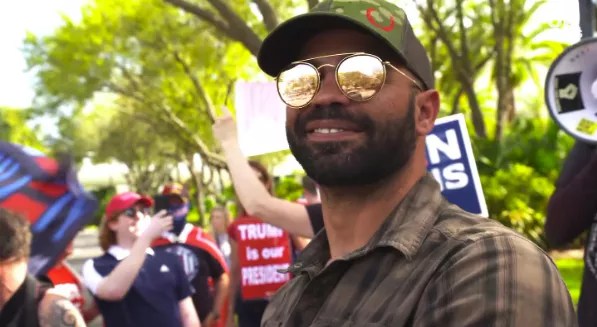
The film is a countdown of the 64 days leading to January 6, as the “Stop the Steal” movement was born and flourished amid the lies, wild theories, and disinformation spewed by President Trump, a muddleheaded Rudy Giuliani, and thousands of willing, enraged Republicans. Over it all hovers the supervillain-like rubbery face of Roger Stone, the (unproven) link between Mr. Big in the White House and the thugs on the street.
Even if you think you know everything about the nefarious plans leading to January 6—as I thought I did, from watching hours of Ari Melber on MSNBC—64 Days knits the whole story together like a Dostoyevskian novella.
“It made me cry,” the woman behind me said. “It was horrible.”

A joyous movie about political prisoners? Yes, that’s possible, at least in Brazil. I’m speaking about I’m Still Here, directed by Walter Salles (who made The Motorcycle Diaries). It’s based on the true story of Eunice Paiva, whose husband was arrested by the Brazilian dictatorship in 1971. She and her five children had to suffer the unnerving emptiness of Rubens’ unknowable fate. (And she herself was imprisoned for long weeks.) But the family refused to break.
While we watch this film, an American dictator is very close to seizing the White House. Will this story become our new daily life?
Seeing movies is the best way to travel—well, maybe the second-best way. It’s certainly cheaper than airfare, and sometimes you see more in a film than you do in a real country, where you sit lazily in a hotel with other tourists.
The Uninvited sounds like a horror movie, and it is, in a way—it shows the horror of upper middle class life in LA, where no one is quite beautiful enough, and toxic envy is ubiquitous.

The central character is Rose, a semi-retired actress—aged out of plum roles in her late 30s—mother of a charming four-year-old, savior of abandoned Labrador retrievers. Her husband, Lawrence, is a high-level, high-stakes, high-anxiety Hollywood agent.
They’re about to throw a big showbiz party when an elderly woman drives up to their house by mistake. “This is my home,” she says. “I don’t think so,” replies Rose. “I believe I live here.” But the uninvited newcomer wanders into the house to find a bathroom, and stays for hours, alternately speaking nonsense, reminiscing about her life, and offering priceless wisdom.
The party drags on, everyone gets drunker and drunker.… Well, I hate to give away plots.
Unbelievably, the movie is based on a true story, according to Nadia Conners, the screenwriter and director, who spoke afterwards. She was about to give a big party in LA with her husband, actor Walton Goggins who stars in the film, when an old woman drove up by mistake. How wise to turn a stray accident into a funny film!
When you see two movies in one day, they ricochet off each other. A gleeful, large Brazilian family mocks the high-prestige, low-empathy life in the Hollywood Hills. I’m Still Here made me wish I were living somewhere else; the LA movie made me happy I dwell in humble, heartfelt Phoenicia. Are all movies ultimately about geography?
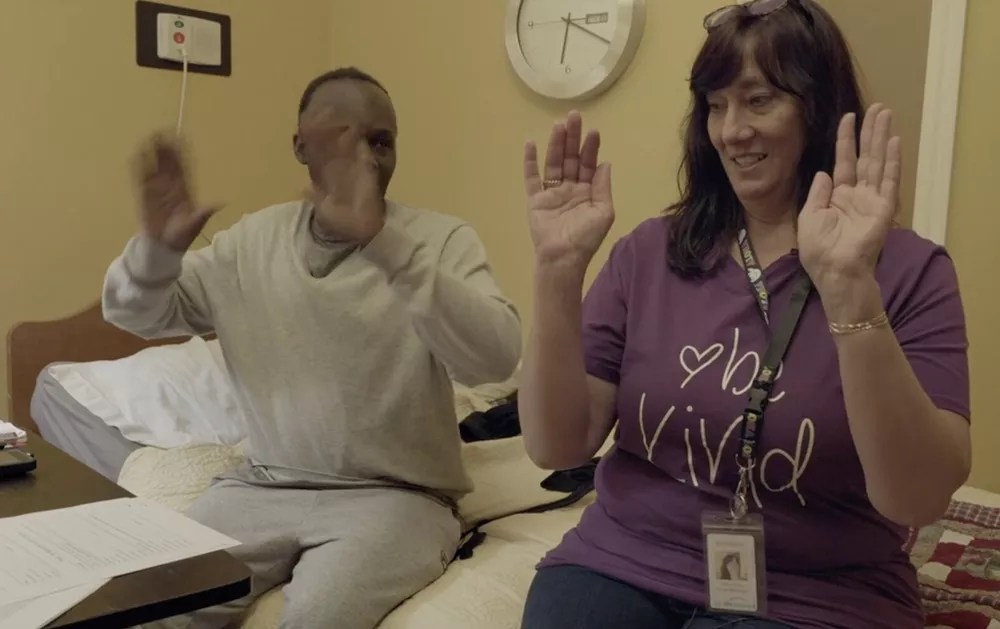
The Inn Between is a portrait of a hospice, which is also a rehabilitation facility, for homeless people in Salt Lake City. The filmmaker, Ondi Timoner, heard about the place on the radio, and visited, to decide if it might be worthy of a documentary. “I wanted to see if there were animals there,” Timoner explained, and there were: a fat pug dog, and a cat who sat on the shoulders of one of the social workers as she walked through the halls. The filmmaker spent a year making the film—shot 500 hours, if I remember correctly—and recorded a number of the residents’ stories.
How easy it is to become homeless! Sometimes a natural disaster is the cause, sometimes a divorce, sometimes an unexpected illness. In this country, almost anyone can fall out of their home, and become a grimy street-dweller!
And even after you’ve been saved, by a place like The Inn Between, your dreams are still tormented by the brutal trials of homelessness (according to Patty, one of movie’s heroines).
I never would’ve watched this movie if my friend Alex hadn’t invited me. Thank you, Alex!
At the headquarters of the film festival, I met Sofian Chouaib, codirector of a short film called Ya Hanouni. We spoke for a half hour in French, about Morocco, where Sofian was born (Casablanca), about Paris, where he now lives, about Islam, about my studies of French—but I forgot to ask him about his film—though I see that the catalog summarizes it thus: “A competition arises between two parents to make their baby say their first word.” How I love to speak French!

Porcelain War reminded me of my absolute favorite film: The Battle of Algiers, where actual freedom fighters played a fictionalized version of themselves. This was a true documentary, made by two artists in Ukraine who are fighting for the nation’s freedom. Slava Leontyev makes small porcelain figurines, which his wife, Anya Stasenko, decorates with dreamlike watercolors. But now S also trains civilians to be sharpshooters, and Slava sometimes paints the drones the soldiers use. They both hate killing, but they understand Ukraine’s struggle. Porcelain War is about the role of art in national liberation.
Each movie that I see seems like the best movie of the festival – perhaps the best movie of my life!
Blitz (directed by Steve McQueen, who made 12 Years a Slave) was a bit of a letdown. I’d heard it was a war movie, which sounded enjoyable, but after seeing lots of eccentric films (I don’t like the word “independent”—what exactly does it mean? Independent of what?) it seemed both too logical and too sentimental.
The film had surprising historical detail about the London Blitz of 1941—there were puppet shows in bomb shelters!—and visual panoramas, but the story itself was a bit trivial, the camerawork unsatisfying.
Particularly after the ceaseless inventiveness of the “Fiercely Independent Animation” program, which included Claymation, stop motion photography, anime-style stories, films that resembled moving paintings. My father used to say: “A movie should move,” and no movie moves like a cartoon. This artform displays the poetry of incremental mutation.
I interviewed Dusty Grella, the creator of 20 Years of Notes to Self, one of the animations. “It’s about a project that I started in 2003 where I write myself a letter every day. So I’ve got 7,000 of these, 8,000 maybe, letters that are still sealed, and chronologically archived, and I scanned each of these letters, and then play them back at two frames per second, so it makes an 11 minute film. And the audio, I’m narrating stories about the project. So you’re watching the address, the return address, you’re watching the stamps jump around…”
(Also, a couple of the documentaries used animation: Porcelain War and The Inn Between. In the first, Anya, the artist who paints porcelain, animated her drawings to show fantasy scenes of giant snails, tiny people, balloons, roadways—and war. In the latter, residents of the group home describe their visions of the afterlife, depicted in dreamlike black-and-white cartoons.)
Every year, the Woodstock Film Festival gets better. But this year, for the 25th anniversary, it was extra-strength!
I’m pretty sure this was the most movies I’ve ever seen in five days. Afterwards, my mind was overflowed with bulging images. It was like walking through a shopping mall and interviewing every single customer—then following them into their homes. For the next three months, no more films!
This article appears in October 2024.


