








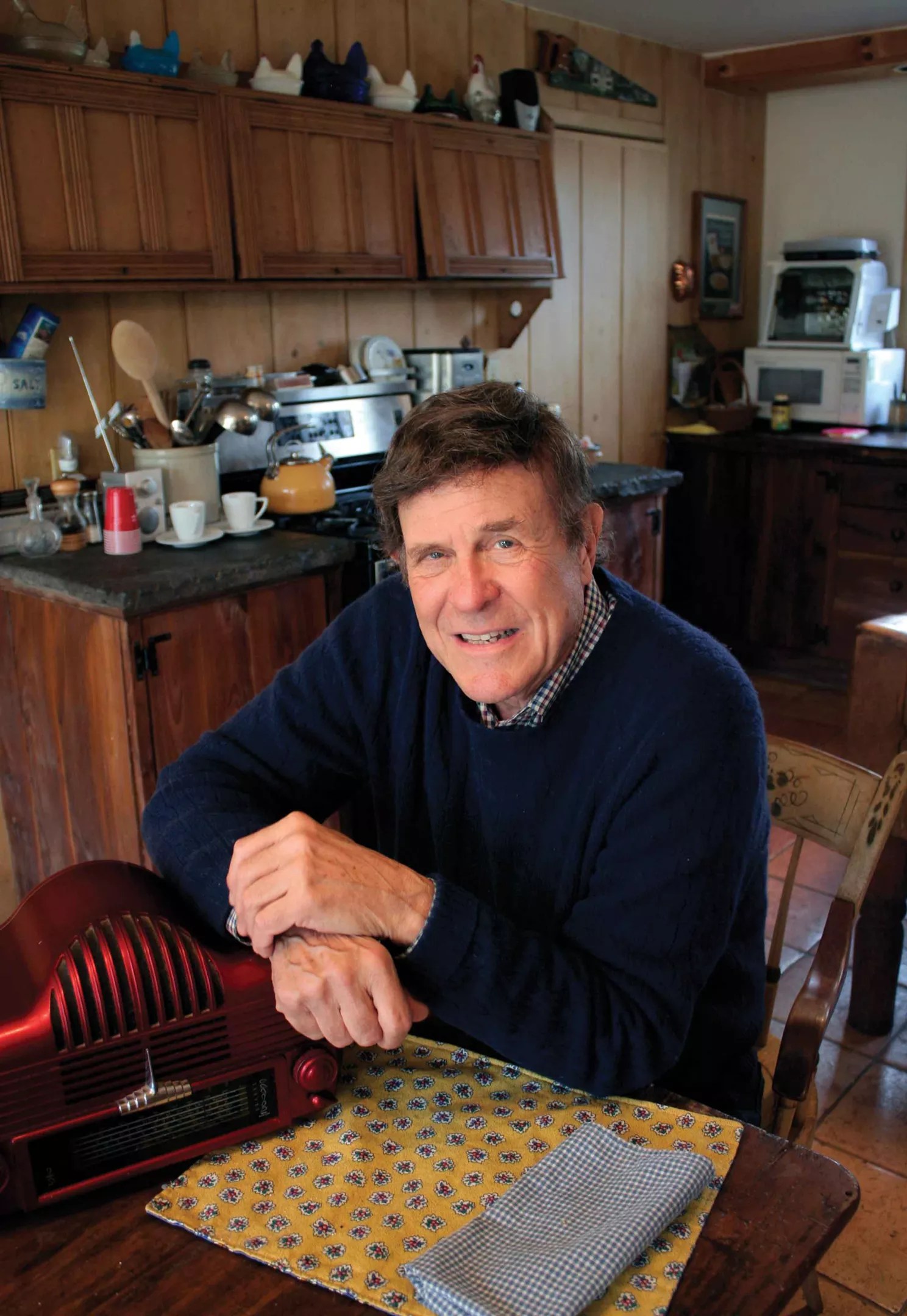
If at first you can’t quite place the smiling face, the sweater might say “uncle” rather than “cousin.” But the sunny voice is a dead giveaway.
“I was what you’d call an ‘Alan Freed baby,’” he says, referring to the daddy of all rock ’n’ roll DJs, the one most often credited with taking African-American rhythm and blues to the white masses in the early 1950s. “As a teenager, I’d go up to WINS to watch him do his radio show. I’d bang my hand on the studio window and press my face up against the glass. I told him I wanted to be on the radio. But he told me [affecting a gruff voice], ‘Kid, this is a boring business. Take it from me, you don’t wanna do this. Go back downtown and work for your dad.’” He laughs. “But for some reason, even though he was my idol, I still didn’t listen to that advice.”
If he had, there’s no doubt the medium of radio—indeed, the story of popular music in America—would have been radically different. Because the speaker is “Cousin Brucie” Morrow, a broadcasting icon for more than 50 years and for multiple generations the very beacon of rock ’n’ roll’s biggest hits. Since coming into his own as the British Invasion struck land, for baby boomers Morrow has been, literally, the vocal champion who soundtracked the big break from the polite pop of their parents’ era and the staid culture that went along with it. As he tells it in his new book Rock & Roll… And the Beat Goes On (Imagine! Publishing, 2011), it was a schism that developed into rock’s many subsequent iterations. But before their hit songs became today’s “oldies” repertoire—a format Morrow has come to personify—the decades from the ’50s to the ’80s unspooled in a turbulent, perspective-shaping fashion. And as they did, “Brucie” was the omnipresent, genial gatekeeper. For most kids on their way to join the workforce, raise a family, and quietly assume the mantle of adulthood, the fun-filled hits of the day were simply that. For many, however, the Top 40 was something more. It was a steady stream of seeds that inspired them to dig deeper into music’s unheard, forbidden grounds—whether to find out more about where the new sounds came from, or simply to do something different than what they were hearing. And, in many cases, to go on to make their own music.
Morrow was born in Brooklyn in 1937 as Bruce Meyerowitz, the son of a Lower East Side children’s clothing manufacturer. “Brooklyn was one of the greatest places to grow up in,” the disc jockey recalls. “What made it so great was the diversity of the neighborhood. I got to know people of all races and financial and educational backgrounds.” While there was music in the house (“Sinatra, Rosemary Clooney, Mario Lanza, okay pop-era stuff, I guess.”), Morrow emerged as an entertainer-personality well before he became a music fanatic. “I was a shy kid,” he says, inconceivably. “Until my English teacher cast me in what they called a ‘hygiene play,’ which was something used to teach sex education, as well as more mundane health-related stuff. This one was about dental health, and I played a cavity! [Laughs.] But when I got on stage, something happened, and I loved it. Then one afternoon I saw my mom and the neighbors gathered around the radio, moved to tears by the news of FDR’s death. The way radio could reach people in such a powerful, human way like that really made a light bulb go on for me.”
In 1953 Morrow enrolled in New York University’s Communication Arts program. While attending the school he also founded, almost singlehandedly, its first radio station, a campus-only setup that later became indie-music powerhouse WNYU. There, he delivered the news and played classical music, but outside of his duties he was being overtaken by a more savage sound.
“I listened to Martin Block’s [big-band-oriented] ‘Make Believe Ballroom’ on WNEW,” says Morrow. “Every once in a while he’d play a rhythm and blues record, Big Joe Turner or somebody like that. This wild, ‘naughty’ music. My friends and I would just go, ‘Wow, what is this stuff?!’ And then in 1954, Alan Freed, who’d gotten a huge audience by playing this so-called ‘race music’ on WJW in Cleveland, came to New York to go on WINS. People say he came up with the name ‘rock “n” roll,’ but that’s not really true: He just popularized it as a new name for R&B.”
In 1957 Bermuda station ZBM-AM, eager to have its own Freed-style jock, gave Morrow his first professional slot. After spinning there for a year he fulfilled his adolescent dream by landing a job at WINS, initially as a producer. His big New York break finally came in 1958, when he filled in for a regular DJ, and soon earned a permanent position that found him smack in the middle of the burgeoning rock ’n’ roll explosion.
Although he’d invented the Morrow moniker as a teen, the familial first part of his handle came from a stranger. “I’d just started DJing at WINS—it must’ve been about 1959,” he remembers. “I was on one night, and the security guard let this old, homeless woman—not exactly my age demographic then—into the studio to say hello. She asked me, ‘Sir, do you believe that we’re all related?’ I figured it was some kind of a line, but I said yes anyway. So then she said ‘Well, cousin, can you lend me 50 cents to get back to the Bronx?’ And the way she said it just made me go, ‘Hmmm.’ I gave her the money but I never saw her again, and she never paid me back!” [laughs]. Its genesis aside, the appellation is perfect for the warm, conversational style of Morrow, who famously addresses his listeners as “cousins.” In his ebullient persona one glimpses the vanishing vapors of the vaudeville tradition, and it can be convincingly argued that his jovial presentation did almost as much to sell rock ’n’ roll to America as the songs themselves.
“Brucie always feels like your pal,” says Handsome Dick Manitoba of punk legends the Dictators, who grew up in the Bronx listening to Morrow and now hosts his own “Handsome Dick Manitoba Radio Program” at the elder DJ’s current network, Sirius XM Radio. “Turning on the radio and hearing him light up the room is like ringing a friend’s doorbell. You think, ‘I know him.’”
As Morrow’s stature as an on-air force grew, many of rock’s early movers also got to know him. Well. Elvis Presley was one. “He was such a nice guy,” Morrow says. “He’d call me up, long distance, and say [adopts Elvis voice], ‘Suh’—he never called me by first name—‘Suh, I just wanna thangya fo’ playin’ mah records.’ Very humble man, Elvis.”
After a year, Morrow decide to give Miami’s WINZ a shot and left WINS. But by 1961 he was back in New York at WABC, where he really began to define himself as rock ’n’ roll’s ringmaster. His time hosting the station’s popular revues at New Jersey’s Palisades Park prepared him for another date with destiny, this one as the man who introduced the Beatles at the group’s landmark Shea Stadium concert on August 15, 1965. “Sixty-five thousand people!” says Morrow. “The noise from the crowd was just deafening. It was really pretty scary, that much electricity in the air. Before they played, even the Beatles themselves were starting to worry about there being a riot. Lennon, especially, seemed very nervous. He asked me [in a Liverpuddlian accent], ‘Coozin, is this gonna be okay?’ I tried to look calm and I told him, ‘John, it’ll be fine! They’re all just excited to share the space with you guys.’ Ed Sullivan was also hosting the show, and he was really freaked out. He was just this older guy who never really understood all the excitement over the Beatles. When he and I were about to walk on stage in front of this mass of screaming kids he turned to me, just shaking and perspiring, and said, ‘What do we do?!’ I decided to have some fun with him, and I looked straight at him and said: ‘Pray, Ed. Pray.’ His eyes bugged out! [Laughs.] No one could hear the band, but the show went fine.”
As that decade rolled into the next Morrow’s ubiquitous presence as the voice of rock ’n’ roll grew well beyond the New York Metro area. Thanks to WABC’s high wattage and the atmospheric phenomenon called “skipping,” at night his broadcasts could be picked up clearly in the Deep South and parts of the Midwest and Canada. In 1974 he replaced another late rival, Wolfman Jack, at WNBC, where he remained until 1977 before leaving to cofound the Sillerman Morrow Broadcast Group, a chain of radio stations that included Middletown’s WALL and WKGL (now WRRV), Hyde Park’s WJJB (now WCZX), and Northampton’s WHMP. By then, Morrow’s reputation and distinctive delivery had also begun attracting TV and movie agents. While he’s starred in the Beatles-themed Sgt. Pepper’s Lonely Hearts Club Band (1978) and Across the Universe (2007), his most celebrated turn came as the magician in 1987’s blockbuster Dirty Dancing. (Morrow will reenter the acting world this month for a limited run—May 3 through May 8—in the Broadway musical Memphis.)
In the early ’80s he returned to New York’s airwaves, signing on with one of the nation’s first all-oldies stations, WCBS-FM, to host the nationally syndicated “Cruisin’ America” and other shows. But the decade also saw the rise of homogenized formatting at odds with the Brucie brand of “human radio.” “Radio is supposed to serve the public’s best interest,” he explains. “But it was becoming less about the listeners, and more about serving greedy advertisers. Advertisers are important, but people still need music as a break from their lives. Just to be able to dream a little.”
Morrow stayed with WCBS-FM until 2005, when the station began its controversial—and ultimately failed—experiment with a virtually announcer-less, computer-run system. Soon after, he inked a long-term contract with Sirius XM Radio (formerly Sirius Satellite Radio), where since 2010 on the network’s ’60s on 6 channel he’s hosted the live “Cousin Brucie’s Saturday Night Rock & Roll Party” (Saturdays at 8pm EST) and “Cruisin’ with Cousin Brucie” (Wednesdays at 5pm EST; repeated Sundays at 3pm EST). Whereas many old-school DJs might be decry non-terrestrial radio, Morrow embraces it with evangelical gusto. “Digital and satellite technology have made this the best time ever in radio, especially with the variety of music,” says Morrow, who waxes with similar zeal about his new iPad. “I have instant access to an endless library of songs, and I can have a song ready to go instantly. A listener can call in and ask for a song that was maybe a local hit but never made the national charts, and right away I can play it for them. It’s incredible!”
Morrow has three grown children, and he and his wife, Jodie, divide their week between their Manhattan loft and the 1774 Stone Ridge farmhouse they purchased in 1997. For someone who makes his living with his voice, Morrow has a keen eye from behind the lens; a gifted photographer, he’s even exhibited the breathtaking travel photos filling his walls at a few Upstate venues. His foray into authordom began with his 1987 memoir, Cousin Brucie: My Life in Radio (Beech Tree Books), which was followed by 2007’s best-selling coffee-table tome, Doo Wop: The Music, the Times, the Era (Sterling; now out in paperback). Released in March, the colorful, photo-filled Rock & Roll… And the Beat Goes On charts the arc of rock from its rumbling ’50s dawn to the mellow ’70s, interspersing artist profiles with segments on pop culture and historic events. “It’s really a book about life, not just music,” says Morrow, who’s been inducted into the National Association of Broadcasters’ Radio Hall of Fame, the Broadcasting & Cable Hall of Fame, and the Radio Hall of Fame; honored by the Rock and Roll Hall of Fame and Museum; and seen New York’s West 52nd Street renamed Cousin Brucie Way, in 1994.
But although he revels in expressing himself through other media, after so many years for Morrow it’s still radio that rules. “When I get on the mike, my belly warms up and I get this electricity in my whole body,” says the broadcaster. “I just love it!”
Rock & Roll…And the Beat Goes On is out now through Imagine! Publishing. www.charlesbridge.com.
This article appears in May 2011.


