








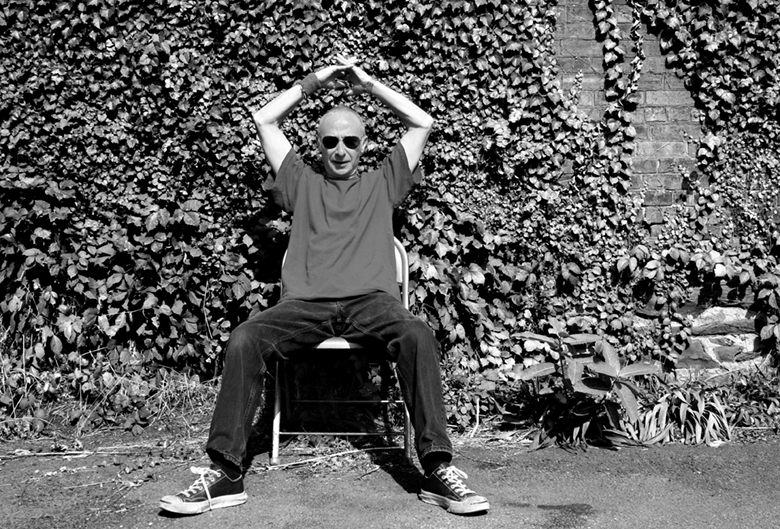
The world of a rock ’n’ roll fan can be a strange and confusing place. Idols you assumed were immortal pass away, quit, or sell out. Songs you once held sacred and figured only a handful of other people even knew about end up being used on TV to hawk everything from cars to cruises, soap to Swiffers. And sometimes, if you happen to be a music journalist, it gets even stranger. You play the hell out of someone’s records in your bedroom—really loud, of course—to piss off your parents when you’re a teenager and, almost 30 years later, you’re sitting across a table from the person who made those records, sharing fragments of an oatmeal raisin cookie. Strange, but sweet.
Graham Parker was tossed in with the English punk and new wave eruption, but in truth his career predates it. His fiery first two albums, Howlin’ Wind and Heat Treatment (both released in 1976)—cited by Rolling Stone’s Greil Marcus as being “among the very finest of the decade”—actually preceded and influenced the debuts of his fellow enfant terrible troubadours, Elvis Costello and Joe Jackson. Today, however, at 56, the gregarious father of two would no longer seem to be the quintessential angry young man of yore. He cracks jokes, shares eye-rolling war stories about being stuck opening for Journey and Lynyrd Skynyrd in the Midwest back in the day, talks about planning his current touring schedule around the soccer season (both he and his 11-year-old son play in local leagues). But his recent music tells a very different story.
On Parker’s latest album, the magnificent Don’t Tell Columbus (Bloodshot Records), tracks like the celebrity gossip-baiting “England’s Latest Clown” and the biting, darkly comical Bush-slam “Stick to the Plan” boil with as much merciless bile as any of the vitriolic tunes on his classic early LPs. And, this being the Noughties, Parker has also begun to pour out his trademark bitter spleen online, offering download-only tracks via his website, such as the now doubly and sadly outdated Iraq War commentary “2,000 Funerals” (released just last year) and the forthcoming “The End of Faith,” which was inspired by the religion-questioning writings of Sam Harris, Richard Dawkins, and Christopher Hitchens. Rest assured, Parker still sounds pissed.
“Oh, there’s always something to get mad about,” says the wiry, perpetually sunglassed singer, who maintains that to him getting angry is “like falling off a log. The other [nonangry] stuff is the hard stuff to write.”
Gray, rainy London in the early 1970s was an easy place in which to be angry. The deep-seeded British caste system left a young person with very few career options. Before he turned professional, Parker worked at a glove factory, a bakery, a gas station, and even as a mouse and guinea pig breeder at the Institute for Animal Health (“The very place they just traced the recent foot and mouth disease epidemic to!” Parker says). And, on top of that, the prevailing music pretty much sucked.
“I had been a mod, into soul music, and then I went through the whole psychedelic thing,” recalls Parker, who grew up in the suburban village of Deepcut. “But by ’73, ’74, it was all this terrible prog rock—Rick Wakeman and all of that crap. I was listening to The Band, the Stones, and Van Morrison instead, and I’d also rediscovered the Tamla/Motown stuff, which sounded a lot fresher than Yes. I was living with my parents, writing hundreds of songs.”
After sharpening his chops in a couple of cover bands, by 1975 Parker was shopping demos of his own tunes to labels. Future Stiff Records founder Dave Robinson got him a deal with Mercury and helped him put together The Rumour, a crack backing band comprised of musicians cherry-picked from various groups of the UK pub rock scene, the back-to-basics R&B-fueled movement that directly prefaced punk. “People write that I was part of the pub rock thing, but that’s not really true,” Parker says. “Pub rock was done by the time The Rumour started. It was more a case of ‘guilt by association,’ since [Rumour guitarists] Martin Belmont and Brinsley Schwarz and [keyboardist] Bob Andrews came out of that.”
With The Rumour, the rasp-voiced Parker worked up a brand of tough, lean rock ’n’ roll that combined his beloved soul/R&B, Van Morrison, and Rolling Stones influences with the accusatory edge of Bob Dylan (“Actually, early Dylan wasn’t that big of an influence—I didn’t really get into him until right around then, with [1974’s] Blood on the Tracks.”). After the Nick Lowe-produced Howlin’ Wind and Heat Treatment, Parker cut two more albums for Mercury before jumping to Arista. There, he made his flawless masterpiece, 1979’s Squeezing Out Sparks, which sold over 200,000 copies, is repeatedly acknowledged as one of rock’s finest albums, and contains his signature hit, “Local Girls.” The follow-up, 1980’s The Up Escalator, featured a guest appearance by fan Bruce Springsteen (who famously said Parker was the only artist he would pay to see), but it didn’t sell nearly as well. After two more shots with the Rumourless Another Grey Area (1982) and The Real Macaw (1983), Parker was dropped from Arista.
From there it was a bumpy ride through major-label hell. Parker bounced from one corporate behemoth to the next, along the way cracking the Top 40 with 1985’s “Wake Up (Next to You),” charting high on college radio with 1988’s “Get Started (Start a Fire),” and pleasing his fans—but still not moving enough units to keep the colossi happy. After 1991’s acclaimed Struck by Lightning (RCA), which featured guest work from The Band’s Garth Hudson, and 1992’s unheralded Burning Questions, the buck-chasing big leagues were done with Parker and he was done with them. He made the leap to indiedom in 1994, releasing the return-to-form 12 Haunted Episodes (Razor & Tie) and a consistent string of other well-received discs.
So does he ever long for the high life of the majors? “Only their budgets,” he chuckles. “It was great to have, like, $300,000 to make an album. If you wanted, say, a horn section, you could get one. But, really, the amount of waste that went on was just unreal. Still, even though independent labels don’t have that kind of money, my records actually sound better for it—more down-to-earth, more immediate. Plus, [indie labels] let me do what I want and they really believe in what I do. Which is just fantastic.”
One of the labels that really believes is Chicago’s Bloodshot Records, with whom Parker has been enjoying an outright career renaissance starting with 2004’s roots-oriented Your Country and continuing with 2005’s Songs of No Consequence and Don’t Tell Columbus, albums trumpeted as his best since the glory days of The Rumour.
“It’s really an honor to work with someone of the caliber of Graham Parker, who just has such an amazing history,” says Bloodshot owner Nan Warshaw. “Especially when he’s at the top of his game, like he is right now.” The relationship began when Parker teamed up with the Waco Brothers (featuring ex-Rumour drummer Steve Goulding) for a track on the label’s five-year anniversary sampler album. “When Graham had recorded Your Country, he thought we might want to put it out, since our label has been so involved in the underground country movement. We loved it, and things just evolved from there.”
Another crew that’s honored and ecstatic to be working with Parker is Saratoga Springs-born power-pop quartet The Figgs, which has toured and recorded as Parker’s backup band on and off since 1996. “Playing with Graham is really great,” says Figgs guitarist and singer Mike Gent, 36. “He’s such an easy guy to work with. He even lets me write the set list some nights, or make suggestions about which studios to use, stuff like that. He seems to trust me because he knows I know his music—I mean, my dad had his albums when I was a kid. It’s really kinda cool.” Besides backing Parker with The Figgs on Songs of No Consequence and 1997’s live The Last Rock N Roll Tour (Razor & Tie), the versatile Gent co-produced and played drums and guitar on Don’t Tell Columbus.
A Woodstock resident since 1988, Parker generally doesn’t bother with the local gigs. “There’s [usually] some weirdness that happens when I do a show around here,” he says. “Because there’s a lot of weekenders up here [who might not] even know there’s a gig happening, a show can fall between the cracks. It’s funny being able to pack out some place in an obscure part of New Jersey and only get half a crowd in your own backyard.” Nevertheless, a nature fiend, he adores the region and compares it to the wooded village of his youth, his own modest plot to the grounds of an English lord. In the winters, he explores his newfound love of skiing, and cultivates a longer-held, music-rivaling passion: fiction writing.
The author of three books, The Great Trouser Mystery, Carp Fishing on Valium, and The Other Life of Brian, Parker finds prose writing infinitely more challenging than songwriting. “A song is just one or two pages of words,” he says. “With fiction, it doesn’t have to rhyme, thank God, but I always end up going back over it, rewriting and reworking things. But when I hit a vein and get on a roll, that’s exciting.”
Some heady excitement arrived last year when the Bard himself, Bob Dylan, praised Parker’s songwriting on his “Theme Time Radio Hour” XM satellite show. “It was a lot of fun hearing Dylan drawl my name and play ‘Back to School Days,’ but, as is typical of my career, something was a bit off about it,” Parker says with a laugh. “He played a demo version, not the studio one from Howlin’ Wind, and mentioned the names of The Rumour’s guitarists—but they didn’t play on the demo!” Parker’s atypical career is also the subject of a documentary, now in production, by Michael Gramaglia, who directed 2003’s stellar Ramones film End of the Century.
Looking back over that same lengthy, unusual career, is there anything Parker wishes he’d done differently? “Well, sometimes I wish I’d done more to have a Top 10 hit or two,” he sighs. “At this point, those could be bargaining chips, so the promoters in Nebraska or Sioux City, Iowa, who also happen to be fans of my music can get people out to shows and not worry about losing their shirts. But I was too bloody-minded back then—I didn’t care as much about having hits as I did about making great rock’ n’ roll.
“I never thought I’d still be [playing music] at my age, let alone making records as good as Don’t Tell Columbus. But I’m a better person for having not let my talent go to waste. It was too seductive to become like the people around me when I was growing up, to stay in some lousy job and end up sitting in a pub, drinking instead of writing songs.”
A world without the songs of Graham Parker? Now that would be something to be angry about.
Chronogram and WDST will present an evening with Graham Parker at Muddy Cup in Kingston on November 10. www.grahamparker.net.
This article appears in November 2007.


