









All around the world, curators are questioning the idea of a museum. Can it be something besides a Hall of Fame for deceased white men? Artworks that were purchased years ago and shelved are now seeing the light of day—or at least the fluorescent lights of a gallery. The Loeb Art Center at Vassar College addresses this rethinking with “What Now (Or Not Yet),” an exhibit that juxtaposes well-known “hits” of its collection with new items and borrowed works. Represented are artists from Chile, Kenya, Germany, Jamaica, Cuba, France, and South Korea, as well as this nation. The show opened on January 21.
One of the mainstays of the Loeb collection, Marsden Hartley’s Indian Composition (1914), appears in the same room as two works by Sky Hopinka, a contemporary Native American artist. Hartley’s work, which was painted in Berlin, is a collage-like array of colorful symbols, including a stylized teepee. Hopinka inscribes prayerful messages (such as: “Free me from this body, my voice can carry only so far”) on photographs of clouds. Perhaps these are visual puns on the cloudlike “thought balloons” in comic strips. Last year, Hopinka received a MacArthur Fellowship, the so-called “genius grant.”

The image on the poster for the show also has a Native American theme. Martine Gutierrez’s Girlfriends (Anita & Marie 7) (2014) is a photograph of two women dressed in traditional indigenous buckskin, hitchhiking together on a desert road. In fact, one of the hitchhikers is Martine, who is a trans woman, and the other is a mannequin. The “girlfriends,” with their glazed expressions, makeup, and brand-new clothing, resemble Vogue models—but does this picture also protest the dispossession of Native peoples?
The installation Untitled (L.A.) (1991) by Felix Gonzalez-Torres consists of “green candies, individually wrapped in cellophane, endless supply,” to quote from the checklist: free treats on the floor, for any visitor to have. Torres died in 1996 from AIDS; it’s nice to see his generosity continue.
“Art at Vassar has always been contemporary. The bequest from Matthew Vassar in 1864—he gave over 3000 paintings and prints that seeded the collection—was by Hudson River School painters, who were still living,” observes John Murphy, curator of prints and drawings. “Vassar wanted students here to see original works of art by living artists. And that’s something we’re continuing today.”
One of the new acquisitions is Dorothy Tanning’s To Climb a Ladder (1987), a column of flesh comprising disordered body parts, which don’t evoke the bathtub of a serial killer so much as a gleeful orgy. Tanning produced the surrealist canvas when she was 77.
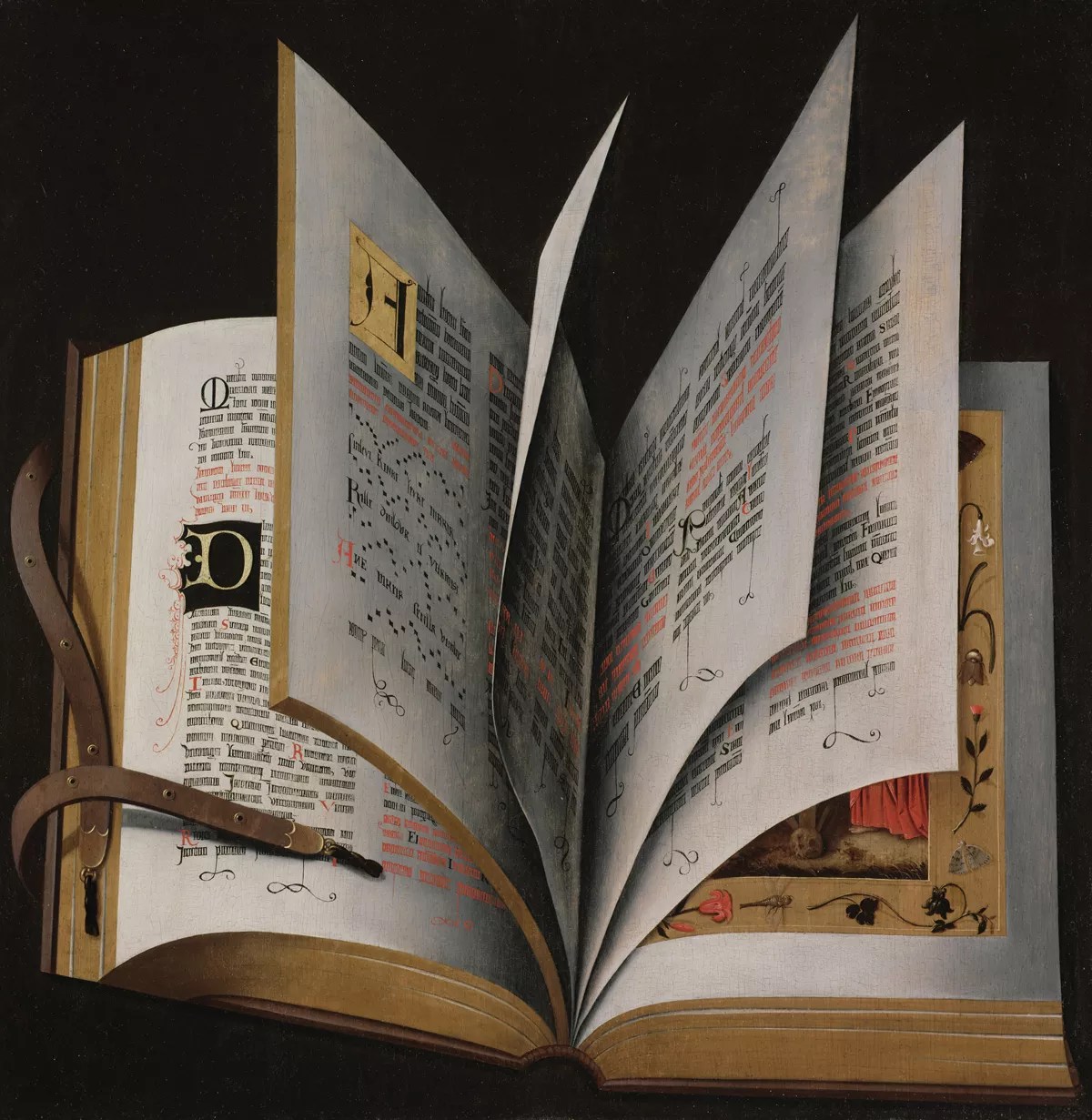
“What Now (Or Not Yet)” fills three rooms, divided into the themes of past, present, and future—but the themes are metaphoric, not literal. In the “future” room, for example, is a 16th-century painting by Ludger tom Ring: The Open Illuminated Manuscript (circa 1570), a thick trompe l’oeil book, its pages being turned by an invisible hand. In the same room are photographs by the African-American artist Arnold Joseph Kemp, from the series “Possible Bibliography” (2015). In each of them, Kemp’s hands hold—almost caress—a book he admires. With just his left hand, for example, he brandishes Angela Davis’ Women, Race & Class. (Does his left hand symbolize the left?)
“What Now (Or Not Yet)” is a strange name for an exhibition, and the show itself has some eccentricities. Midway through the exhibition, a committee of students will rewrite the captions, reorder the pieces, and possibly devise an even stranger title for the show. That second version of the exhibit opens May 27.
This article appears in February 2023.


