









2003

“The roots of censorship go right back to the Bible. God—our God, Yahweh—is the first censor, and he’s a failed censor. He forbids Adam and Eve to eat from the Tree of Knowledge, and they eat. Why? Because they’re human! God doesn’t understand or appreciate human nature.”
—Joe Raiola, From an interview with the Mad magazine editor in the October issue
Charismatic Megafauna
In January, we chronicled the work of Heinz Meng, a SUNY New Paltz biology professor who spearheaded the effort to bring peregrine falcons back from the brink of extinction in the 1970s. Peregrine falcons were taken off the endangered species list in 1999.
Poetry Man
In June, Phillip Levine became Chronogram’s fifth and longest-serving poetry editor. His work is ongoing–Phillip refuses to quit and cannot be fired. In his 20 years as poetry editor, he has published thousands of grateful poets in these pages.
The Tastiest Cake is Yellowcake
In 2002, former diplomat Joe Wilson traveled to Niger to substantiate claims by the Bush administration that Saddam Hussein had bought uranium yellowcake for weapons of mass destruction. Wilson found no evidence of this. On July 6, 2003, the New York Times published an op-ed by Wilson that stated, in part: “some of the intelligence related to Iraq’s nuclear weapons program was twisted to exaggerate the Iraqi threat.” A week later, Vice President Cheney’s Chief of Staff, Scooter Libby, outed CIA agent Valerie Plame, Wilson’s wife, in an attempt to discredit Wilson. Lorna Tychostup’s interview with Wilson in December was published while the grand jury investigation into what became known as Plamegate was still underway.
2004

“We’ve forgotten how to take care of ourselves when we’re sick. You take a painkiller and go to work, but you’re infecting people around you and you get sicker by not redirecting the immune system to the appropriate place. You need to know how to convalesce. Lie down and rest, because the body’s trying to heal.”
—Herbalist Jennifer Costa, From “Flu Shot Frenzy” in the December issue
Return to Baghdad
Senior political editor Lorna Tychostup returned to Baghdad after the overthrow of Saddam Hussein and reported on a chaotic tangle of foreign businessmen on the make, tribal feuds, media-hungry peace activists, and a populace emerging from fear. This would be the first of many reports from Tychostup in post-war Iraq.
Bans & Circuses
On February 27, Jason West, New Paltz village mayor, performed 25 same-sex weddings. The New York State Department of Health refused to issue marriage licenses to any of the couples and West was charged with violating state marriage laws. Amanda Bader interviewed West for the April issue.
Messing with the Masterpiece
In the first of a two-part series in the April Issue, Lorrie Klosterman reported on several of the region’s environmental damage legacies and the organizations working on repairing the damage.
Wag the Elephant
In one of her first profiles of local writers, Nina Shengold profiled Larry Beinhart, author of Wag the Dog. (Beinhart would go on to write a political column for the magazine for a decade.) Shengold served as books editor for a dozen years. Much of her work for Chronogram was gathered in River of Words: Portraits of Hudson Valley Writers (SUNY Press, 2010), accompanied by photos by Jennifer May.
2005

“There is just no evidence for the existence of God. Evolution by natural selection is a process that works up from simple beginnings, and simple beginnings are easy to explain.”
—Author Richard Dawkins, From a interview in the June issue
Fowl Feast
Susan Gibbs visited Hudson Valley Foie Gras in Sullivan County, the world’s largest producer of fine-quality foie gras, as bans on foie gras production were being enacted into law in California and across Europe, for the February issue.
Prison Parchment
Jay Blotcher traveled to Eastern Correctional Facility in Napanoch to report on the graduation of 11 men from college via the Bard Prison Initiative, a program founded in 1999 by Bard student Max Kenner for the March issue. To date, the program has faciliated degrees for 600 incarcerated students.
New Blood
With the May issue, Chronogram had a new art director, David Perry, who continues in that role to this day.
Running on Empty
David Bryce reported on how oil industry experts were predicting that the top producers were about to peak in the April issue. We haven’t always been right about everything.
Deep Read
The 2005 Literary Supplement, edited by Nina Shengold and Mikhail Horowitz, featured short stories by Brent Robison, Jack Kelly, and Carol Bugge; essays by Casey Kurtti, Greg Correll, and Mary Louise Wilson; and illustrations by Carol Zaloom.
2006
“We didn’t know when we started that it would make such a big splash. We didn’t really even know what we were doing. But Brian [Lee] and I would constantly remind each other: There are guys in the back woods with no teeth and a kindergarten-level education making money on this? How hard can it be?”
—Ralph Erenzo, Looking back on the launch of Tuthilltown Spirits in 2019
Hudson Valley Hooch
From Jennifer’s May’s profile of the man who started New York’s small-batch distillery boom: “Ralph Erenzo stumbled into the whiskey trade. After purchasing a 36-acre parcel in Gardiner in 2000, complete with historic farmhouse and 200-year-old gristmill, his neighbors blocked his every attempt to develop the climbing, camping, and bunkhouse concept he had imagined. So he turned to booze.” There are now over 200 craft distilleries in New York.
Casting Giant
For the December issue, Ann Braybrooks visited Polich Art Works outside Newburgh where internationally renowned artists had their ideas made into reality: “With sparks flying from welding torches, hammers pounding, and machines rumbling, the foundry resembles a giant toymaker’s workshop, with one-of-a-kind pieces of art by artists instead of dolls and model trains. When CEO Dick Polich talks about the excitement of working at the foundry, he compares it to being ‘like Christmas every day.’”
Beinhart’s Body Politic
Larry Beinhart waxed poetic about Democratic gains in the mid-term elections in December: “The black cloud from Mordor has lifted. Life has reappeared. We’ve pulled back the curtain. The Wizard of Odds is revealed as just a man. We believed in the Wizard. We believed that with a wave of his wand he could convince the whole world—or at least the United States—that black was white and day was night. With good reason. After 9/11 he sold the delusion that failure was strength and that hysteria was courage.”
2007

“I don’t know what I’m doing. My books are all flawed. I don’t outline, I don’t rewrite, and I don’t allow editing. I hand it in, it goes to the copy editor, and God have mercy on all our souls.”
—Daniel Pinkwater, The author talking about his writing process for the August issue
Po Better Blues
Peter Aaron profiled Poughkeepsie multi-instrumentalist and composer Joe McPhee for the June issue. An excerpt: “McPhee is widely revered as one of the most important avant-jazz musicians to take the 1960s ‘new thing’ ideas of icons like John Coltrane, Albert Ayler, Archie Shepp, and Pharoah Sanders to the next level. His incendiary early albums burn with radical political themes, their rousing, often funk-fueled sound a preternatural balance of aggressive experimentalism and melodic sensibility.” A preview of an upcoming concert by McPhee, now 83, is also in this month’s issue.
Tea Master
John Harney started his tea business in 1983, in the basement of his home in Salisbury, Connecticut, not far from the company’s current location. Ann Braybrooks profiled Harney and his thriving business in the July issue.
The Subprime Squeeze
In October, Don Curtin reported on a coming storm in the housing market: “Thirty-two subprime lenders folded their tents between early 2006 and May of 2007; $1.3 trillion in subprime loans are currently outstanding, and $235 billion of that debt is expected to be reset at rates that could be as high as 12 percent. All of which is likely to translate to a couple of million foreclosures in the US.”
Capital Region Chronogram
Seven issues of a standalone Capital Region edition of Chronogram were published in 2007.
2008

“What’s the point of trying to please everybody? We can’t fit them in here anyway.”
—Chef Rich Reeve, From a profile of Elephant Wine Bar in the May issue
Any Port in a Storm
Tricia Hagerty-Wenz formed Safe Harbors of the Hudson in 2000 and bought the 13,000-square-foot Hotel Newburgh in 2002 with a $3.1 million grant. The complete gutting and rehabilitation of the dilapidated welfare hotel—where 88 people were living in squalor and drug dealers and prostitutes transacted business in the hallways—took two years, and cost $21 million. Safe Harbors now acts an achor for the entire neighborhood. Brian K. Mahoney spoke with Haggerty-Wenz for the February issue.
Punk Tapas
“Elephant, which celebrated its one-year anniversary in late April, is the brainchild of Rich Reeve and his wife Maya Karrol, former owners of Brady’s Public House in Poughkeepsie. Reeve has brought the passion for tapas he debuted there to his latest endeavor, giving it a decidedly punk edge.” We reported in the May issue on the burgeoning of the Uptown Kingston dining scene, through the lens of Elephant Wine Bar, which was part of the cultural revival of the city.
The High Price of Plastics
Ilyse Simon looked into possible negative health outcomes regarding plastics in the July issue:
“Plastic is the material of choice for items too numerous to tally. At the same time, many of us have simmerings of concern that plastic may be exposing us to harmful chemicals when it is heated, boiled, microwaved, frozen, left in the baking sun, dishwashed, scrubbed, chewed on, or dropped for the umpteenth time.”
2009
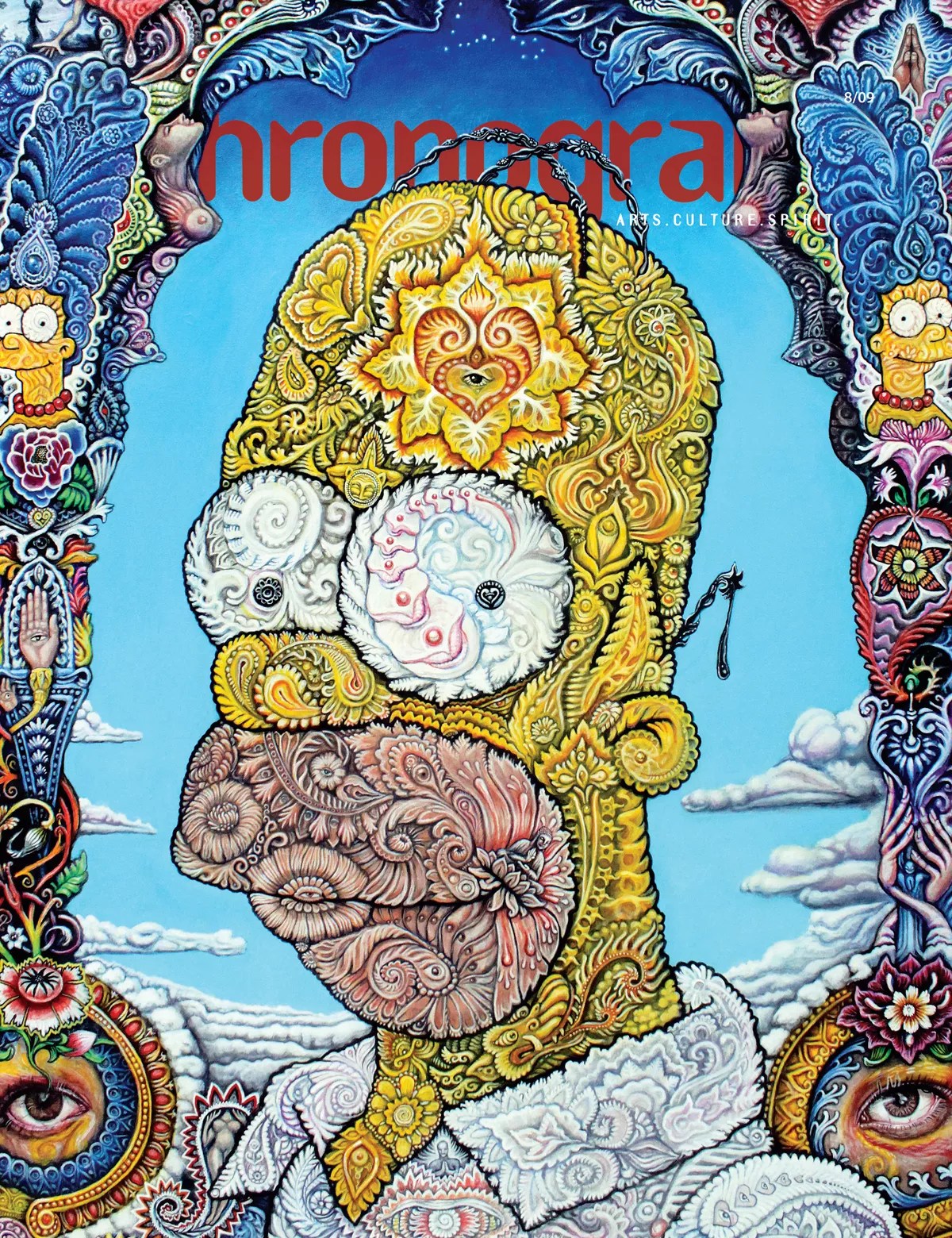
“He’s a loving father and a good man.”
—Randall Roberts, The cover artist stating his unequivocal opinion of Homer Simpson in the August issue
Financial Crisis Fallout
In the January issue, Lorna Tychostup interviewed Diane Reeder, who ran the soup kitchen Queens Galley, for an article on the local fallout from the financial crisis. Reeder noted a sharp increase in the number of free meals she serves in a month—close to 10,000, up from 1,200 when she opened in 2006. “And it’s not the stereotypical people coming in either,” Reeder said. “My newest clients are not people on social services, but people who have jobs, who are looking to stay off social services.”
Roy G. Biv
With the February issue, Chronogram was printed in full color throughout the magazine for the first time.
Take it to the Bridge
Peter Aaron banged on the Mid-Hudson Bridge with Bridge Music composer Joseph Bertolozzi for the March issue: “Pulling a pair of hammers from his bag, Bertolozzi snaps into a sumo-esque stance, feet spread far apart, and begins to bang out a rhythm on the handrail. His long coat flaps crazily in the heavy gusts. Trucks roar by not eight feet away. The occasional weather-braving runner and arctic-clad dog walker passes through, throwing Bertolozzi confused looks.”
Award Season
In 2009, we were nominated for an Independent Press Award by Utne Reader for our health and wellness coverage. We didn’t end up winning, but it was a well deserved tip of the hat to Lorrie Klosterman, our health and wellness editor from 2002-2010.
2010

“Having to write melodies and chord progressions and then trying to come up with words that fit is almost a form of tyranny to me. By doing it the other way around—getting the mood of a poem and then using the structure as a skeleton makes me the tyrant; a tyrant informed by the lyrics.”
—Natalie Merchant, Discussing the songwriting technique for her album Leave Your Sleep in the February issue
In the Flesh
Nina Shengold profiled the author Julie Powell for the Febuary issue as she prepared to release her second book, Cleaving—in part about apprenticing as a butcher at Fleisher’s Meats in Kingston—on the heels of the runaway success of Julie and Julia. Powell died at the age of 49 in 2002 in Olivebridge.
Hold the Firefight
James Foley reported from an embedded position with the US Army in remote Afghanistan for the June issue: “Outpost Badel is a hilltop surrounded by rock-faced mountains and terraced wheat fields separated by stacked stone. Enclosed by an outer cordon of razor wire, fortified by rock and sand-filled cardboard-and-wire barriers, and secured by heavily armored trucks topped with grenade launchers and automatic machine guns, it’s one of the few remaining outposts in lower Kunar province.” Foley was reporting from Syria in 2014 when he was abducted and later murdered by ISIS.
Pray and Work
Peter Barrett wrote about Brother Victor-Antoine d’Avila-Latourrette, a Benedictine monk at Our Lady of the Resurrection Monastery in Lagrangeville who had become renowned for his painstakingly crafted, superlative vinegars.
2011

“If the human race is still here in 100 years, it will be because of lots of people doing lots of little things. Bigger things can get co-opted or bought off by the powers that be. But if there are many, many little things going on it will be too hard for them to keep up with all of them.”
—Pete Seeger, From the February issue
The Pig Dies at Noon
Peter Barrett went full farm-to-table for the May issue when he attended a BBQ where the pig would be slaughtered, butchered, cooked, and eaten on the same day: “Richard and the pig arrived, and he described how the pig would meet its end. He slipped a couple of ropes around the animal. Tate loaded the .22, and they worked out who would stand where. There was a bit of tumult as the animal came off the back of the truck, and I remember thinking for a moment as Richard yelled, ‘Shoot it now! Shoot it now!’ that there was a real chance that the whole operation could go badly off the rails.”
Hiking Beacon Mountain
We excerpted Akiko Busch’s Patience: Taking Time in the Age of Acceleration for the June issue: “The switchback trail threads its way through a forest of maple, hemlock, and oak, thickets of white birches or thin groves of black birches, their trunks etched with silver hieroglyphs. Laddered with roots, the path is carved by stone and strewn with rocks and gravel. Where the slope levels off, a bed of ferns has taken root. Every rift in the granite offers its own still life—a pocket of citrus-colored moss, or a handful of wild grass. A tiny, orange spider negotiates its way across both of these; a red eft scurries across an oak leaf in its own vignette of determination.”
Birdbrain
Writer Jana Martin and photographer Roy Gumpel teamed up for a piece in August on the Northern Catskills Pigeon Racing Club, a group of 15 men, mostly 50 to 70, who raise and race pigeons over hundreds of miles across the state.
2012

“And so Levon Helm has left us now, his spirit going back into the soil, dust, and sepia tones it seemingly rose from, threading itself into the rich tapestry of American culture with the great artists who so inspired him. But the music, the light, and the love he gave us are still here.”
—Peter Aaron, In Memoriam for Levon Helm, from the May issue
Eye Candy
Paul Smart sat down with Geddy Sveikauskas, founder and publisher of the Woodstock Times (now HV1), for the September issue. When asked if he viewed Chronogram as a competitor, Sveikauskas unleashed this sick burn: “Some within our company call it ‘eye candy.’ For me, there isn’t the content I’m used to. So we’re not competitive in the ways we want to cover a community, but we are in terms of advertisers’ limited dollars. I’m just not interested in putting something out like it. Because it’s expensive to produce, the aim seems to be for it to produce an illusion of a classier reality rather than that reality which reflects the communities it serves. My life is about finding the right way of expressing something; Chronogram’s view seems different.”
Power to the Plant Eaters
In November, Wendy Kagan wrote about the increasing number of people switching to a plant-based diet: “Not just a political statement made by tattooed PETA warriors and pretzel-bodied yogis, adopting a plant-based diet can be a powerfully effective way to take charge of one’s own health and wellbeing. ‘People are wanting a way out of the insanity that is our healthcare system,’ says Kris Carr, a self-described wellness activist, author, and ‘cancer thriver’ who lives in Willow.” Kagan served as Health and Wellness editor from 2010-2022.
This article appears in November 2023.


