









Tucked away in a nondescript Highland strip mall, flanked by the usual suspects—Hannaford, a nail salon, a dollar store—Alons Halal Grill is easy to miss. But step inside, and you’re no longer in Ulster County. You’re in Uzbekistan, or at least as close as you can get without a passport. (With its strip mall location, Alons joins a group of restaurants anchored in commercial plazas that are well worth a visit.)
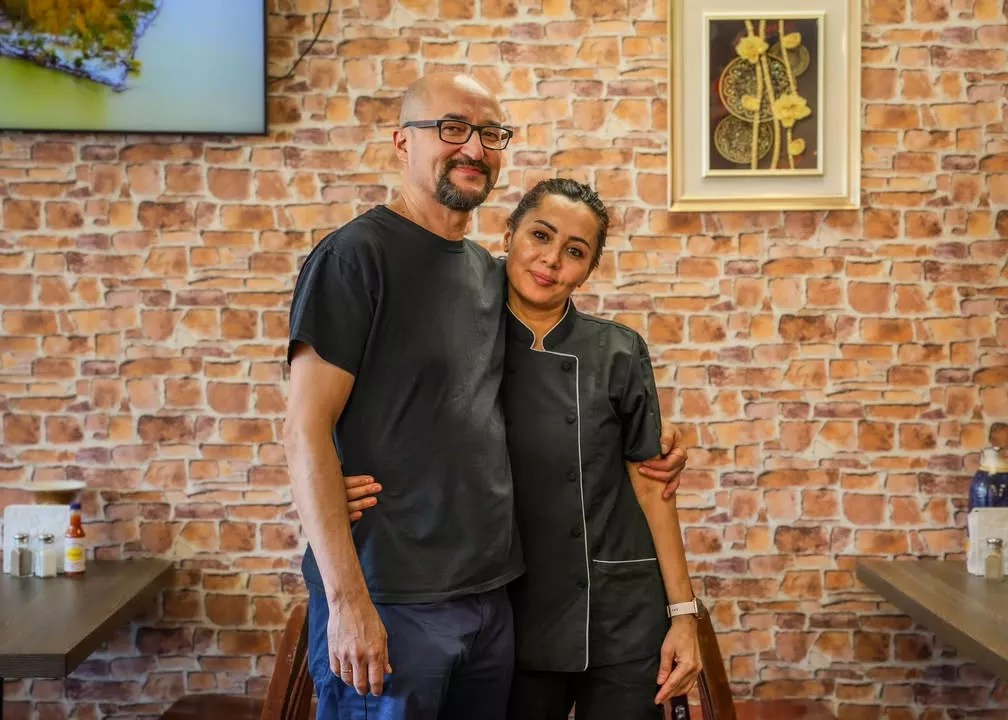
This unassuming eatery is the work of Sobir and Nayoba Murtazaev, proud Uzbek-Americans with a mission: To bring the flavors of their homeland to the Hudson Valley. “I want to bring my cuisine to my community,” he says. “Something different.” And different it is—Alons is the only Uzbek restaurant in the region, and the only halal spot in Ulster County.
The Murtazaevs’ story is one of grit, hustle, and an unshakable belief in his dream. He arrived in the US in 2008 with his wife, Nayoba, speaking no English. Back in Uzbekistan, he had studied law, but his degree held little weight here. So, he worked for a moving company in Queens, then landed jobs at Mohonk Mountain House in New Paltz, where he and Nayoba climbed the ranks—he to buffet manager, she to chef. He credits Patrice Huart, Mohonk’s longtime food and beverage manager, with mentoring him in the industry.

But working for someone else wasn’t the dream. In 2019, Murtazaev bought a food truck, thinking it would be a stepping stone to his own restaurant. Bureaucracy proved otherwise. “There are lots of rules for food trucks,” he says, shaking his head. “I make a dream, I make goal. I say one day I’m gonna open a restaurant and nobody can kick me out.”
That day came in September 2024. Alons Halal Grill—named for the first initials of Murtazaev’s three children, wife, and mother—opened after a six-month renovation of a long-abandoned storefront. “I keep eye on this place,” he says. “This place was almost 10 years empty.” The Murtazaevs saw potential where others saw decay.
The menu is a love letter to Uzbek cuisine, a melting pot in its own right, the county’s culinary traditions shaped by its history as a vital stop along the Silk Road. The food reflects a blend of Persian, Turkic, Russian, and even Chinese influences, with hearty, spice-laden dishes that highlight the region’s agrarian bounty. The foundation of Uzbek cooking is meat—typically lamb or beef—balanced by an abundance of grains, root vegetables, and legumes. Dishes are seasoned with warming spices like cumin, coriander, and black pepper, often complemented by the sweetness of dried fruits such as raisins and apricots.
That fusion is evident in dishes like manti ($15.99), delicate dumplings stuffed with spiced lamb; lagman ($15.99), a rich hand-pulled noodle soup with beef and vegetables, reminiscent of Central Asian and Chinese flavors intertwined; and sambusa ($4.99), hand-rolled pastries that speak to centuries of trade with Turkish and Mongol cultures. Other cross-cultural dishes include naan ($4.99), borscht ($9.99), as well as gyro and shawarma (both $12.99 to $15.99).

Unlike the fiery heat of some neighboring cuisines, Uzbek food leans more toward deep, earthy warmth, with layers of spice that enhance rather than overpower. It’s a cuisine built for both sustenance and celebration, and at its heart is pilov. Murtazaev is especially proud of his version of the dish, sourcing rice directly from Uzbekistan. “France has good land to make grapes—that’s why they have good wine. Greece has good land to make olives. Mexico has good land to make avocados. Uzbekistan has good land to make rice,” he explains. And that rice matters. “You can’t make Uzbek pilov with basmati,” he insists. Instead, he uses a golden, slightly longer-grained variety, mixing it with slow-cooked lamb, carrots, chickpeas, and golden raisins. The result is both hearty and nuanced, the sweetness of the raisins cutting through the richness of the meat. Pilov is also served with chicken and beef ($15.99 to $17.99).
No Uzbek meal is complete without tea, and at Alons, it’s served with ceremony. Murtazaev pours it from the pot into a cup and back again, a traditional method to speed up the steeping process. There’s no alcohol on the menu—just tea and soft drinks. More recently, he’s added smoothies and yogurt bowls to the menu, like the Bahama Mama Bowl: pineapple, strawberries, coconut, granola, and chia seeds with honey drizzle ($12.99).

Alons Halal Grill is no white-tablecloth affair. “I didn’t want do fancy dining,” Murtazaev says. “I wanted to make a family dining room that was inviting for everyone.” And he has. The restaurant is simple, the food homey, the prices reasonable. Sobir is the amiable host in the front of the house, Nayoba helms the kitchen. It’s the kind of place where strangers share dishes and first-timers leave feeling like regulars.
For the Murtazaevs, Alons is more than a restaurant—it’s a piece of home, a bridge between his old life and his new one, a dream realized. And if you sit down with a plate of pilov and a steaming cup of tea, you can taste that dream for yourself.
Related Stories

These Hudson Valley Restaurants Dish Up Underrepresented Cuisines
This article appears in February 2025.



Excellent review. Been meaning to try it. Now I will make it a point of a destination and support from Gardiner