








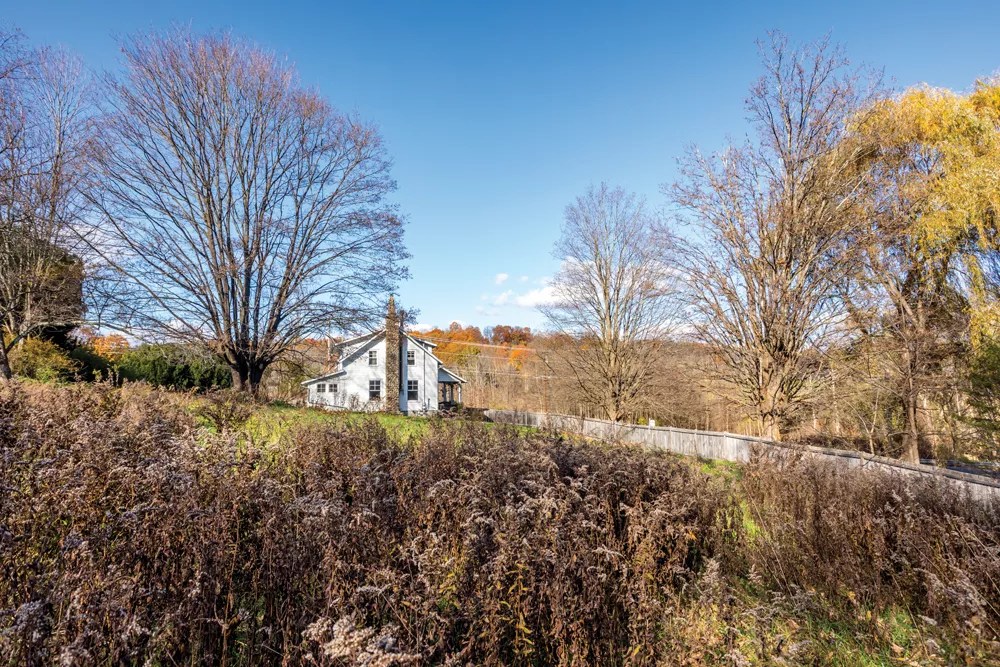
Every autumn, the strand of apple trees in Kieran Kinsella and Giselle Potter’s yard puts on a show. “The closest tree ripens at the end of August and then they successively turn various shades until the last apple drops at the end of October,” explains Kinsella. “The trees are the same size as when we moved here, so they must be almost 100 years old. Some years they produce apples, some years they don’t, but occasionally they’re still really bountiful.”
The trees at the edge of the couple’s hilltop three acres are the last vestige of the former dairy farm built in the late 1800s. In 1998, when Potter and Kinsella found the property, few hints of the home’s previous incarnation remained. “We looked at a lot of houses,” says Potter. “Every one we walked into had so much of someone else’s personality, but this home was clear.” The couple felt they could make the traditional white clapboard farmhouse their own and moved in shortly afterwards.
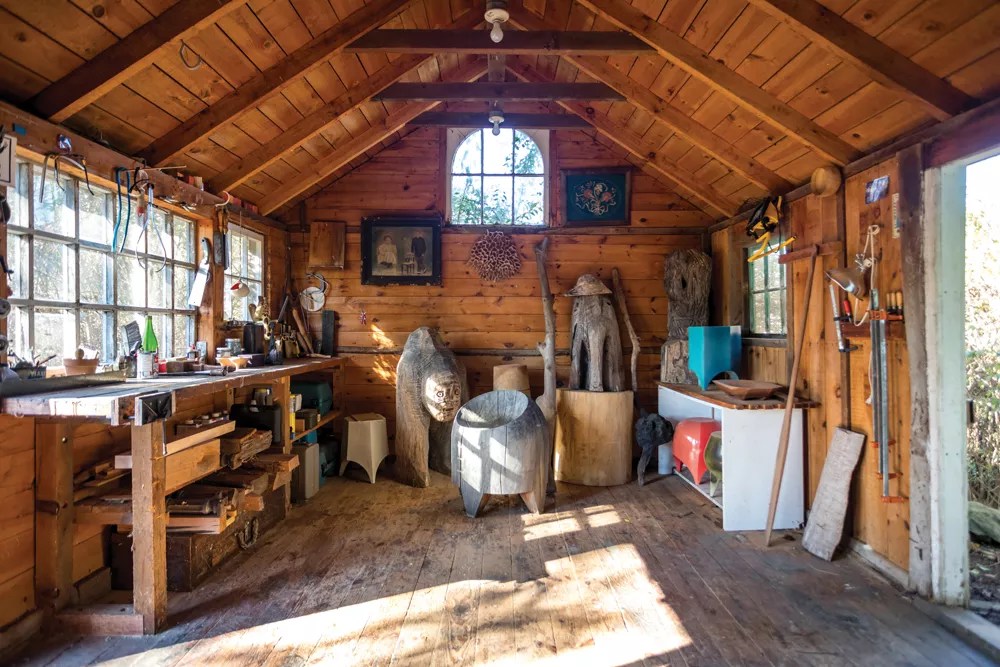
Still, watching that row of trees through the succession of years was enough for Kinsella to connect to the property’s former life. “The trees are great to watch,” he says. “As dairy farmers, the family probably grew most of their own fruits and vegetables. Clearly someone planted them to ripen the way they do.” Trees are undoubtedly Kinsella’s thing. A wood carver, he creates distinctive stools and tables from cast-off logs and stumps he collects from local tree services. Singular and stark, his pieces retain the essence of the original tree within their finished designs. First drawn to the art of carving as a way of utilizing forgotten wood, Kinsella has made a study of the oak, walnut, and maple dropped off at the edge of his yard. “The finished pieces are still very much the tree,” he explains. “It has the presence of the being. I like using the wood as a living thing, rather than chopping it up into bits and pieces.”
The Endless Three Acres
Kinsella and Potter were living in Brooklyn when they decided to uproot themselves for a home surrounded by land. “We had kind-of unrealistic ideas of living somewhere with acres and acres around us,” says Potter. A native of Connecticut and coming from a family of visual and performing artists, Potter was living in the city and working as a freelance illustrator for The New Yorker and other publications at the time. “That was back when you’d get a last-minute call to go on an assignment to see a performance that night, then have an illustration done in a day or two,” says Potter. Through her time at the magazine, Potter met a children’s book editor and began writing and illustrating her own stories. Two of her books, The Year I Didn’t Go to School and Chloe’s Birthday…and Me were based on her childhood experience of traveling and performing in her family’s puppet theater company, the Mystic Paper Beasts. In 1998, with her career connections established, Potter was ready to fulfill the couple’s dream of living in a more rural setting and the two began looking northward.
“In the beginning, we had these visions of living ‘Little House on the Prairie’ style and were looking at old farms surrounded by 40 acres or more,” says Kinsella, who is a native of the Adirondacks. “We actually looked at an incredible farm north of Lake Champlain. I could just imagine the winds howling down from Canada. I remember the real estate agent saying, ‘You know you’re only 45 minutes to Burlington—until the ferry crossing freezes over.’” They nixed that idea, and when friends invited them to High Falls for a visit, they realized the Hudson Valley was abundant with the natural beauty they were seeking.
Their former dairy farm sits at the top of a hill in Rosendale, with a clear view of the back side of Joppenbergh Mountain. Even though it has much smaller acreage than they’d originally envisioned, the views of the surrounding farmlands and woods give the property a feeling of expansion. “Over time we realized it’s just the perfect amount of space,” says Potter. “If we’d gotten more it just would have been too much work.”
Little Farmhouse in the Mountains
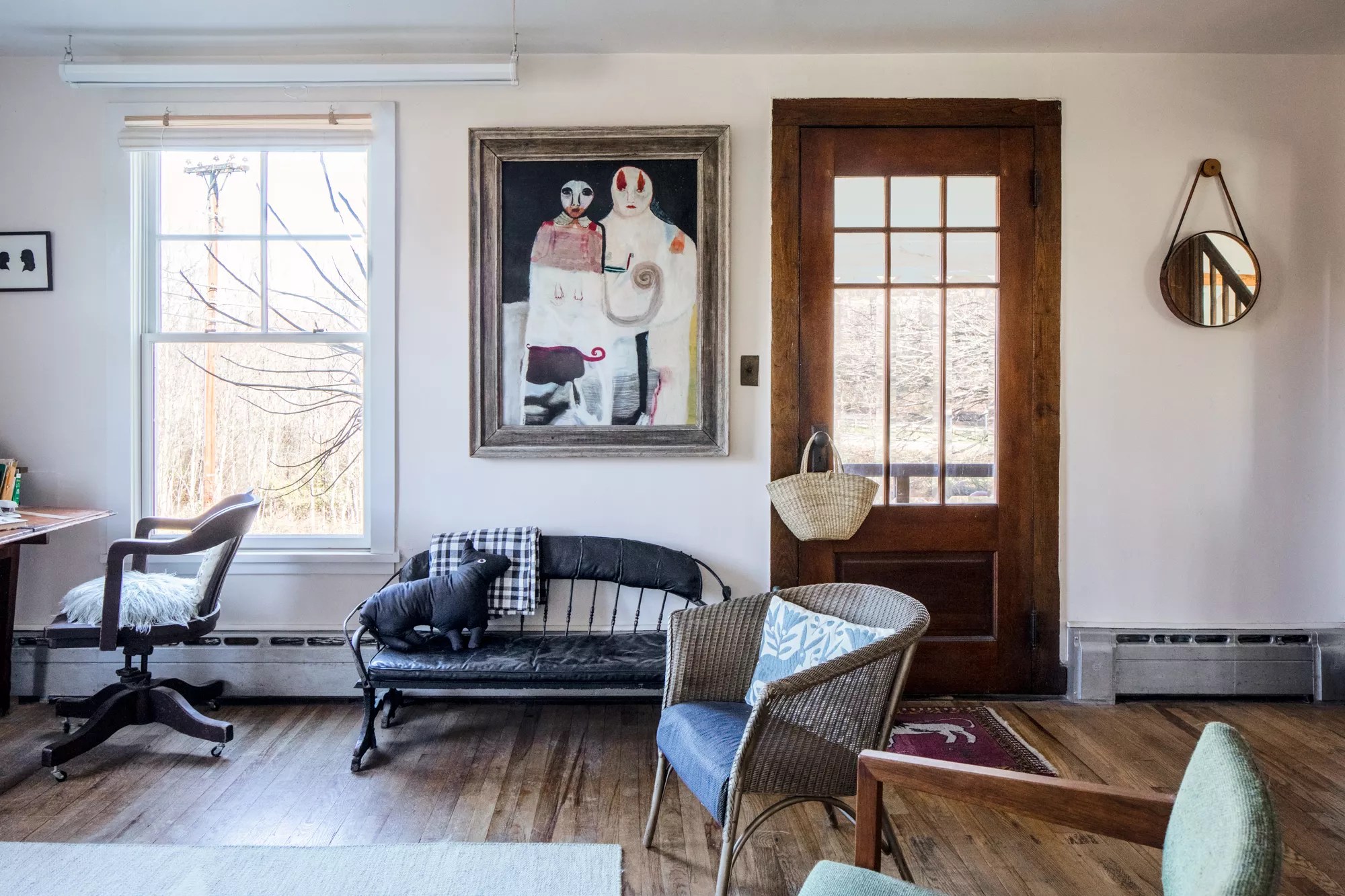
“It was just a generic old farmhouse. It wasn’t too precious and it hadn’t been tampered with,” Kinsella says of their home’s appeal. The two-story home features oak floors and trim throughout, with a living room and parlor downstairs and three bedrooms at the top of an oak staircase worn by years of family use. Throughout the downstairs, oversized double-hung windows look out to the surrounding fields and nearby Rosendale. “We loved that even though this was an old farmhouse, it had such big picture windows throughout the space,” says Kinsella.
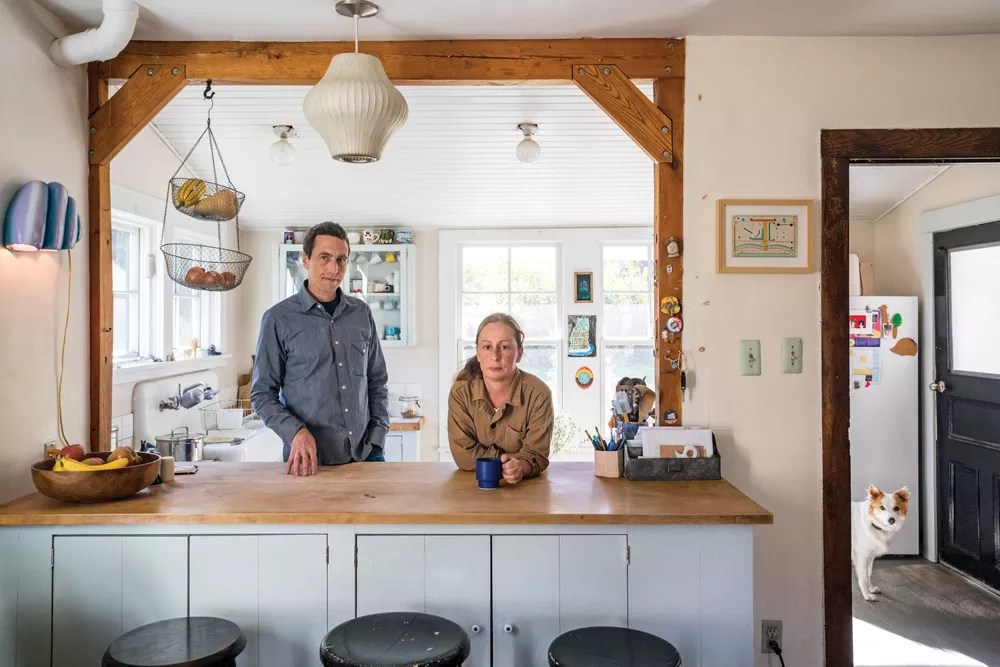
The couple did some initial work on the 1730-square-foot house when they first moved in. Downstairs, they removed a wall between the kitchen and living room to create a pass-through over one of the kitchen counters and borrowed space from an adjacent closet to expand the kitchen area. During their first winter in the house, snow seeped in through the downstairs windows, so they upgraded the glass but left their farmhouse charm intact. They couple added a wood stove to the living room area, enhancing the cozy feeling throughout the first floor.
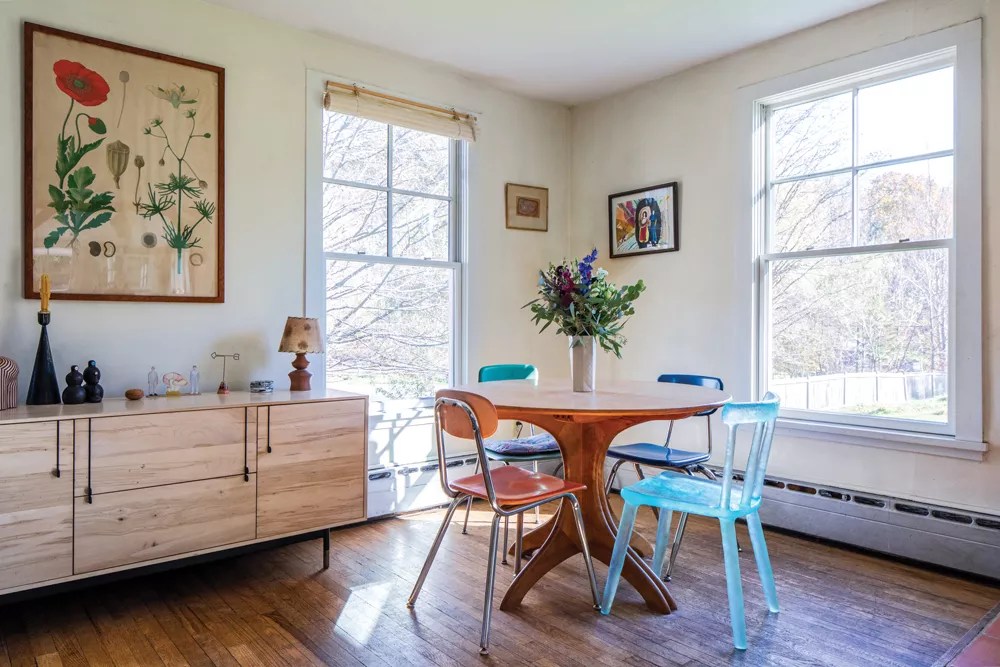
Off the traditional second-floor farmhouse landing, they built an additional bathroom by adding plumbing and fixtures. The two salvaged a farmhouse-style sink locally, then found the perfect claw foot bathtub in Brooklyn. “We dragged the tub across the streets of New York City,” remembers Kinsella. “In hindsight, we might have realized dragging a claw foot tub all the way from Brooklyn to Rosendale was too much work.” Over the years the couple have decorated the home with an eclectic mix of second-hand furniture and work by local artists. They converted the parlor into a sewing room where a collection of Potter’s grandfather’s oil paintings adorns the walls.
The Bountiful Harvest
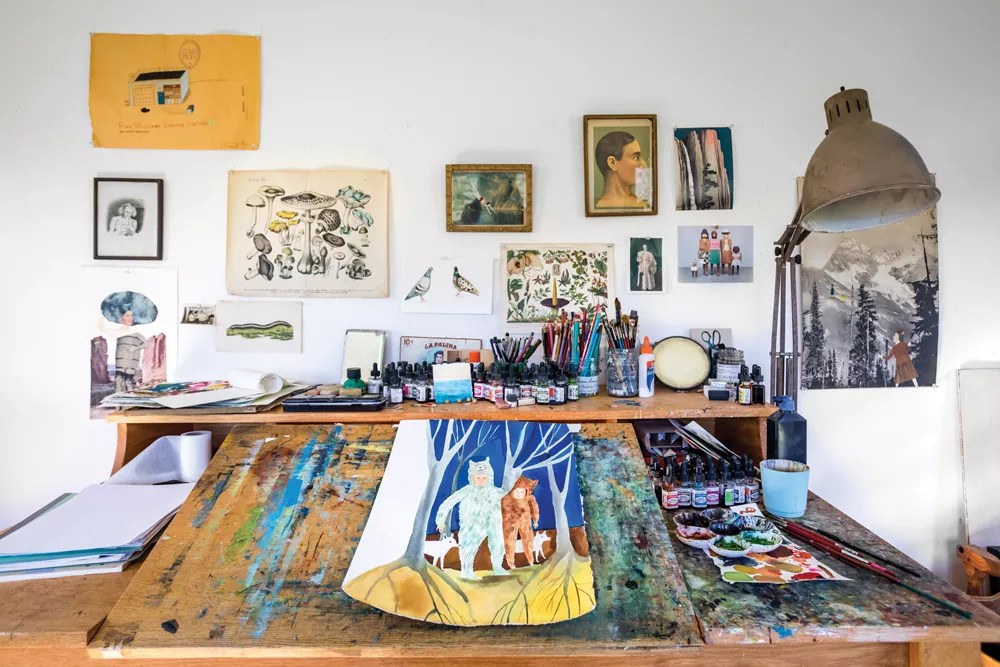
Like the stand of apple trees, both Potter and Kinsella have produced bountiful creative fruit over their seasons at the farm. Each maintains a workspace in their own verdant corner of the surrounding hilltop. One mown path winds to a white clapboard studio matching the original farmhouse. Kinsella and a friend built it for Potter’s illustration work. The studio was located just far enough away that their two daughters, who are now teenagers, wouldn’t disturb her when they were young. “It was the distance that a three-year-old wouldn’t look for you,” explains Potter. Inside, stacks of her children’s books line one wall with an eastern view of the nearby mountains. Potter’s prolific body of work includes over 30 children’s books, as well as many short stories and articles.
Kinsella originally made use of the farm’s old chicken coop as his workshop. The ground outside, covered in soft mud and wood chips, was the ideal place to stand up all day and carve. He’s recently relocated his workshop to a separate building in Rosendale. However, at a back corner of the property, he still keeps a holding area for giant logs, which he shapes into the raw material for his furniture pieces. During the initial carving process, Kinsella always takes note of the years represented in the rings of each tree. “I guess I’m like the butcher,” he confesses, although he mostly diverts logs from becoming firewood or just being thrown over someone’s back fence. “If you examine the lines and mineral deposits, you can tell whether it was a rainy year or a good one,” he explains. He preserves the rings of each log through the carving process until they are finished pieces of furniture. “I try to keep the pieces connected to the original tree,” he says. “That way, you can really tell the whole story.”
This article appears in December 2021.


