










To Tess Hogan, living in a pigpen isn’t something to be ashamed of—in fact it’s an architectural style more humans should aspire to. “Pigs are so intelligent, so emotional, highly sensitive, and very perceptive,” explains Hogan. “They are empathetic creatures that are capable of deep connections with humans. Also, truth be told, they are very clean.”
Hogan’s “pigpen” is actually a charming and well kept, porcine-adapted 1870s farmhouse in the shadow of the Shaupeneak Ridge. Hogan and her partner, Raymond McLaren, share the 1,500-square foot, two-story home and surrounding six acres, once a vineyard, with a cast of four-legged companions, each with its own story and distinct personality. Over the past 10 years Hogan and McLaren have reimagined not only the fields, barns, and overgrown vineyards, but also the entire first floor to accommodate the needs of their 21 pigs, some rescued, some born there, and a few temporary fosters waiting for the right home. With a few dogs and one adult child thrown into the mix, it is a lively, ever-evolving sanctuary that raises awareness rather than breakfast sides.
Their work has yielded a symbiotic relationship between human and pigs—along with a few strange hybrid vegetables. In rescuing the pigs and reshaping their own lives to accommodate the operation, Hogan and McLaren have transformed themselves—learning to see the world through the eyes of their companions and embracing the joys of sharing life with intelligent, complex creatures that share 98 percent of our DNA.
As You Wish
Hogan’s fascination with pigs didn’t start upstate—it began in the heart of Brooklyn, where she shared a Bushwick apartment with her first pig companion. I’ve always loved pigs and wanted one,” says the Tucson native. After moving to New York City to attend Columbia University and later launching her own production design company, Fill in the Blank Productions, Hogan’s dream to own a pig became a reality when her parents gifted her a pet she named Buttercup.
While pigs can be fussy—”It’s because they pick up on everything,” Hogan explains—she found that, with a few adjustments, Buttercup was a surprisingly city-friendly companion animal. “This was back before Bushwick was chic, so we actually had a roof deck where she could hang out,” Hogan recalls. “Pigs are easily litter box trained and don’t really need to be walked, so I could keep her in various apartments.”
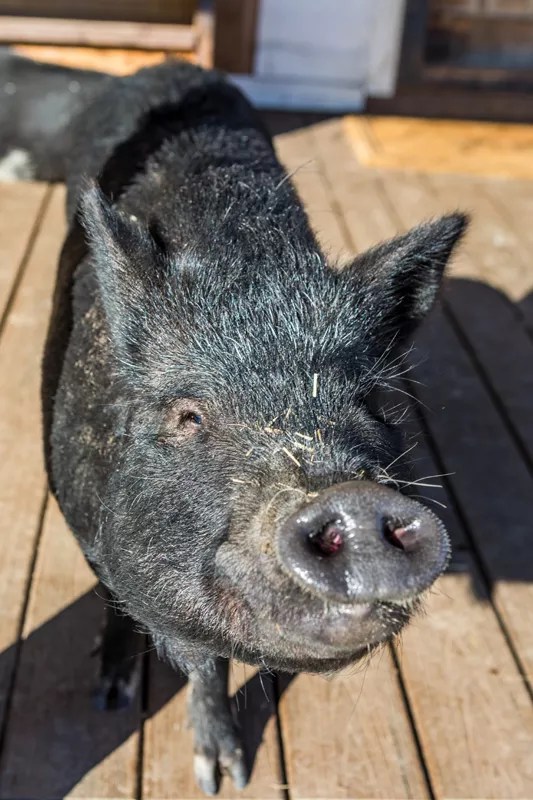
Buttercup remained a constant companion as Hogan moved from Bushwick to a three-bedroom apartment in Harlem and later to Roosevelt Island, where their routine included walks in the local park. Life with Buttercup was a master class in inter-species connection, introducing Hogan to a niche community of fellow pig enthusiasts. “There are a ton of people in New York City that have pigs,” she explains. “I know at least five, and I’m sure there’s more than that. It just takes a bit of infrastructure.”
Hogan’s bond with Buttercup ran deeper than any connection she’d shared with other pets. “People don’t really understand pigs like they know cats and dogs,” explains Hogan. “But they are basically like three-year old humans, that’s how they act, so they bond to you more deeply than you do with dogs.” When Buttercup eventually succumbed to cancer, the loss was profound. “It took me a very long time to get over her passing,” says Hogan. It was two years before she felt ready to welcome pigs back into her life, but when she did open her heart again, she opened it wide.
A Soulful Home for Sentient Beings
Hogan and McLaren’s decision to move to the Hudson Valley wasn’t initially about pigs. They were simply ready for a life outside the city. “We really wanted more space,” explains Hogan. “We came up here in 2015 because we wanted a quieter lifestyle. Honestly, we picked the house based on the house itself. We had no idea about the area until we went to take a drive around after we made an offer.”
The couple found the red-and-green painted farmhouse on Zillow and decided to drive up and check it out in person. Their connection was immediate. “We drove up the driveway and saw the shape of the house,” says Hogan. “I knew I could work with it.” It was not in pristine condition, but that worked to their advantage. “It was an old house and not presented well,” remembers Hogan. “There was also old shag carpeting and wood paneling in every room.” Despite its dated elements, the couple saw the property’s potential. “We brought in an inspector and he told us, ‘Well everything is fine, but it’s a doll house,'” Hogan remembers. “But that was exactly what we wanted.” The house needed work, but it had character and the six-acre mix of woods, fields, and vines felt full of possibility. “It had a soul,” says Hogan. “We could see what it could become.”
Vintage Glow-Up
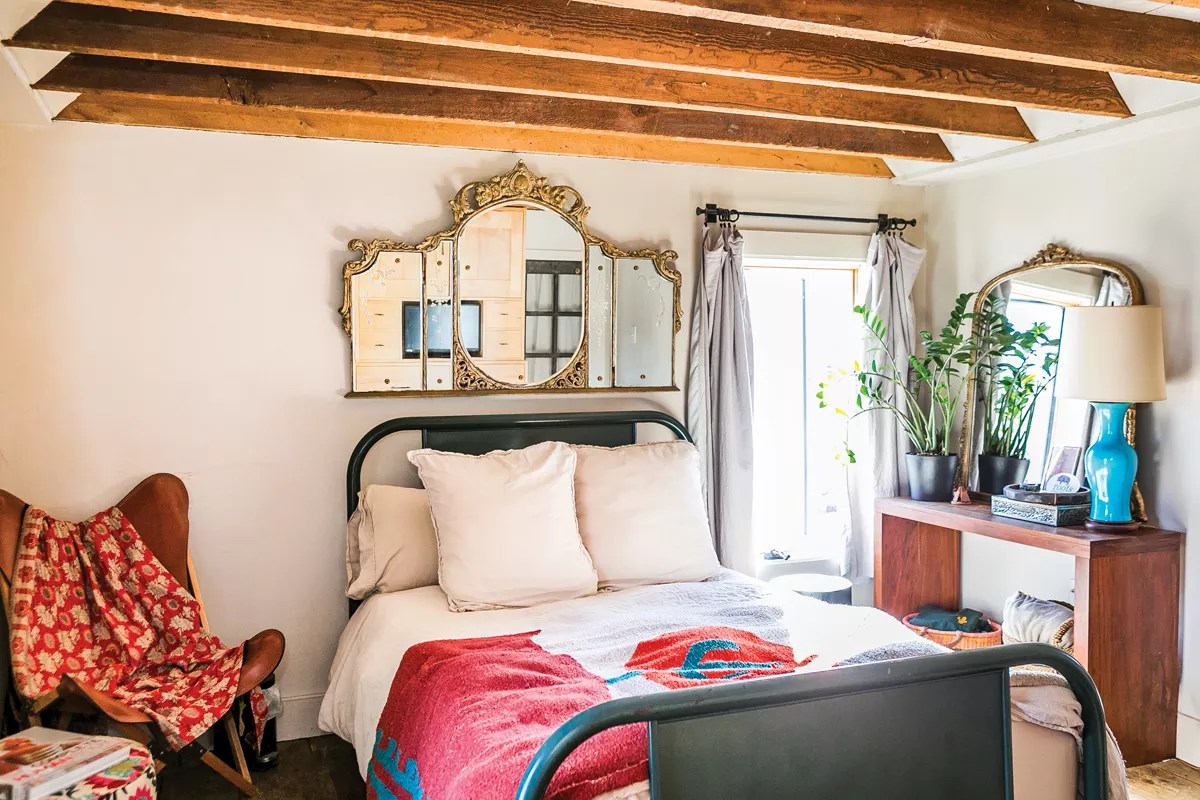
The couple’s initial renovations were human-centric. With the help of Mike Appollonia of Apologia Enterprises in Saugerties, they ripped out the wood paneling and outdated drop ceilings, replacing them with insulation and open spaces that gave the house an airier feel. Underneath the shag carpeting, the home’s original wood floorboards were mostly salvageable. After reinforcing the foundation they restored the floor planks.
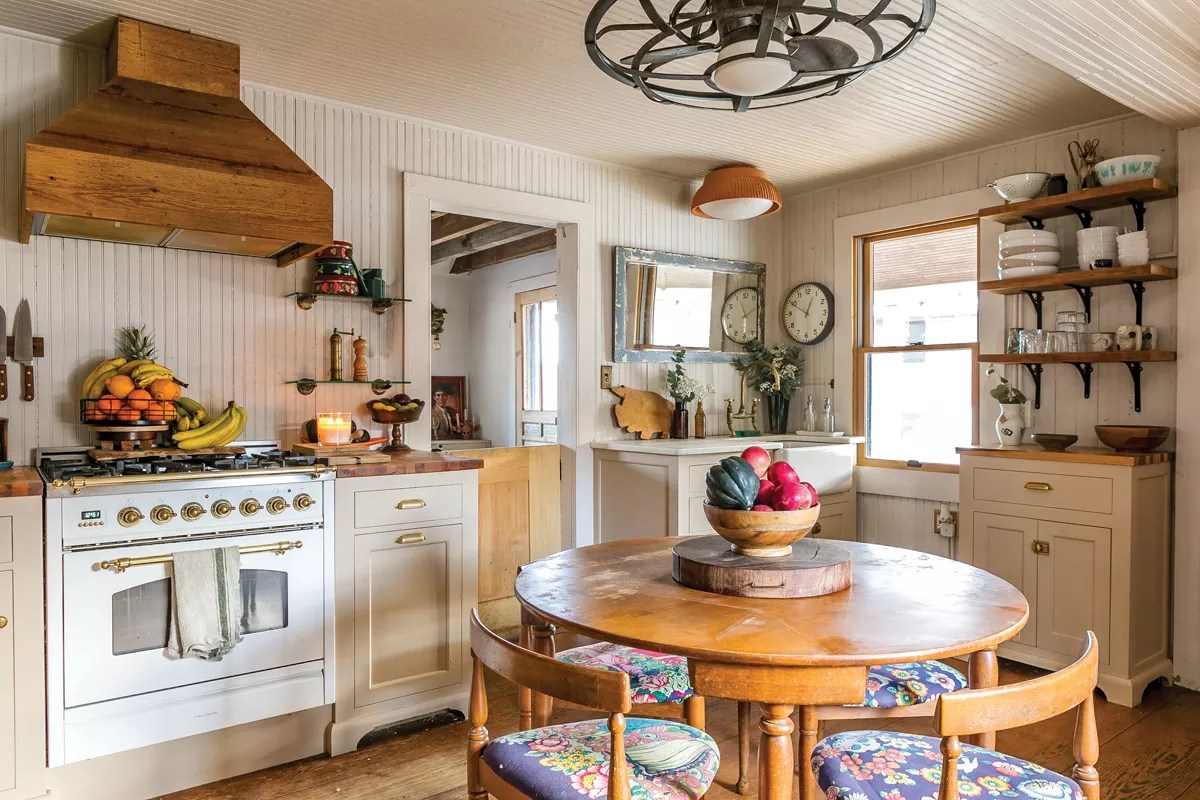
Appollonia saved the unsalvageable wood and incorporated it into the kitchen rehab, crafting new drawers and a custom wooden range hood. Because the home originally only had only one upstairs bathroom, the couple decided to capture space from a wraparound porch to create a full downstairs bathroom with a step-in shower, as well as a laundry room.
The kitchen-adjacent dining area also received a similar glow-up. “The one thing I wanted was a beautiful, open dining room,” says Hogan. “It was set up wonderfully.” To enhance the home’s vintage vibe, they refinished the walls with skim coat plaster and added wainscoting. They also replaced dated, crooked windows throughout the home.
Pigs in Blankets
Originally, Hogan and McLaren’s vision was simple: Settle in, renovate, enjoy a quieter life. But by 2018, Hogan knew she was ready to bring pigs into her life again. This time, however, she would do things differently. “I knew I wasn’t going to buy an animal,” she says. “I realized I should never get a pig from a breeder because there were so many out there in need of adoption.” McLaren was supportive, but at that point “he was just along for the ride,” explains Hogan.
Their first rescues, Bourbon and Delilah, came from Wayward Ranch Animal Sanctuary in Kerhonkson. To accommodate the new arrivals, they converted old paddocks into a pen and added heat to a barn as a pig bunkhouse. In 2018, they adopted Urban, who quickly established himself as the alpha.
When Urban needed elbow surgery, they brought him inside to recover, converting the dining room into a rehab center for four months. “The running joke has been that I made this beautiful dining room and had to turn it into a rehab zone,” says Hogan. “Once Urban got reintegrated, I thought I had my dining room back. “
It wasn’t for long. As their rescue efforts grew, so did their pig family. They took in Derek and Clive, survivors of a failed sanctuary where 78 pigs had been crammed onto just two acres in a homeless encampment. Jolene was rescued from an elderly man and Tex soon followed. The calls kept coming and the couple kept adapting their home to meet the needs of their new rescues. They installed special kitchen storage for pig food, added Dutch doors to close off rooms, and renovated the home’s covered porch to create a shared space for both pigs and humans.
It was the rescue of Babs that finally, completely transformed McLaren into a pig convert. “Babs was a whoopsie because she came to us pregnant,” says Hogan. Once again, the couple converted their dining room—this time into a maternity ward where McLaren delivered piglets with the help of a veterinarian over FaceTime.
“As the pig numbers kept growing, he humored all my requests for property upgrades, sat through endless calls and forums on pig education, and sloshed through mud for rescues,” says Hogan. “But when Raymond helped deliver Babs’s babies in our dining room he was sunk, his love for the pigs was totally solidified.” Hogan adds, “We call him grandpa Raymond now.”
This article appears in March 2025.


