








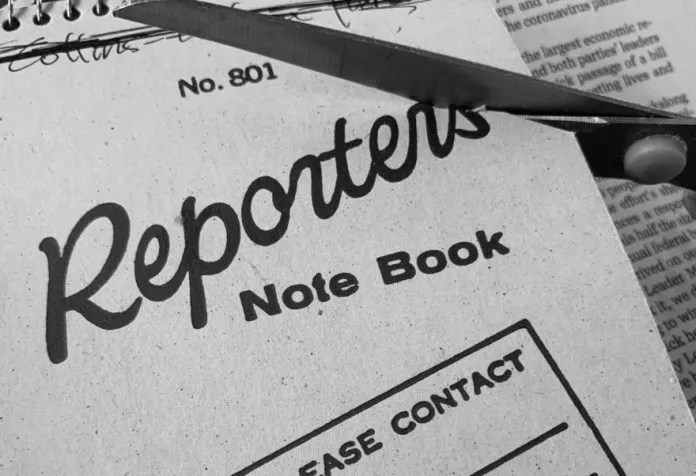
On March 1, we published a piece on the sad demise of the Catskill Mountain News, a tiny paper serving the Delaware hamlet of Margarteville for 116 years until it closed on January 22. Lissa Harris reported on many of the problems facing small publishers—declining print advertising sales being a particularly vexing issue—noting that in the past 15 years, 2,100 American newspapers went out of business. Small publications have always existed on the precipice of profitability.
And then came the coronavirus.
In the past three weeks, everything has been disrupted—our health, the economy, our sense of certainty. In the past few weeks, businesses that publications rely on for advertising revenue—retail, restaurants, event venues, the hospitality industry—have basically shut down, waiting for the all-clear on the other side of the pandemic to reopen. Some of these businesses will never reopen. We have been reporting on the industry sectors hardest-hit, like restaurants and restaurant workers. The fallout caused by putting the economy on pause for an undefined period will be devastating and long-lasting. Brace for the Great Recession II: COVID Boogaloo.
One industry that’s already been laid to waste is local media. Newspapers and magazines were already facing substantial challenges on the revenue side prior to the arrival of the coronavirus are now facing an existential threat no one saw coming. Small dailies, regional magazines, and alternative newsweeklies are likely to be the hardest hit. (Chronogram is a member of the Association of Alternative Newsweeklies.)
Joshua Benton reported in Nieman Lab on March 19 about the possible demise of alt-weeklies across the country in the wake of the coronavirus. “In dozens of cities, papers are asking for donations, laying off staff, or abandoning print as social distancing dries up their revenue streams.” The problem is not only related to revenue, but also how to get print copies into the hands of readers who normally pick them up at retail locations, most of which are now closed. “Alt-weeklies are facing a double blow: Not only have their main advertising sources dried up, so have their main points of distribution. (Where do you pick up an alt-weekly? At a bar, at a restaurant, at a theater—all the places that have gone dark.)”
This past week, Ulster Publishing, which publishes published four print weeklies around the county, the Woodstock Times, the New Paltz Times, the Kingston Times, and the Saugerties Times, suspended print publication and announced it was going digital-only. The company laid off most of its staff, including long-time editors like Brian Hollander, who had helmed the Woodstock paper for 19 years. In a note to readers, publisher Geddy Sveikauskas remained bullish about continuing with online-only operations and a skeleton crew. “Our objective remains to publish the best journalism we can in whatever format serves our communities best. The need for what we do at our best has never been greater. Members of our diverse community are being amazingly supportive. We love you all. We beg you please to stay with us on this necessary detour on our common journey.”
As at newspapers and magazines across the country the majority of Chronogram’s revenue comes from advertisements placed by local businesses that have been forced to close. This is revenue that keeps our staff employed, contributors paid, and allows us to deliver our print issue and online product for free. With a significant drop in advertising revenue, we are unsure if we’ll be able to keep generating the content that so many of you have told us you’ve come to love and expect.
For local media to survive, it will require more than advertising revenue to keep publications sustainable. (Though the recent passage of the $2.2 trillion CARES Act may give small publishers a lifeline in the short term.) To survive, publications like Chronogram need readers to support them directly, paying for content they had previously gotten for free. For those who can afford to support, we humbly ask to subscribe or donate toward our efforts.
And while it seems like this strange emergency may never end, it will bloody end. We will see the other side of this. In the meantime, help who you can. Be kind. Be brave.
This article appears in March 2020.


