









[Image-1]
An all-American district
The demographic makeup of New York’s 19th Congressional District resembles that of the United States in a deeply rooted and profoundly depressing way.
In the massive upper portion of the district, vast tracts of sprawling farmland, and mountains in and around the Catskills are dotted with small communities of 500, 1,000, or 3,000 people. They are predominantly white, low-income, and lacking in upward mobility and college education. They are almost uniformly conservative–most voted for Trump–and receptive to the kind of gritty economic populism that has been espoused by the more radical elements of both parties. In terms of infrastructure, healthcare, and technology, some of these communities are decades behind the national median. They are struggling.
Then there are the liberals and progressives packed in the urban and suburban communities in the Hudson Valley and a few other population centers. These communities consist of middle class families, New York City transplants looking to get away from the hustle and bustle of city life, aging hippies in Ulster County, and minority communities in the more urban areas. These voters tend to be more college-educated than their rural counterparts. They are culturally egalitarian and economically progressive. They feel disaffected, disenfranchised, and frankly betrayed by not only their government, but their fellow Americans. Many are saddled with student debt, hefty tax bills, and healthcare insecurity. They, too, are struggling.

These two parts of NY19 represent America better than any region of the country I’m familiar with. Both are facing difficulties, with numerous overlapping political interests and common enemies: hostile corporate machines, jaded Washington politicians unaffordable healthcare, and an economy that just isn’t working for everyone.
Conventional wisdom and the pundit class would have people believe that because the two parts of the district diverge on philosophical solutions to commonly shared problems, they must live in a state of deeply rooted animosity for one another. But this is simply not the case. Many voters in the northern areas of NY19, the bulk of whom are Republicans, independents, Trump supporters and the like, are dissatisfied with Faso. They feel he fails to represent their interests and are even receptive to progressive solutions to issues like health care, taxation and the environment. All a candidate really needs to do to win these votes is show up and listen.
On June 26, these voters will flock to the polls to nominate the candidates they believe will best represent their interests. On the Republican side, incumbent Representative John Faso is running unopposed. On the Democratic side, seven progressives are duking it out for the opportunity to challenge Faso. Because the vast majority of Democratic votes lie in Ulster County, northern Dutchess County, Hudson, and a few other isolated population centers. For almost exclusively that fact, few of the Democratic candidates have extensively reached out to those upstate voters in the primary, focusing their efforts instead on those aforementioned liberal strongholds.
[Image-3]
Breaking down the numbers
NY19 is a pivotal seat for the Democrats to pick up in order to gain control of the House of Representatives. Its diversity has culminated in a roughly even split between Democrats and Republicans; the Cook Partisan Voting Index gives the district an R+2 PVI, meaning that in an election year with no party favored, the Republican would be expected to win by just roughly 4 percentage points. In fact, as of November 2017, the district actually had nearly 5,000 more registered Democrats than Republicans despite being represented by Republicans for the last 10 years.
Considering that congressional special elections this cycle have had a whopping average swing of 16 points in favor of Democrats, Faso would be expected to lose this election by double digits. Even based on the Democrats’ much more modest lead of around 8 points on the FiveThirtyEight generic ballot, they would still be expected to carry the district handily.
Moreover, Faso is not popular. Besides the anecdotal evidence of bleeding support in the upper region of the district, sometimes coined the “Faso Belt,” he has been dubbed an “Absentee congressman” and has driven intense progressive ire for his yea votes on key Trump legislation, as well as his alleged inability to properly represent the interests of NY19 voters. A PPP poll commissioned by the Pat Ryan campaign indicated that Faso’s approval rating in the district is in the ballpark of 30% compared to nearly 50% for Trump. That’s staggeringly low, and the high total for Trump indicates that it’s probably not an outlier.
Faso has been pegged by Democratic candidates, as well as the grassroots protesters who frequently congregate outside his office, as supporting corporate interests and towing the party line above all else. He’s a “rubber stamp” for the party, they say. Clearly this image of Faso as putting party before country has made its way to Faso’s natural base in the more conservative Catskills. There, the economic populism of Trump seems to dominate the traditional Republicanism espoused by Faso.
But if all this seems rosy for the Democrats, it must be noted that there are a few key factors make it an uphill battle for them. First off, Faso has tons of campaign cash and has outraised all but one of the Democratic candidates. Moreover, the Ryan poll showed that despite his low approval rating, Faso still runs competitive with Ryan and Delgado, two of the frontrunners. This might indicate that there is still a deep partisan or cultural divide keeping Republicans who disapprove of Faso from voting Democratic. Or perhaps it’s simply because those two, and most other Democrats, haven’t bothered to campaign in half the district.
A history lesson furthers the Democrats’ grim prognosis.
A graveyard for progressive hopes
2014 was a bad year for Democratic House candidates, but even national misfortunes to the tune of a 26-seat swing for the GOP pale in comparison to NY19 Democrats’ misfortunes. Democratic nominee Sean Eldridge, a New York City venture capitalist married to Facebook co-founder Chris Hughes. The couple bought a $2 million house in the district just months before Eldridge filed to run. He faced off against Chris Gibson, a popular moderate Republican incumbent and a war hero, in the general election,. Eldridge was dogged by accusations of being a carpetbagger. Despite outraising Gibson 3 to 1, Eldridge, whose firmly progressive campaign focused more on national issues than local ones, was trounced by Gibson. Just two years earlier, Barack Obama had won NY19 by 6 points.
In 2016, NY19 deflated yet another progressive candidate’s opportunity flip the seat. Zephyr Teachout was a Fordham law professor who, like Eldridge, migrated from New York City to the Hudson Valley shortly before filing to run. She was defeated by Republican John Faso, a former State Assemblyman who had previously been the Republican nominee for New York Governor. Faso won by nearly 10 points.
The 2018 Democratic candidates seem confident that each of them can finally be the foil to the long string of Republican victories in NY19.

The Plucky Seven
The Democratic candidates in NY19 have more commonalities than differences. All identify as progressive, though some more so than others, and none have held public office. Moreover, all can reasonably call NY19 their home. With a lack of true policy diversity between candidates, the race has instead distilled into a clash of distinctive personalities and backgrounds. It can often be hard to tell who is in the lead, but based on fundraising, a few polls, public and private, there appear to be three frontrunners.
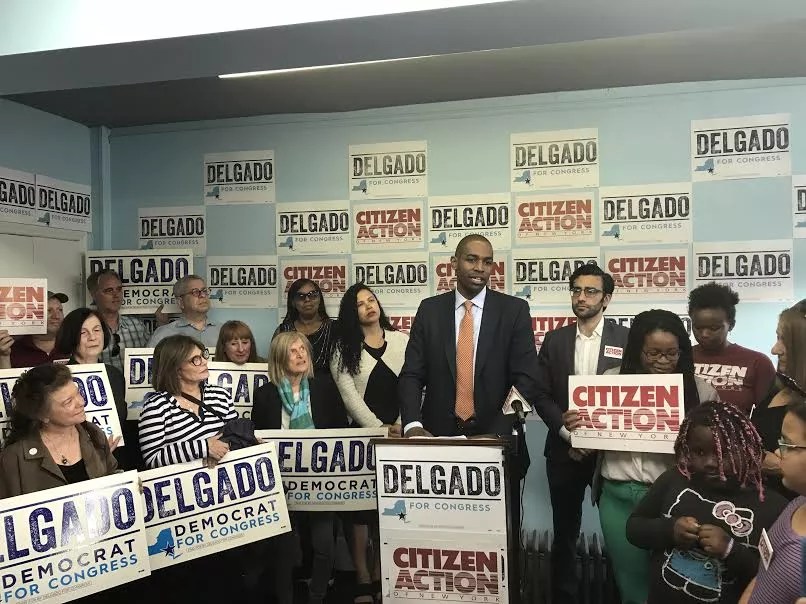
Leading the pack by most measures is Antonio Delgado, a lawyer at the prestigious New York law firm Akin Gump who lives in Rhinebeck. Delgado carries with him an air of inevitability and exudes an Obama-like charisma that makes it feel as though he’s run in a thousand campaigns. An alum of Colgate, Harvard Law school, and Oxford University by way of a Rhodes scholarship, Delgado has an intellectual pedigree that rivals or even exceeds Obama’s. His energy, passion, and clear vision make him a solid candidate. His persona feels comfortable and familiar to voters in a time of fear and tumult, and brings with it the kind of achieving-the-American-dream story that has never gone out of vogue in the history of American political campaigns.
As of the latest FEC quarterly filing deadline at the end of March, Delgado has raised an astonishing sum of nearly $2 million in campaign cash–three quarters of which came from donations of more than $1,000–which he can deploy against Faso. His campaign believes this makes him the best positioned to defeat Faso, which is why a common refrain in his stump and the speeches of those endorsing him is, “he can win.”
Delgado’s greatest vulnerabilities come in the source of his fundraising and community roots. Delgado certainly has stronger roots than Teachout, having been born in Schenectady and educated at Colgate. He now resides in Rhinebeck with his wife, a longtime Kingston resident. But some have alleged that Delgado has built the bulk of his life outside the district, at Harvard and Oxford, then in Los Angeles as a hip hop artist and New York City working for Akin Gump. In addition, the fact that the bulk of his campaign funds come from high-dollar campaign donations, including well over $100,000 alone from employees of Akin Gump, has made him a target for progressives looking for campaign finance purity.
Delgado is followed by Pat Ryan, a veteran and tech businessman from Kingston. Ryan is a relatively young, pragmatic, but still firmly progressive candidate who gives off a strong vibe of modernity and evolution. Very much a millennial, Ryan has an unparalleled tech and military background that helps him stand out in this pack. He is among a new generation of progressives like Tulsi Gabbard (HI02), Tim Ryan (OH03), Seth Moulton (MA06), and Richard Ojeda (WV03 candidate) who seem to have formed a whole new kind of Democrat. These politicians are economically populist, young and disproportionately have military backgrounds. They are coming into congress with new ideas and have formed a club that seems to transcend partisanship and win over voters of all stripes, including Trump supporters. This positions Ryan as a strong general election candidate. His fundraising, like Delgado’s, is aligned with his status as a frontrunner.
Ryan is the number three fundraiser at $1.3 million, with the bulk of his funds also coming from contributions above $1,000.
But Ryan has been accused by some voters of absentee campaigning, appearing to sometimes be partial to campaign ads and fundraising. Additionally, a piece in The Intercept accused him of spying on left-wing activists, which is pretty damning for a Democratic candidate. Ryan denies these allegations, with his campaign asserting, “Pat has been a strong voice for privacy issues.” Oblong Valley Indivisible, an activist group, concurs, writing in an open letter to voters, “[Ryan] would curtail the ability of private companies to collect personal data.”
[Image-6]
The last of the frontrunners is Brian Flynn, a business executive and activist from Elka Park in Greene County. Brian Flynn is the “fun dad,” of this race. Flynn is a man of great personal character and conviction; he often cites his brother’s death in the Pan Am Flight 103 bombing in 1988 as the trigger for his foray into activism and, eventually, politics. Flynn is a true progressive, as well as a performer at heart, having studied theater in college in addition to accounting. He has a penchant for cracking jokes. Sometimes this lighthearted nature gets him in trouble, like when he made light of Social Security in a forum and was slammed by his opponents for a seeming lack of seriousness about the dire issue. Flynn, like his colleagues, has put forth a slew of solidly progressive proposals like Medicare-for-All, which both Ryan and Delgado oppose at the moment, making him probably the most progressive of the frontrunners.
Flynn is the number two fundraiser as of March, having raised about $1.4 million, though half of that comes from self-funding, which he argues means he’s beholden to no interests other than the voters’.
Some have pointed to Flynn’s business history as an example of his tainted record. Besides having held many lucrative executive positions in various corporations, including Citigroup, Flynn has also been faulted for the fact that one of his companies outsourced jobs, though he seems to give a pretty airtight explanation as to why he had to do it. Still, the optics aren’t good.
One of the few Democrats to campaign extensively in the upstate areas of the district is Gareth Rhodes, a 29-year-old former press aide to Governor Andrew Cuomo who has more experience in politics than any of his competitors, all of whom are older than him. Though he seems to be in the middle of the pack based on the numbers, Rhodes would argue that he is one of the frontrunners due to his extensive campaigning in communities overlooked by his opponents. In April, that Rhodes gave great substance with shaky delivery, though he has since grown into his skin as a campaigner and speaker. What is remarkable about Rhodes is his strategy and method, one that is sure to speak to millennial voters who feel they need a different kind of politician to win their votes. “I was at a town in Delaware County on my trip to all 163 towns in this district,” Rhodes might say at a forum, “and here’s the moving story of an old farmer, a Trump supporter, who I met while going door to door.” I got to witness this campaigning firsthand, and his ability to persuade even the most ardent Trump voters cannot be understated. Rhodes, more than any other candidate in this race, is making a concerted effort to campaign to non-Democratic voters.
Rhodes has raised just under $700,000, a substantial 41 percent of which comes from donations under $1,000, including 18 percent from donations under $200.
Rhodes’s ties to Andrew Cuomo, a New York City Democrat who is unpopular upstate and is seen by many as corrupt, may hurt him in the general election. However, with the exception of some haphazard commentary by VICE, nobody really views this as a salient issue in the NY19 race.
Despite not being in the lead, Dave Clegg, a longtime lawyer from Kingston is something of a rockstar in the region, it seems. The impression that I have gotten of him is a man universally beloved by neighbors, Democrat and Republican, and well-respected by his competitors and voters alike. He’s a bulldog, equal parts fierce and loveable. To me, he has stood out for his one liners at forums, calling Stormy Daniels a “porn queen” and ribbing Erin Collier, who often plays up her family’s long history in the district, by calling her “roots.” He’s a skilled lawyer with an impressive track record of bleeding heart work like representing the NAACP and the Lakota Sioux tribe. He is also a firm community man, coaching high school basketball and serving as a local deacon, while also frequently taking in NY19’s beautiful outdoors in hiking and biking trips. He is just a good, well-rounded, decent guy.

Clegg has raised $650,000, two thirds of which comes from self-funding.
But Clegg has been perceived by some as a weak fundraiser, discounting his self-funding, who may not have much appeal outside Kingston and Ulster County. That appeal would be crucial in winning the general election.
Jeff Beals has made waves. Beals is a CIA officer, diplomat, and teacher from Woodstock. A man of history and of firm ideological convictions, he’ll stand on stage and unflinchingly lecture the audience on the ins and outs of policy like nobody I’ve ever seen. No spin, no stump, just Medicare-for-All, campaign finance reform, and economic justice. He combines the flavor of 1960s’ fuck-the-establishment resistance movements, those that found their proverbial home right in his town of Woodstock, with the kind of bold policy ideals that shifted the tectonic plates of American politics in the New Deal era. He is a true American renaissance man. Notably, he has been unafraid to voice his disagreements with his own party, most notably in a Rolling Stone article which outlined his frustrations with the Democratic establishment’s fundraising guidelines among other things. He’s carved out distinct space for himself among the left-wing, anti-establishment portion of the Democratic electorate.
43 percent of his $265,000 in campaign cash comes from donations under $1,000, with over 20 percent coming from donations under $200. With numbers like those, I wouldn’t be surprised if his average contribution settled around the $27 average donation of Bernie Sanders’ 2016 campaign.
But Beals has been attacked by several publications for the shadiness of some aspects of his background. One piece in CounterPunch offered some compelling–though also somewhat biased–evidence that Beals’ record in foreign affairs and Clintonite politics does not support the progressive persona he has put forth. Additionally, a Politico piece cast both his campaign fundraising and the self-cultivated image of him being simply a lowly high school teacher with no significant wealth into doubt. Beals grew up in the wealthy Westchester town of Scarsdale. This affluence is reflected in Beals’ father’s ownership of a million-dollar farm in the district. If nominated, questions will almost inevitably rise over whether he can walk the walk of progressivism.
Finally, there is Erin Collier, a farmer and economist from Cooperstown whose resume and personal story are a prime example of what gives this race its distinctive verve. Collier will often remind voters of her family’s eight generations in upstate New York dating back to the Colonial era. She often cites Colliersville, a hamlet in Otsego County named after a member of her family. Collier has been able to get a lot of attention thanks to the strength of the #MeToo movement, which has propelled a historic number of female candidates to victory this cycle. She has been endorsed by Emily’s List, funded by a Kirsten Gillibrand-aligned PAC, Off The Sidelines, and was featured in a piece in Teen Vogue. She has impressed in forums, speaking in fluent Spanish and giving well-fleshed-out answers on economic policy questions. Without a doubt, she has carved out a distinct space for herself despite jumping into the election late in the game.
Collier has raised just under $100,000 but has by far the the most formidable small-donor numbers in the race. Three quarters of her campaign cash comes from donations under $1,000, and nearly half comes from donations of under $200.
But Collier is one of the few candidates who I have heard undecided Democratic voters explicitly rule out due to her comparative lack of fundraising, late entry to the race, and status as a relative unknown. She is also alleged to have purchased Twitter followers back in May. While this is not a totally salient issue for voters, is still not a good look.
While Clegg, Beals and Collier all have the potential to gain momentum and propel themselves to frontrunner status before the June 26 primary date, it’s unlikely for any of them to prevail. Rhodes may be discounted from that because the argument that he has a strong base of sleeper supporters in the upper part of the district is a compelling one. Anything is possible.
[Image-8]
When the dust settles
Despite a brutal history and a challenging forecast for Democrats in NY19, the seat is by no means unwinnable. But they’ll have do do many things right, and few things wrong, to snatch it from Republican control.
Any of the Democratic candidates will likely be able to run up the score in Ulster, Hudson and the few other Democratic bases of support due to their ideological similarity and the nature of the blue wave which, at this moment, is still going strong. But that simply won’t be enough even with the rosiest turnout projections.
The eventual nominee will have to win upstate votes as well. A majority of NY19 voters voted for Trump, but there is a near 20-point voting bloc who approves of him and not Faso. When candidates tout themselves as electable, consider this fact. Electability in this particular race at this particular moment means being able to go to Delaware County and Sullivan County and sell progressive solutions to Trump supporters disaffected with Faso. It’s not impossible; I’ve seen it done. TV ads, phone calls and mailers won’t be enough to win them over. The Democrat will likely have to follow the Rhodes model; get an RV or a bus, visit all the towns, go door to door, diner to diner, and win people over vote by precious vote.
That’s how the Democrats take NY19.
Related Stories

A “Who’s Who” of NY19 Democratic Congressional Candidates

Can John Faso Keep his Head Above Water when the Blue Wave Hits?

In NY19, Substance Reigns Supreme
This article appears in June 2018.



I’m not reading 10,000 words of analysis by a 19 year old Vassar intern. I am going to say shame on you, Brian AND Jason, for not taking this election more seriously and PAYING a PROFESSIONAL to cover it.
Betsy: What’s your actual beef with the piece? Please feel free to criticize it on its merits.
American “family values” now include breaking up families and traumatizing children who are asking for our help to escape death and enslavement.
The Attorney General of the United States has quoted the Christian Saint Paul to justify taking children away from their mothers, making child abuse and traumatization our official National Policy.
The American Experiment had promise; although we started out compromising with slave holders to form “…a more perfect Union, and establish Justice…”, we fought a civil war and are continuing to fight for Civil Rights against that spirit that would deny “liberty and justice for all”.
Even though genocide was our National policy in regard to Native Americans, we have toned this down somewhat; people are more aware, at least.
Even though Franklin Roosevelt signed Executive order 9066 establishing concentration camps for Japanese-Americans, Reagan’s Civil Rights Act of 1988 delivered an apology and reparations to survivors, not quite 50 years later.
Regrettably, the moral high ground the United States enjoyed as the defender of freedom and enemy of evil after World War II is now just a memory.
America has not healed from the catastrophe that was the Vietnam war; a war fought in a country 10,000 miles away against a people trying to establish independence from French Colonialism. The American people accepted lies from three American Presidents about the war’s moral justification and its “winability”. By the time the “light at the end of the tunnel” was reached, America had lost 50,000 dead, 153,000 wounded (who needed hospitalization) and its soul.
On June 18, 1971, President Nixon declared that drug abuse was “public enemy number one”. The “War on Drugs” began, not coincidentally, five days after the NY Times published the Pentagon Papers, exposing government lies about the Vietnam War.
America’s “War on Drugs” resulted in hundreds of thousands of dead across the continent, by war, murder, and overdose. The “War on Drugs” expanded and militarized the nation’s police forces, made America the world’s leading nation in incarceration, and turned into a war on brown people; The “War on Drugs” made selling drugs to American consumers a highly profitable business, thereby financing rich and powerful gangs who now control and wreak havoc in Mexico and Central American countries.
America has been coping with the refugees of the War on Drugs for some time.
Our current remedy is to try to intimidate Central Americans seeking relief and asylum by taking their children away from them, in an attempt to convince them to stay in their own countries to die, and to allow their children to be exploited and sexually enslaved by drug gangs.
Perhaps the 50,000 Americans, including many of our Dutchess County friends and neighbors, who are killed by drug overdoses yearly, are part of our nation’s karmic reward.
We can all join Colin Kaepernick in taking a knee, until such time as America finds its moral compass. To use Lincoln’s words: With malice toward none, with charity for all, with firmness in the right as God gives us to see the right, let us strive….do all which may achieve and cherish a just and lasting peace among ourselves and with all nations.
Brian: I’m not going to spend more time critiquing this piece than you spent editing it.