










During the public comment period near the end of a Woodstock town board meeting on July 8, resident Michael Veitch stood to speak. “One of the main failings of the Catholic Church and the Boy Scouts and others was the failure to disclose the presence of known pedophiles to the parents of the children who came in contact with them,” he said. He’d drafted an email for the town board to send to parents letting them know that a “registered violent sex offender” was working for the town.
The town employee is Michael Innello, 32, hired in March for a job doing outdoor maintenance and picking up trash. Town supervisor Bill McKenna had recommended Innello be offered the job, which the town board voted to approve. McKenna hadn’t told the board that Innello’s name appeared on the New York State sex-offense registry but contends he wasn’t required to.
Five months after Innello started, there’s no indication of problems with his work performance. But Woodstock has erupted. For McKenna’s opponents the conflict has everything to do with a supervisor whose leadership they see as verging on autocratic. But it’s been catalyzed by a system that deputizes citizens to monitor people coming out of prison who’ve served time for sexual crimes and the state’s use of a risk tool that experts have long said is defective to tell them who’s dangerous.

McKenna is in his fifth term as supervisor, and the past two years have been his most controversial. In 2023 after the town police chief and an officer were accused of racist and sexist behavior, McKenna handled the investigation himself instead of giving it to an independent investigator, as reported in several news outlets. He was accused that same year of not doing enough to remediate illegal contamination of a resident’s land by a neighbor and not involving the town board in devising the remediation plan. McKenna declined to seek a sixth term and in the recent Democratic primary to replace him, candidates seemed to compete over whose leadership style was least like his.
Woodstock politics haven’t always burned so hot. In his 2011 election campaign, long-time supervisor Jeremy Wilber’s tagline was “We may not be transparent, but we are translucent,” and opposing candidate Lorin Rose ran on being “not the loosest cannon in town.” Democrats dominate the voting rolls, and anti-Trump demonstrations happen every weekend on the green. The Dalai Lama visited in 2009, and it’s easier to find someone to align your chakras than your tires.
Veitch’s statement took the frictions between McKenna and opponents to a new level. In 2020 Innello had pleaded guilty to sexually abusing someone who wasn’t able to consent because they were physically helpless and to possessing a “sexual performance by a child,” according to his criminal record. He was released from prison last December on parole after completing about four years of a five-year sentence.

All those elements collided in an explosive July 22 town board meeting with a standing-room crowd, some carrying signs demanding McKenna resign. Two minutes in, board member Anula Courtis, formerly a McKenna ally, jumped to her feet and to loud cheers read a resolution calling for Innello’s hiring to be reversed because the board had approved it without complete information. McKenna took back control, but the meeting devolved into chaos as Courtis and two others in favor refused to vote on other items until McKenna returned to her resolution. It eventually passed 3-0, with McKenna and board member Laura Ricci, a McKenna running mate in 2023, abstaining.
During public comment, all speakers, some of them survivors of sexual abuse or assault, expressed outrage at Innello’s hire. Many called for McKenna to step down. As McKenna drove away from the meeting, people carrying signs shouted “Resign!”
McKenna’s secretary Melanie Marino knows Innello personally. She declined to be interviewed, but in an August 6 essay in Hudson Valley One wrote that Innello made a mistake that he “acknowledges, profoundly regrets and paid for with a prison sentence.” She wrote that his crime didn’t involve drugging or raping anyone, that while locked up he never had prison infractions and worked his way up to leadership roles, and that both while in prison and after release he participated in “multiple therapies by choice.” In a separate statement to The River Newsroom, she said she’s known Innello for about seven years and that he’s a “humanitarian and inherently witty, compassionate, self-reflective, hard-working, family oriented, genuine, honest, and loyal.”
Innello’s listing on the New York Sex-Offense Registry notes that he didn’t use a weapon or force in his crimes and that they involved people he knew, not strangers. It’s notoriously hard to glean the context for a crime from criminal records alone, and court filings about the case are marked confidential, the Dutchess County clerk’s office told The River Newsroom. One of Innello’s convictions involved sexual contact with someone who wasn’t able to consent because they were intoxicated or unconscious for another reason, a legal description on New York State’s court website shows.
Outdated Science and Public Shaming: The Systems That Fueled Woodstock’s Crisis
Behind the story were two little-considered pieces of bureaucratic machinery that likely made it all possible. The first is the state’s risk assessment instrument. In New York, sex offenders are assigned one of three risk levels—Level 1 (low), Level 2 (moderate), or Level 3 (high)—based on a court’s assessment of their likelihood to re-offend and pose a threat to public safety. The primary difference is the risk of recidivism: Level 1 indicates a low risk, Level 2 a moderate risk, and Level 3 a high risk of re-offense. A Level 3 designation also signifies the offender is a high risk and a threat to public safety. Innello was deemed a “Level 3” offender and thus a threat to public safety.
That assessment tool has long been panned by judges, sex-offense management risk professionals, and others. Critics cite that it relies on outdated research, uses an apparently arbitrary design, and has never been validated against actual reoffense rates in the real world, according to a 2022 report by the US Department of Justice.
The instrument was created in 1996 by the five-member state Board of Examiners of Sex Offenders, New York State employees who “picked things which they felt were especially egregious or had some relationship to risk… and combined them into a numerical scale with 15 categories they made up,” New York State County Supreme Court Judge Daniel Conviser wrote in a 2021 article for the New York Law Journal. For example, there’s significant evidence that completing a properly designed treatment program reduces a person’s risk of reoffense, but the creators dismissed that in devising the instrument, Conviser wrote.
The result is that New York classifies far more people as high risk than do other states. Almost a quarter of those who’ve committed a sexual offense are labeled high risk under New York’s scheme, compared with 10 percent in other states, the New York Association for the Treatment of Sexual Abusers and Alliance for the Prevention of Sexual Abuse said in 2020 legislative testimony. State lawmakers have taken notice: Bills introduced this year in both chambers would require the state to conduct a study of the validity of its assessment tool and repeat it every five years.
The second is New York’s sex-offense registry. Veitch, an advocate for sexual abuse survivors and a survivor himself, declined to speak to The River Newsroom about where he got his information about Innello, but the language of his statement suggests he found Innello on the registry.
Policymakers created state registries like New York’s on the assumption that publicizing the names of those convicted of a sexual crime, along with their photos, places of work, home addresses, and more, improves public safety. But a 2021 meta-study of 18 other studies concluded that’s wrong: registries “demonstrate no effect on recidivism,” the authors wrote.
What the registry system has done is serve as a banishment machine, driving those on the lists into unemployment, isolation, and homelessness, New York State itself acknowledges. “Sex offender registration can lead to social disgrace and humiliation, loss of relationships, jobs, and housing, and both verbal and physical assaults,” notes the state court system’s website.
Jobs, Housing, Support: The Real Keys to Preventing Reoffense
For her 2023 book From Rage to Reason: Why We Need Sex Crime Laws Based on Facts, Not Fear, Emily Horowitz, a sociology and criminal justice professor at St. Francis College in New York City, chronicled dozens of cases of people on registries being harassed by neighbors, unable to find housing and work, shunned by family, friends, and their communities, and worse. A 2015 Al Jazeera America story highlighted the fallout for family members, including the case of a 16-year-old girl who said her family fled the country because her father’s presence on New York’s registry led her to be sexually harassed, bullied, and ostracized.
All of that is precisely the reverse of the research consensus on what keeps people from reoffending: jobs, housing, and social support.” The traditional view of what should happen when a prisoner is released has it backward—that you get people to stop committing crimes so that you can reintegrate them,” former University of Vermont criminologist Kathy Fox told The American Prospect in 2016. “Actually, you reintegrate them to keep them from committing crimes.”
The three weeks since July 22 have featured escalating moves and countermoves. McKenna contended the July 22 vote was illegal, kept Innello on the payroll, and froze town funds, which prevented Courtis and her allies from using town legal counsel to seek help in court. They struck back by filing termination papers directly with the county, which confirmed the firing. McKenna then reinstated Innello after the Communications Workers of America filed a grievance arguing that the termination violated the terms of its contract with the town.
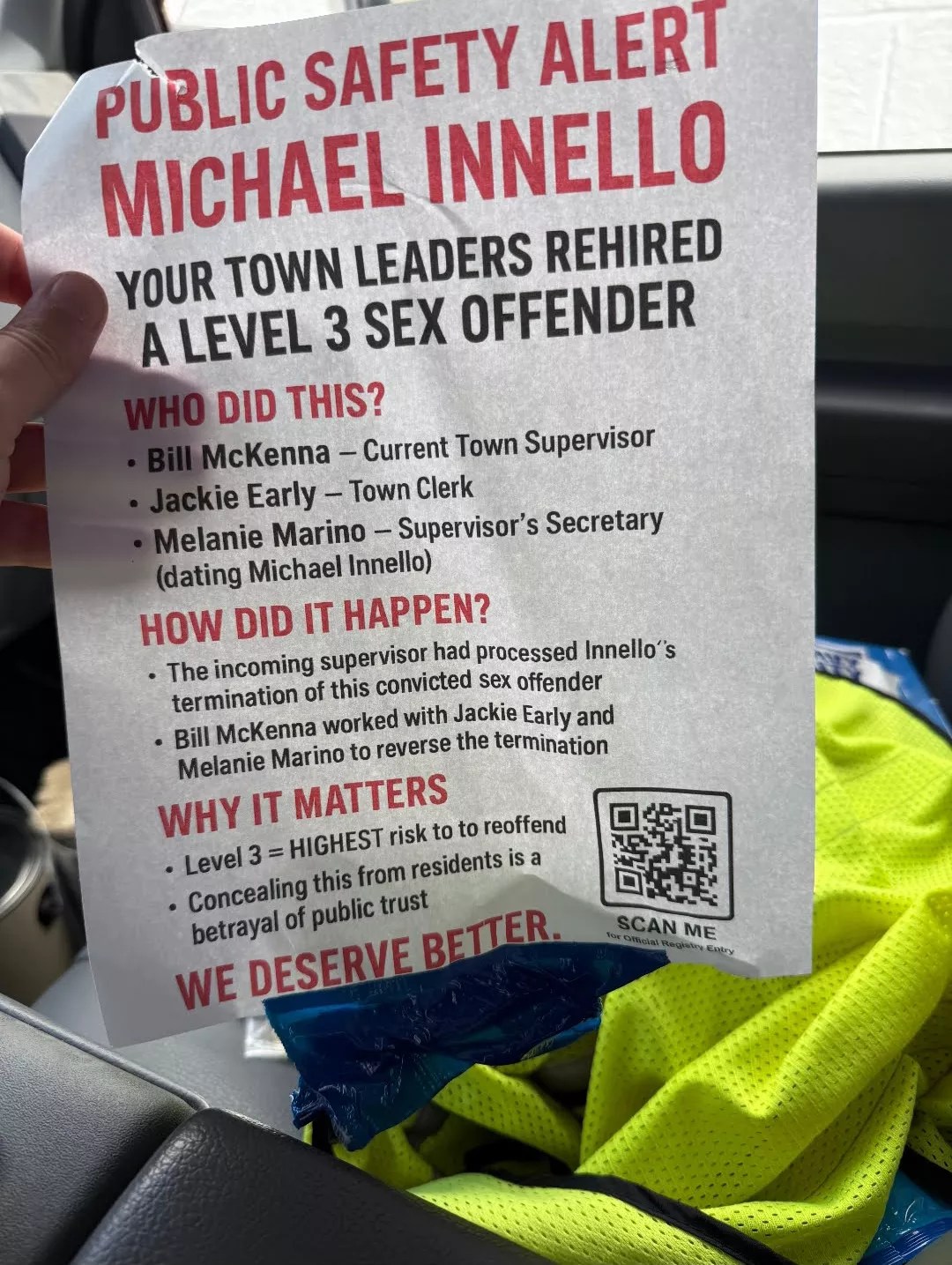
On August 13 flyers started showing up with “PUBLIC SAFETY ALERT: MICHAEL INNELLO” at the top in red block letters. The next day someone saw Innello running a weed trimmer at a busy corner about 400 feet from Woodstock Elementary School and emailed Innello’s parole officer Veronica Ahumada to suggest Innello was in violation of parole for working within a thousand feet of a school. (Ahumada didn’t respond to a request from The River Newsroom for clarification.) That week McKenna lost his last potential board ally when Ricci came out in favor of firing Innello.
Innello’s prospects for keeping his job long term are likely dim. Town board member Anula Courtis won the June Democratic primary for supervisor and given Democrats’ dominance in town, is near-certain to take the job in January. She has also led the board’s efforts to have Innello terminated.
Experts Point to Accountability and Support as Keys to Safety
But sexual violence experts say there are other options for jurisdictions trying to keep the public safe while re-integrating those convicted of a past sexual crime. Promising alternatives have proliferated in recent years in the US and Canada. A 20-year-old program run by Vermont’s Department of Corrections, for example, has those re-entering after prison meet weekly for at least a year with community volunteers who both help them stay accountable and offer social and practical support.
Reoffense rates for those with sexual crimes in their past are already low: 88 percent never reoffend, a definitive 2014 study concluded. But where circles models like Vermont’s have been used, studies show they cut those relatively low reoffense rates even further
Alyssa Ackerman and Alexa Sardina are resarchers who study sexual violence and themselves survivors of rape. The assumption underlying current sex crime policies is the notion that people convicted of sexual crimes “are somehow different from everyone else,” they wrote in the introduction to a 2020 episode of their podcast “Beyond Fear: The Sex Crimes Podcast.” Housing, jobs, and getting beyond social stigma, they noted, ”are precisely the elements that are necessary for a person to reintegrate into their community in a positive, prosocial way.”
This article appears in August 2025.

The River is an independent news outlet that produces in-depth, quality journalism and analysis about the Hudson Valley and Catskills regions. Learn more about our mission and ethics.


Thank you for bringing attention to this. The Florida Action Committee has written extensively about this issue — not only in Woodstock, but across the country. Time and again, we see people reentering the community after serving sentences for a sex offense only to be fired from the lowest-paying jobs, removed from volunteer positions, barred from churches, and essentially shunned for life.
Think about it: someone commits a crime, receives an appropriate sentence, serves their time, and pays their debt to society. Upon release, they should be able to take the very steps that reduce recidivism — finding stable housing, working to support themselves and their families, giving back through volunteerism, and improving spiritually. Yet these are exactly the opportunities being stripped away.
When we cut people off from the very tools of successful reentry, we are not making our communities safer. We’re doing the opposite. This kind of perpetual punishment undermines rehabilitation and public safety.
I knew a person who volunteered during Covid 19 crisis. Had medical experience and would have made a great asset. He managed to volunteer assisting staff but was let go due to his status even though he was not in contact with people. He was backbone, answering calls, paperwork, etc. He freed up important staff personal so they could do their work to save lives.
I posted his story a long time ago on one of the advocacy websites. People would rather see their house burned down to the ground than having someone who can assist to put out the fire who is on the registry.
I am hoping this guy takes this to the Human Rights Division in New York and take this matter to court. He is protected and I believe he could win. (Under Correction Law 23 A. New York’s Correction Law Article 23-A governs the licensure and employment of individuals previously convicted of one or more criminal offenses, aiming to prevent unfair discrimination based on criminal history.)
To comment on the article: If the person was on parole, the question is on the parole officer who is supervising him. Maybe the person should have waited until his parole was over and he is fully released back into society. However, it is a concern with the community, but the registry is built on fear more than facts. There was a court ruling that stated that they way the registry is done in New York is arbitrary and capricious and have no basis in really determining dangerousness. That should be the scary part. This guy deserve to work in order to integrate back into society and live a productive and law abiding life. There are factors that the town should have determined for hiring.
People who molest children always target kids they know. Reporter needs to do its research. They gravitate towards jobs that will give them easy access to kids- piano teachers, gym teachers, child psychiatry and so forth
Only some do; most on the registry were “situational” not “fixated” offenders. You are the one who needs to do research. Lay off the SVU reruns, “Mercy.”
Million dollar properties with zero services. Water polluted. Not drinkable. When will the realtors put polluted water in the listing