









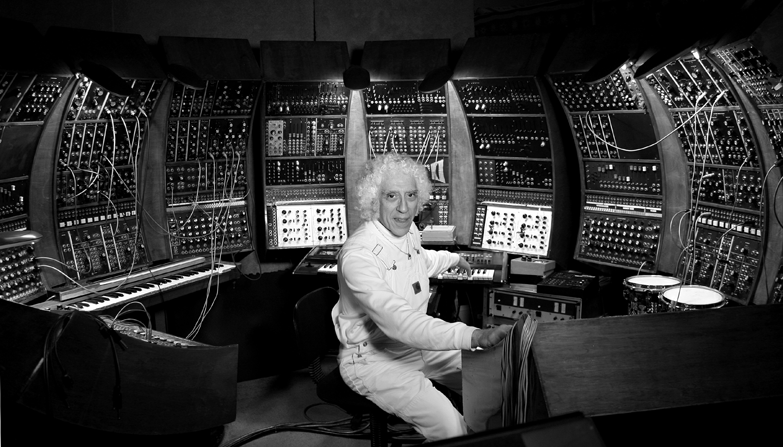
Standing in front of his Saugerties home in a pair of pristine white overalls and waving frantically at your lost music editor, Malcolm Cecil looks like some kind of mad lab technician. In fact, with his thick, curly hair—also a pure shade of white—he looks like an older version of another Englishman with a cult following: TV’s Doctor Who.
Cecil (“In England it’s pronounced ‘Sess-il,’ but I’m an American now so I’ll also answer to ‘See-sil’”) leads the way inside and through the red shag-carpeted living room, a sunny space lined with bulging bookcases and populated with statuettes of Buddah and Hindu deities, Tibetan bells and singing bowls, and a formidable, wall-hanging collection of ceremonial swords and daggers. Then it’s out the back door and past the shed that houses his artist-wife Poli Cecil’s workspace, which is filled with her brightly hued paintings and sculptures. Finally, the spry 70-year-old is standing at the door of his personal studio, a converted barn with a newly sided exterior and a tall-pitched roof. He turns the key, enters, and flicks a light switch.
In one corner of the enormous room is a dark overstuffed sofa, the walls behind it dotted with framed gold records and certificates; a lone shelf holds a Grammy Award. Bookending the couch are two of the musician-producer’s upright basses and taking up the remainder of this half of the chamber are some older tape decks and the usual modern, computer-assisted gear. But dominating the far end of the sanctum is something else—a series of large, gracefully curving wooden cabinets linked closely to form a semicircle. Cecil steps behind the edifice, the clicking of another switch is heard, and the massive machine comes to life. With its loosely hanging patch cords and dozens of randomly blinking lights, the futuristic structure looks like something Lt. Uhuru, rather than Cecil, should be sitting in front of. With his fingers on one of the contraption’s several keyboard units, he starts to play, and a deeply funky, soul-saturated motif fills the room and rattles the floor. The sound is unmistakable, and it should be: This is TONTO (an acronym for The Original New Timbral Orchestra), which, at a height of five feet and occupying 300 square feet, is the world’s largest analog synthesizer and the very one played by Stevie Wonder on such hits as “Living for the City,” “Higher Ground,” and “Superstition.” Cecil began its ongoing construction in 1968 with fellow engineer-producer Bob Margouleff.
“TONTO will always be a work in progress,” Cecil explains. “It was designed to be able to incorporate whatever new technology came down the line.” In actuality, the machine is comprised of several standard-sized Moog, ARP, and Oberheim synthesizers and various sequencers and other units, all connected so as to be played from a single keyboard; hence the “Orchestra” part of its name. (For a great vintage clip of Wonder playing “Living for the City” on TONTO with technical assistance from Cecil and Margouleff, visit YouTube and search for “TONTO & Stevie Wonder.”)

Ask Cecil about his long and fascinating life and be prepared for an answer to match it. He was born into a musical family in northwest London’s Cricklewood district. “My grandfather was an American from the Bronx, and he played the organ for silent films in a Times Square cinema. He was wounded in World War I and ended up in London, where he met my grandmother,” Cecil recounts. “My mother was the musical director of a gypsy band and she played violin, piano, and accordion. My father managed the band.” He found his own release in music early on. Sort of.
“I had a piano teacher when I was very young, but she was very mean and I hated her,” Cecil chuckles. “So I never bothered to practice playing or reading music. Later on, of course, I saw that the girls would really gather ’round if you played music. I decided to give it a go on the bass.”
Around the time Cecil took up the bass, he joined the Royal Air Force and found himself stationed near Newcastle as a radar operator, a position that fueled his growing interest in electronics. (“Throughout my career, I’ve always tried to balance the technical stuff with the musical stuff,” he explains.) During his time off base, Cecil began performing and ran the nearby Downbeat Club with future Jimi Hendrix co-manager Mike Jeffries. (In one of the many other Forest Gump-like moments to come, Cecil made a live recording of Monday-night filler act The Animals, which the band used to get its first record deal; later on, he would also make live test recordings of The Who during that band’s teeth-cutting residency at London’s Marquee.) After leaving the RAF in 1960, Cecil moved back to London, where he became the house bassist at jazz club Ronnie Scott’s. At the legendary venue, he started to make his name as a first-call UK jazz musician, backing up visiting US greats like J.J. Johnson, Stan Getz, Roland Kirk, Sonny Stitt, and others.
In 1964, Cecil got a gig as principal bassist for the BBC Radio Orchestra, working for the venerable broadcaster during the day and in the clubs at night. Unfortunately, in 1967 his relentless schedule and hard-partying lifestyle led to a collapsed lung, which made playing his unwieldy instrument too difficult and forced him to give up his Ronnie Scott’s slot to, coincidentally, another future Saugerties resident: Dave Holland.
Thankfully, Cecil’s RAF experience protected him from being let go by the government-run BBC, which simply reassigned him to its engineering department. In 1968, after undergoing a lung operation and playing in South Africa, Cecil immigrated to the US, where he toured as the bassist for torch singer Laine Kazan. But it would be some time before he could become a citizen, and the country’s then-strict musician’s union laws limiting the work of foreign players had him continuously looking over his shoulder. He took a job maintaining the equipment at busy New York studio Media Sound. It was there that he met Margouleff.
“Bob had one of the early Moog synthesizers and had it set up in the studio,” Cecil recalls. “We started working together and hit on the idea of hooking a couple of Moogs and some other things together, and trying it all out with some original compositions. One day, Herbie Mann was recording downstairs. He’d just been given some money by Atlantic Records to start his own label, Embryo, and since he knew me from my Ronnie Scott’s days, he stopped up to say hello. I played him some of what Bob and I had recorded and he just flipped out. He asked if we wanted to be one of Embryo’s first acts.”
Christening their “group” Tonto’s Expanding Head Band (“The name was Bob’s idea—this was the psychedelic period, and he was always quite the businessman”), Cecil and Margouleff released the LP Zero Time in 1971. To call the record groundbreaking would be a woeful understatement. Comprised of six lengthy, infinitely trippy tracks (sample titles: “Aurora,” “Jetsex,” “Cybernaut”) that arc between lulling ambience and percolating motion, Zero Time sounds like nothing else from its day—or any day, for that matter. (The band released a second LP, It’s About Time, in 1975. Used copies of TONTO Rides Again, a 1996 CD reissue of both albums, have commanded as much as $800 online; Cecil recently rereleased TONTO Rides Again himself, remastered and with extra material, as simply Tonto’s Expanding Head Band.)
“The sounds [Cecil and Margouleff] made were neither kitschy, funny, nor imitative,” writes Cornell professor Trevor Pinch in Analog Days (Harvard University Press, 2002), a book on synthesizer pioneers he co-authored with Frank Trocco. “The soundscape they built pushed the machine and their consciousness to the maximum limits. As they migrated inward, the machine helped them move outward. Musicians came to the instrument and found a willing partner.”
One of these musicians was Wonder, who had been turned on to Zero Time by mutual friend Ronnie Blanco, yet another bass-playing future Saugerties resident. “One afternoon in 1971, there was a knock on my door,” Cecil says. “I opened it and it was Ronnie and Stevie Wonder, who had a copy of my album under his arm. He asked if he could check out TONTO, so we went down to the studio and played a bit. Pretty soon after that we started recording—and didn’t stop for four years.”
And over those years, 1971 to 1974, the partnership, now ensconced in New York’s Electric Lady Studios, produced the landmark, million-selling albums Music of My Mind, Talking Book, Innervisions, and Fulfillingness’ First Finale, records that dramatically and indelibly reshaped pop and soul music through their blending of Wonder’s gospel roots and au courant psychedelic obsessions with the TONTO team’s electronic innovations. “It was just one flowing trip,” Cecil recalls in Analog Days, “with just the three of us [Wonder, Cecil, and Margouleff] in the studio.” While this trip netted Cecil and Margouleff a Grammy Award for their engineering of Innervisions as well as two other Grammy nominations, diminishing production credits eventually saw their association with Wonder come to a close.
But during and after the Wonder years, Cecil remained busy, making hit records with a slew of other artists in the 1970s and ’80s: the Isley Brothers, Steven Stills, Billy Preston, the Jackson Five, Little Feat, Bobby Womack, T. Rex, Jeff Beck, Weather Report. For much of the latter decade, Cecil, his family, and TONTO lived in the Los Angeles area, where Cecil and his creation found lucrative work in the film industry, recording the soundtrack of the first Star Trek feature and other movies. But something was missing in his life.
“I’d been doing all this work on other people’s music for years, but I hadn’t really been playing any myself,” he says. “On my birthday in 1992, I got a call from John Halliwell, the saxophonist in Supertramp, who was my neighbor. He said he knew it was my birthday because he saw my bio in Grove’s Dictionary of Jazz, and he asked if I wanted to jam. I told him I’d stopped playing years before, but he said that I couldn’t stop if I was in Grove’s!,” Cecil laughs. “That got me playing the bass again.”
So how, then, did he end up in Saugerties? Like most of his life’s journey, the route was an unplanned, circuitous one. “Poli and I had moved back to New York in the late ’90s, after I’d taken a job with TVT Records, for whom I was recording [poet-musician-activist] Gil Scott-Heron,” Cecil says. “Then TVT went bankrupt, owing me and a lot of other people money. Luckily, we knew that if we were going to be in the city we had to have an upstate getaway and we’d bought this place.” The Cecils became full-time Saugertesians in 2002.
Since then, the reenergized instrumentalist and composer has been involved in a number of live and recording projects, playing in solo and group settings at area venues like Woodstock’s Colony Cafe and Kleinert/James Arts Center, the latter of which has featured his newest ensemble, Superstrings, a jazz-ethnic-folk fusion duo comprised of Cecil and Russian violinist Valeri Glava.
But if TONTO once held the future, what does the future now hold for TONTO? Any chance of dragging the beast out for another live performance? Unfortunately not much of one, as the instrument’s sheer mass makes moving it an extremely difficult and cost-prohibitive proposition. Thanks to recent technology, however, Cecil has been able to give “Virtual TONOTO” concerts using digital samples taken directly from the source; in fact, last year he headlined at England’s Big Chill festival with just such a presentation. But that doesn’t mean that the TONTO mothership is destined to hide in a barn for the rest of eternity. After all, life, like TONTO, is full of surprises.
“As long as I’ve learned something new every day,” Cecil says, “then I know I’m making progress.”
Superstrings, featuring Malcolm Cecil and Valeri Glava, will perform at the Kleinert/James Arts Center in Woodstock on August 25. www.myspace.com/tontosexpandingheadband.
Related Stories

This article appears in August 2007.


