









The perception of suburbia has changed a lot since the 1950s, when car-based communities outside the city limits were seen as the domestic ideal. Cleaner streets, less crime, better schools, the convenience of shopping malls and supermarkets, a wide lawn and a backyard barbecue—if your family could afford it, you moved to the suburbs. If not, it was a dream deferred, an aspiration for the following generation. You watched “The Brady Bunch” as an instruction manual.
Suburbia’s reputation has taken a beating in recent years. More often than not, the word is used as a blanket pejorative for entire communities perceived as dull and conformist. Current depictions of the burbs on television portray tortured executives and their unfulfilled wives, like Don and Betty Draper of “Mad Men,” a far cry from the honeyed contentment of Rob and Laura Petrie on “The Dick Van Dyke Show,” pesky ottomans notwithstanding.
And then there’s sprawl, the car culture’s masterpiece of nowhereism, three lanes of traffic and strip malls on each side of the divided highway as far as you can drive. You could be in New York or you could be in Orlando. Best Buy. McDonald’s. Barnes and Noble. Wal-Mart.
Small town charm
Orange County is one of the fastest growing suburbs in New York, with a population spike of 10 percent in the last decade. What was once a rural, farming area—the Black Dirt region’s fertility is legendary—has become mainly residential. The two villages of Chester and Washingtonville, in central Orange County however, will cause you to rethink your assumptions about suburbia.
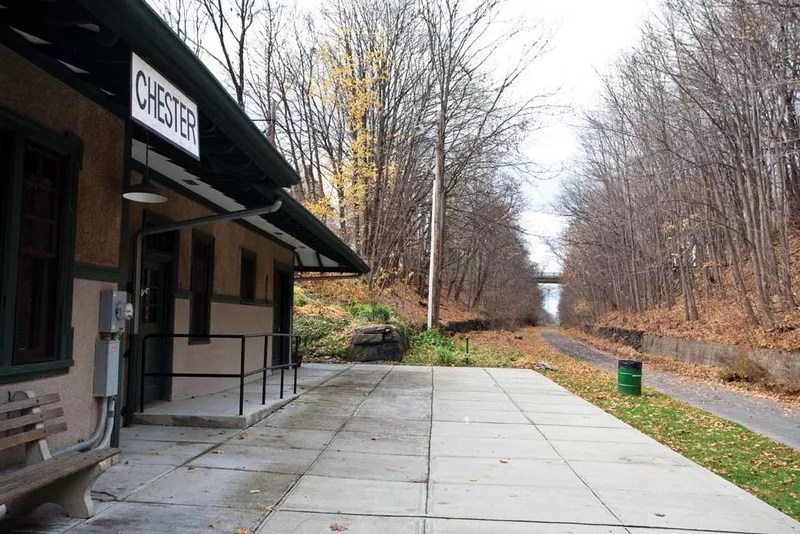
The village of Chester, population 3,500, just north of Route 17 on its way from Monroe to Goshen, has a Main Street perched on a bluff overlooking acres of fields below. The street is lined with three- and four-story buildings built over a hundred years ago, ending at the historic Chester Depot, a train station that now houses the Chester Historical Society. Behind the station lies the Orange County Heritage Trail, a paved, a multi-use rail trail stretching 11 miles from Goshen to Monroe on the former Erie Railroad line. The trail winds through the county’s signature rolling hills, past bird sanctuaries and farmers’ fields, used by bikers, walkers, and rollerbladers. The completed trail will eventually extend 25 miles from Harriman to Middletown.
Across the plaza from the station is Outdoors, a clothing and footwear retailer housed in a massive barn with exposed beams. It’s been a cornerstone of commerce in Chester since 1978. Owner Barry Adelman, like most of the residents and business owners in the region, attributes the success of is business, and the village’s charm, to its old school attention to personal interaction. “In this day and age, you gotta give people a good reason to come, you have to do something special” says Adelman. “Customers really appreciate a small store that can give them the personal service they won’t get elsewhere. I advise my customers.”
Up the street, Jeff Johnson, who runs Awake Fitness, a core to extremity fitness studio with partner Piper Bowman, echoes the lure of Chester’s small town feel. “The town clerk walks by every morning and waves,” says Johnson, whose studio is open to the street with a bank of windows, through which passers-by can watch Johnson coach his clients.
A good place to raise kids
“My favorite thing about Chester is that it’s close knit, and family oriented,” says Stacy Padilla, who runs Pixie Dust, a shop across the streets from Johnson which carries a wide variety of jewelry and New Age and alternative healing items. Padilla cites the annual Kiwanis Halloween parade and the police department’s Easter Egg hunt, as well as the family friendly fare at Clayton Delaney’s dining saloon, a village institution.
Fran Fumo, moved up to nearby Washingtonville from the Bronx 17 years ago. She runs the Kokopelli Cookie Company in Chester, and oversees all the baking herself, testifying that all her cookies are made from scratch. Fumo, too, loves the small town feel of the area. “You can garden in the backyard,” says Fumo. “It’s a nice place to raise your children. It’s growing, but it’s still peaceful.”
Mayor Phil Valastro grew up in Chester and worked the black dirt in his youth, and remembers driving into town in the back of his grandfather’s `55 Chevy for an ice cream cone (for him) and a pack of Camels for grandpa. “I’ve seen Chester go form a quaint farming village to what it is today,” says Valastro. “We have the hustle and bustle of modern-day suburbia: our industrial park, our Lowes, our ShopRite. Most of the people that have come here have come from the city, but they’re trying to get away from that. They want to still be close, but not too close.” Valastro works full-time as a field technician for Verizon in addition to his mayoral duties.
When asked how the closing of Bodle’s Opera House, which operated as a restaurant and performance venue for 25 years until September, will affect the village’s economic prospects, Valastro laments that the shuttering of Bodle’s is keenly felt downtown. Valastro is quick to point out that new businesses have opened up recently on Main Street, including the Angles and Cuts hair salon and A Music Place, a center for musical instruction, and that many empty storefronts are in the process of being refurbished.
The strength of Chester, Valastro believes, lies not in its buildings but in its people. “Whenever the chips are down in this community—when something terrible has happened—the community rallies around to help and gets involved,” says Valastro, citing several instances, including a native son killed in Iraq, whose family was provided with every type of support possible, financial and otherwise. “Yes, we are a bedroom community, but when things are really down, that’s when you see the best of Chester come through. When adversity strikes, we’ll be there for you. Whether you’re family or not, we treat everyone as family.”
Famous Alumni
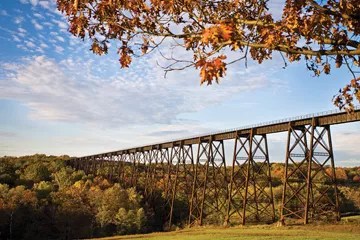
Driving northeast on Route 94 from Chester to Washingtonville, the two-lane road meanders through rural countryside, eventually crossing Moodna Creek just before entering the village. Moodna is a corruption of the Dutch Moordenaars—Murderers’ Creek. It’s said that the creek, which parallels Route 94 for a couple miles around Washingtonville, gets its name from the massacre of an early family of settlers, the Staceys, along its banks by Native Americans in the early 18th century. (In nearby Salisbury Mills, the creek is traversed by the Moodna Viaduct, a railroad trestle almost a mile long and 193 feet high at its highest point, the highest and longest railroad trestle east of the Mississippi River. The Viaduct appeared as a backdrop in the 2007 thriller Michael Clayton, starring George Clooney. The film was directed by Tony Gilroy, who attended Washingtonville High School. Other notable former students in the school district include Scott Pioli, general manager of the Kansas City Chiefs, screenwriter James Mangold, Yankees’ general manager Brian Cashman, and Mel Gibson, who attended six grade here before moving to Australia.)
The high school is one of the first large structures you’ll pass coming in to Washingtonville, and if you happen to do so as the school is letting out, you’re likely to get caught in what passes for a traffic jam in the village. Michael Rossi, the principal at the high school, is a 20-year resident of Washingtonville, where he and his wife have raised their three children. “You have a suburban community, still with some farmland, though not as much as there used to be. But Washingtonville has kept its sense of small town community. When something bad happens, it’s great to see people rally round and help out. I don’t see my myself moving outside this community, it’s the best.”
In the center of the village is the Moffat Library, named for railroad magnate Samuel Moffat, who donated the money to build the library in 1887, on the site of his former home. Added to the Register of National Historic Places in 1994, the library boasts a formidable clock tower and stained glass Tiffany windows. Assistant director Carol McCrossen, an impressive repository of knowledge about the area, enjoys Washingtonville’s access to nature. “I like the country feel of it, the proximity to the natural world,” says McCrossen.
Laurel Stauffer-Daly, who owns Curves of Blooming Grove of Salisbury Mills, also enjoys the area’s outdoor attractions, like nearby Schunemunk Mountain, the tallest point in the county (1,664 feet), where she leads walking groups. Stauffer-Daly’s clientele at Curves, a women’s gym focused on 30-minute circuit workouts, run the gamut in age from 9 to 90, with the majority being moms and retirees. Stauffer-Daly says she never wanted to own a woman-focused business, as she “didn’t want to deal with the catfights,” but it’s been smooth sailing with Curves. “There’s never an argument or verbal altercation in my gym,” says Stauffer-Daly. “All the women know each other because their kids are in the same school or the same church. It really feels like small-town America.” It’s exactly this small-town vibe that has led Stauffer-Daly to try and convince Dr. Mehmet Oz to bring his Highway to Health Bus to Washingtonville and feature the town on his television show.
Kitty-corner to the Moffat Library at the center of town is Gami’s Family Kitchen, a Latin-American hybrid restaurant run by Gami Penaherrera, who serves the dishes of her native Dominican Republic and other Latin fare alongside typical “American” food like chicken wings, wraps, and burgers. Drive a couple miles down Route 94 and you’ll find another ethnic eatery of altogether different color, namely shamrock green—Loughran’s Irish Pub, which is known for its welcoming, cozy atmosphere and oversized portions of prime rib, what Bill Guilfoyle of the Times Herald-Record referred to as “obscenely enormous…large enough to satisfy a grizzly bear.”
Still further along Route 94 is the Bethlehem Art Gallery, run by Robert, William, and Paul Gould, the sons of painter John F. Gould, who established the gallery in 1957 after moving his family from Queens a few years earlier. One of the most prominent illustrator’s of his day, Gould painted hundreds of covers for magazines like the Saturday Evening Post and Popular Science, and counted blue-chip companies like General Electric among his illustration clients. His sons were often used as models for his compositions, and they carry on the family tradition of art and continue to promote their father’s work and offer custom framing services. Paul Gould, a noted landscape painter, also runs the Hudson Valley Gallery in nearby Cornwall.
America’s oldest winery
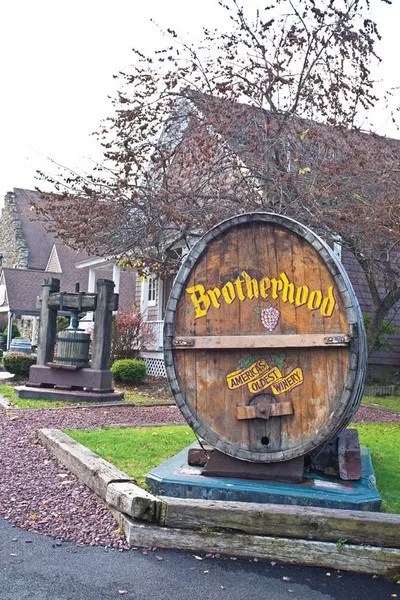
No story that touched on Washingtonville would be complete without mention of Brotherhood Winery, the oldest continually operating winery in the US, and the village’s main tourist attraction. Its first commercial vintage was produced in 1839 by founder John Jaques, a French Huguenot emigrant who was also instrumental in changing the village’s name from Little York to the more patriotic Washingtonville in the early 19th century. Brotherhood, the village’s main tourist attraction, features tours of its cavernous underground cellars and wine sampling in its massive vaulted ceiling tasting room. (Interesting historical note: The winery remained in operation during Prohibition by producing sacramental wine for the Catholic Church.)
For more than a century the winery was known for its sweet wines, some seasoned with fresh herbs and spices based on 19th-century formulas; known as “holiday wine,” it’s been a best seller for many years. Currently owned by Cesar Baeza, a master winemaker from Chile, the winery has started to create wines from vitis vinifera grapes, including Cabernet Sauvignon, Pinot Noir, Merlot, Chardonnay, and Riesling in recent years.
The pleasures of suburbia
For Jeanne Tompkins, who grew up in a small town, and spent many years living in northern New Jersey, Washingtonville is the perfect size. “It isn’t too small, it isn’t too big. We don’t have traffic, and the other problems that they have in Jersey,” says Tompkins, an elder law attorney with a practice in the village who also teaches Spanish part-time at the high school. Tompkins and her husband moved to the area 11 years ago, looking for a place to raise their kids; they have three. “There’s a lot of stuff to do here, we have nice trees and a big yard, it’s affordable, we’re close enough to the city that we can go there all the time, and it’s not so small that everyone knows what you’re doing and is in your business,” says Tompkins. “It’s a suburb without the negatives of the suburbs.”
RESOURCES
A Music Place (845) 613-0064
Adam Pass Photography www.adampass.com
Angles and Cuts (845) 469-4445
Bethlehem Art Gallery www.bethlehemartgallery.com
Town of Blooming Grove www.townofbloominggroveny.com
Brotherhood Winery www.brotherhoodwinery.net
Curves of Blooming Grove (845) 487-8332
Kokopelli Cookie Company www.kokocookies.com
Loughran’s Irish Pub www.loughransirishpub.com
Orange County www.co.orange.ny.us
Outdoors www.outdoors4u.cc
Pixie Dust (845) 469-3940
Village of Chester www.villageofchesterny.com
Village of Washingtonville www.villageofwashingtonville.org
Washingtonville High School washingtonville.ny.schoolwebpages.com
This article appears in December 2009.


