








When Emily Taylor was desperately sick with a bacterial infection that ravaged her gut, she found an unlikely cure: her father’s stool. After being treated for Lyme disease and chronic fatigue with a course of antibiotics in 2009, Taylor had developed the potentially deadly Clostridium difficile (C. diff) infection. “In one month, I lost 40 pounds. I couldn’t keep food down,” says Taylor (not her real name), a Kingston-based artist. “I was extremely fatigued and in bed, and at the end of it I couldn’t take care of my young daughter. I was going to have to be hospitalized pretty soon.” Since all her doctor could offer were more antibiotics, which only made her worse, Taylor took matters—including waste matter—into her own hands. It was on the Internet that she came across the idea of a fecal transplant. A simplified version of the process involves taking fresh, donated stool from a healthy person (in Taylor’s case, her father), whirling it up with water in a blender, and inserting it via enema where the sun doesn’t shine. Almost immediately, the “good” bacteria from the donated stool help to repopulate the sick gut, keeping the pathogenic bacteria in line and restoring the system to health. “It’s pretty gross because it smells horrible, and, you know, it’s poop,” says Taylor. “But it was so worth it. It made a huge difference right away—it was incredible.” After just a three-day course of this unusual, not-for-the-faint-of-stomach solution, she was back to living a more normal life. And the blender? “I threw it away,” says Taylor.
A Friendly Invasion
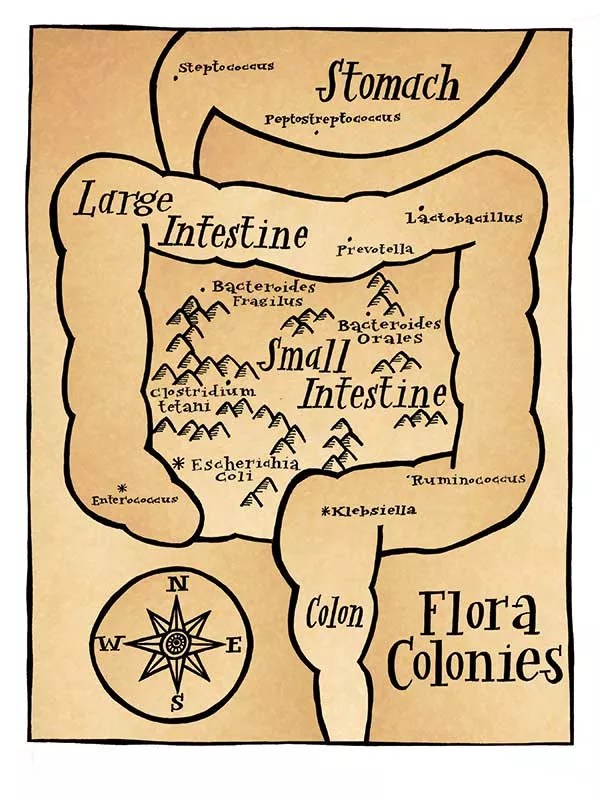
Radical as it sounds, fecal transplant is just one example of a game-changing way of thinking about health and disease, and it’s taking the scientific and medical worlds by storm. A storm of bugs, that is. Researchers are looking to the human microbiome—the vast colonies of bacteria that live in and on just about every part of our bodies—for the secrets to understanding and treating a range of diseases, from rheumatoid arthritis and inflammatory bowel disease to diabetes, autism, and cancer. “This idea that we were raised with, that the only good bug is a dead bug, may sound intuitive but it’s not true,” says Lita Proctor, coordinator of the Human Microbiome Project at the National Institutes of Health in Bethesda, Maryland. “The vast majority of microbes that we come in contact with on a daily and lifetime basis are actually either benign or in many cases beneficial. In fact, we couldn’t live without the microbes. This is a super-new idea, and it’s about thinking of the human body as a whole ecosystem.”
In this ecosystem, it turns out that there’s more “them” than “us.” If you added up all the human cells and all the microbial cells in your body, the microbial cells would outnumber the human cells by 10 to 1. In other words, you’re not alone—although it takes a few years to develop the mature microbial communities that populate the body. An unborn fetus does not host a single microbe, but during delivery, vast bacterial communities from the mother’s birth canal colonize and inoculate the infant. From then on, life is a snowball effect of microbes gathered from food, people, clothing, pets, air—in short, everything.
“By the time a child is approximately three years old, it has trillions of microbial cells inside its mouth, its skin, its nose, its GI [gastrointestinal] tract—every surface has its own particular microbial community,” says Proctor. “They’re unique to each body site and they do many things, including acting as a major trigger for the child’s immune system. They can create antimicrobials that fight off pathogens. In the gut they play other important roles; they help digest our food, and they also make anti-inflammatories.” Most of them—about three pounds’ worth—live in the gut: About 50 percent of the dry mass of human stool consists of microbial cells. Something so omnipresent in our bodies is bound to impact our health, and the microbiome may well be the elephant in the room of the scientific and medical worlds. “We’re starting to recognize that when we think about disease we have to include now this major contributing factor, which hasn’t necessarily been a normal part of our thinking,” says Proctor. “Not only do we need to think about genetics, but we need to think about the contribution of these microbes to human health.”
Science Is Abuzz
Since the Human Microbiome Project started in 2008, with its initial goal of creating a map of all the common microbes in the human body, waves of scientific papers have come out about this field of biomedical research. One team of researchers set up camp at a roller derby to observe and measure the microbial swapping that occurs among players during contact sports. Other studies have connected the destruction of certain bacteria in the body to a higher incidence of chronic illnesses like asthma and obesity. Then, of course, there are the fecal transplant studies, including one that was so successful with C. diff patients that the trial was stopped early because it was considered unethical to withhold the treatment from the control group.
Yet as effective as they are, fecal transplants are controversial, and not just because of their ick factor. Earlier this year, the FDA banned doctors from offering fecal transplants to patients because there was not yet enough research proving their safety. A public outcry prompted the FDA to retract this policy in June, though only for C. diff patients; doctors are still banned from offering fecal transplants to other patients, including those who might find relief from inflammatory digestive scourges like ulcerative colitis and Crohn’s disease. So despite the fact that a doctor-governed transplant—in which the donor-stool solution is administered through a colonoscope—is potentially safer and more effective, many people are resorting to DIY fecal transplants like the one that Taylor whipped up in her own bathroom. Could fecal transplant become the new coat-hanger abortion? The FDA hopes not, and is trying to set up a donor registry that will screen potential stool donors for parasites, communicable diseases, and other hazards. Ultimately, researchers are looking for ways to replace the messy procedure with a sanitized version—and Big Pharma will likely find a way to profit on the microbiome. Says Proctor, “We’re really hoping that scientists can come up with a combination of microbes that people could take in the form of a pill or enema that’s free and clean of fecal waste.”
In fact, that’s already happening. Emma Allen-Vercoe, associate professor of molecular and cell biology at the University of Guelph in Canada, has created a fecal transplant cocktail that she calls, with a wink of scatological humor, RePOOPulate. “There are around 500 to 1,000 different microbial species in the average gut,” explains Allen-Vercoe. “Our RePOOPulate mixture, which is a prototype microbial ecosystem therapeutic, contains 33 different bacterial strains and so is nowhere near as diverse as the human gut microbiota. However, we have included microbial species in our mixture which are considered to play potentially important roles in gut health through the metabolites they produce.” So far the microbial cocktail has been tested on two C. diff patients, both with excellent clinical outcomes—but before Allen-Vercoe and her team can conduct further trials they must sort out regulatory issues, which are very stringent because microbial mixtures are considered biologics, not probiotics, and thus subject to rigorous safety testing. Meanwhile, she is trying out new versions of the ecosystem in her “Robogut,” a lab-based model of the human gut. But it could be a while before regular Joes can get an Rx for something like RePOOPulate from the family doctor.
In Defense of Dirt
While we’re waiting on the science, what can we do? In some cases making small changes can help, suggests Sheryl Leventhal, MD, of Hudson Valley Functional Medicine in Valley Cottage. Many of Leventhal’s patients come to her with chronic autoimmune and inflammatory disorders—tough nuts to crack with traditional Western medicine. “We always start with the gut,” says Leventhal about functional medicine’s integrative method. “And this new thinking about the microbiome is in some ways validating that approach.” When a patient comes to her with arthritis, she might start by asking them about their bowel habits. “They’ll look at me sort of strange, but I’ll point out that about 70 percent of your immune system is in your gut and takes instruction from the gut flora. Part of healing for them might involve a rehab of their digestive flora.”
Much more careful use of broad-spectrum antibiotics, which wage war against not only pathogens but good bacteria too, is important—as is avoiding antibiotic-laden meats and animal products. Leventhal recommends introducing naturally pre- and probiotic foods into the diet such as kefir, miso, and kimchi. “We’ve done so many things to make our food dead. There’s less diversity in the bacteria we encounter in our food and in our homes. But we have some tools available to us to improve the flora and maintain it better, to make ourselves more robust and more resistant to illness.” A little dirt, too, is not so bad. “We might not want to wash everything quite so much,” says Leventhal. “Antibacterial soaps make sense in the hospital, but in the home, maybe not. The way we’re raising our kids is so sterile, and they’re indoors so much. We may not be doing them a favor.”
Life-Saving Potential
At the Human Microbiome Project in Bethesda, the first phase—which involved mapping the microbes of 242 people tracked over two years—is already complete. A second phase, to begin in October, is looking into exactly what all of these microbes are doing. “We need to understand all the kinds of activities and roles they play,” says Proctor. “Now we’re going for the biology of the microbiome.” We already know that many microbes are context dependent—that is, they live as normal microbes in one environment yet can become pathogens out of context. One example is E. coli, which lives happily in the gut but if smeared on the skin could cause a raging infection.
There’s quite a lot more that we don’t know about the microbiome, and some potentially life-changing answers will come out of studying it further. “An old idea has come back now that microbes may be at the root of many kinds of cancer,” says Proctor. “There’s evidence that not only does a disturbed microbiome cause inflammation in tissues but it can also cause DNA damage, which is a hallmark of cancer.” Could eliminating a microbe cure one of the deadliest diseases of our time? Science can’t say for sure yet. In the meantime, we’d do well to take care of the bugs that have co-evolved with us for millennia and that call our bodies home. It could be that they hold our health—and yes, our survival—in their proverbial, ever-so-tiny hands.
This article appears in September 2013.


