









I remember the first time I learned about amber wines from the nation of Georgia. Whereas most widely available “orange” wines I had encountered felt a bit like the producers were just hopping on the bandwagon of the buzzy popularity of skin-contact natural wines, learning about how the small family-owned vineyards in Georgia fermented their amber wines in massive clay amphoras called qvevri then buried them under the earth felt positively ancient, in the best kind of way.

That’s mostly because the art of making traditional Georgian amber wines goes back over 5,000 years, with archaeological evidence that points to the country as one of the oldest (if not the oldest) winemaking regions in the world.
For much of the 20th century, Soviet-era policies forced Georgia’s vineyards away from indigenous grape varieties towards blight-resilient cultivars fit for mass-scale production and export. But now, after three decades spent catching up to the rest of the industry, Georgia’s wines have finally reemerged as the epitome of ancient winemaking in contemporary form.

“Georgia is a very resilient culture. It’s been dominated by many others throughout history, and they’ve been able to maintain their language, their cuisine, and their winemaking through all of it,” says Anastassia Tsivy, who opened the wine bar Oda Wine Garden in the Catskill Mountain town of Margaretville with her husband Noli Alaj this July. “The history of Georgian winemaking is what made us want to focus on ancient-world regions like Croatia, Greece, and Georgia, because they’re not very well known, but the wines are very high quality. We wanted to share the wines from our regions and help people discover them.”
Tsivy and Alaj, who are both first-generation immigrants from Georgia and Albania, respectively, began dreaming of opening Oda after trips back home to both countries before Covid. “It made us appreciate our own culture,” says Tsivy. “It is very different the way that we eat and drink together, and what those things mean to us.”
Though they’ve both been working in the corporate world for the past 10 years, the two called on their combined 20 years of working in the New York City hospitality industry in opening Oda. Tsivy honed her wine knowledge working at several wine bars, including the beloved Spanish tapas spot Ñ in Soho, while Alaj worked both front- and back-of-the-house positions in the critically acclaimed restaurants of fellow Albanian immigrant and early farm-to-table champion, chef Zod Arifa.
After many weekend trips up to the Catskills, they bought a home in Andes about six years ago, and when the opportunity arose earlier this year to open a little spot of their own on Main Street in Margaretville, they jumped. “We looked at the space and the patio, and we thought maybe we could do something here,” says Tsivy. “It was pretty spontaneous.”
They completed most of the renovations for the space themselves, transforming the tiny interior of the former barbershop into an intimate 18-seat dining room with crisp white walls, birch-hued wood chairs and barstools, and a thick wood slab bar. Soviet-era posters and advertisements for Georgia adorn one wall. Out front, the pea gravel patio seats 20 or more in good weather, a perk my party and I enjoyed on our visit.
A Palate-Expanding Menu

The menu at Oda focuses on the rich culinary and winemaking heritage of countries in the Balkans and Caucasus regions. The 14 wines offered by the glass and carafe during our visit ranged from stony whites from Spain and Greece to a peppy rosé from Catalonia, a tannic, bone-dry Georgian amber, and complex, lesser-known reds from Croatia, Slovenia, and Georgia, with a few more familiar French options thrown in for good measure.
The pricing on the orange wine section alone is a microcosm of Oda’s approach: with three options at $11 to $17 a glass, there are blessedly affordable options alongside splurge prices for adventurous wine lovers out for an exploratory sipping sesh. The bottle list of close to 100 wines is where Tsivy gets to play with sourcing more obscure varieties like Greece’s beloved Retsina, a wine fermented with the resin or branches from the Aleppo pine tree that the country’s producers are bringing back from a harsh edge of unpalatability.

On the food side of the menu, Alaj is turning out a tight list of well-composed small plates mostly inspired by Balkan cuisines. Individually, most dishes pair well with a glass of wine as a pre-dinner aperitivo or—like we did, they can be combined into a pretty substantial meal.
For anyone intimidated by unfamiliar flavors or ingredients, there are several plates that pull from well-known European traditions to fall back on, including a chicken liver or mushroom paté ($7), a burrata salad with heirloom tomatoes ($13), and the impressive-looking whole-roasted eggplant with whipped ricotta-mascarpone cream and green olive relish ($13).

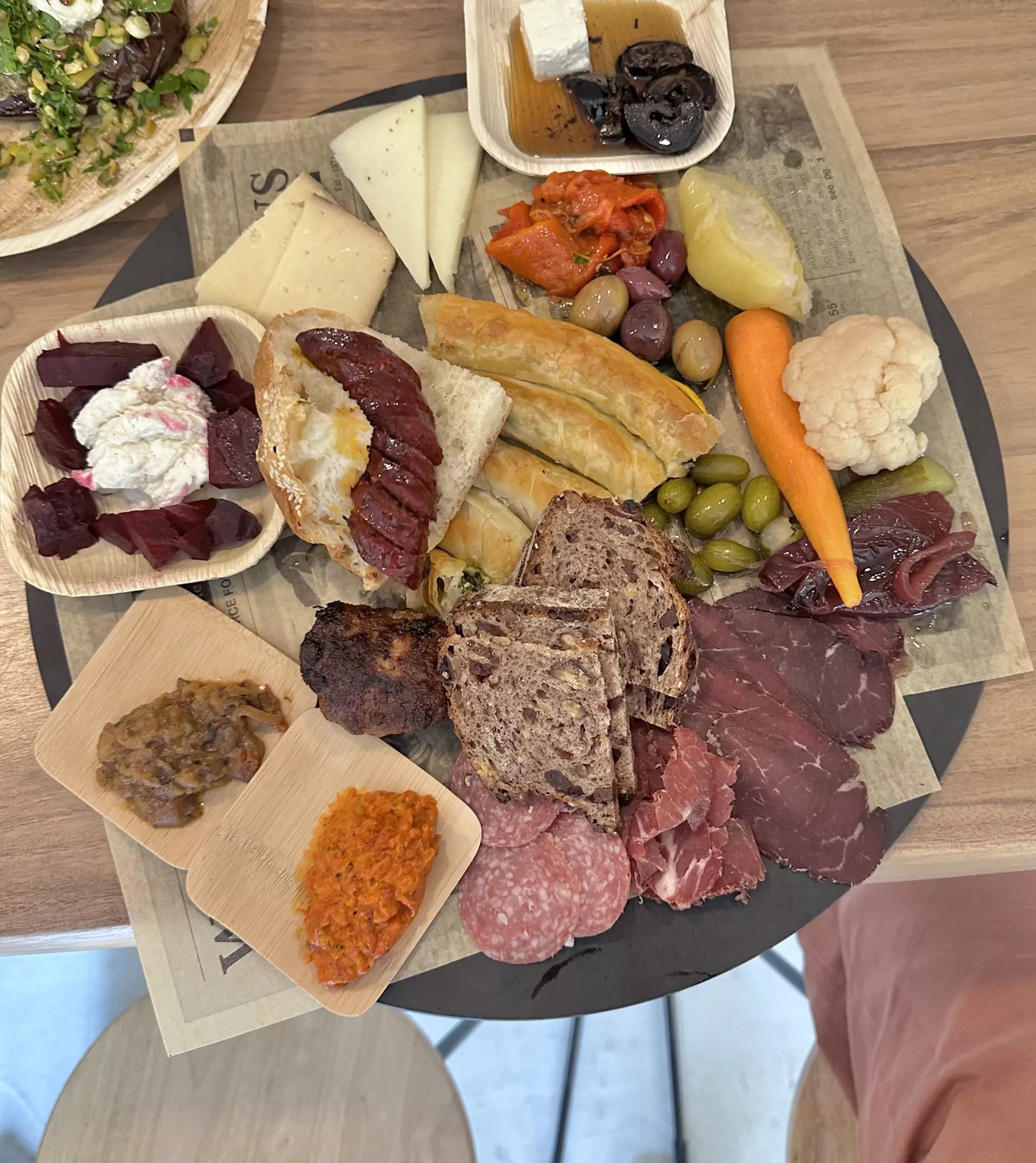
The Balkan platter ($40) is the standout dish on the menu. It leans heavily into the bold, bright flavors of Albanian and Georgian cuisines, and combines many of the menu’s other small plates into one.
Alaj rotates its components regularly, but on the evening we visited, it featured sujuk, an Albanian fermented spicy beef sausage; smoked beef prosciutto; a creamy Albanian red pepper sauce called ajavar; several types of cheeses, including a barrel-aged feta served with Georgian preserved walnuts (unripe walnuts poached in syrup until their shells are softened and made deliciously edible); smoked beets with mascarpone, a hefty wedge of flaky spinach burek; pide bread; and an array of house-fermented vegetables, offering a bracing bite to cut through all that richness.
Oda Wine Bar is open Friday 5 to 10:30pm, Saturday 12pm to 10:30pm, and Sunday 12 to 8pm.



Isn’t Georgia in the Caucasus, not the Balkans?
Hi Nate, Georgia is indeed in the Caucasus! There’s a little line in the piece that describes the menu as mostly focused on the culinary and winemaking heritage of countries in both the Balkans and Caucasus regions.
Overall, the owners are currently describing their small plates as Balkan. The food menu (and particularly the dish they call the Balkan Platter) currently leans more heavily in the Balkan direction, with a few small elements like the preserved walnuts and some of the pickled items imported from Georgia. Though there are definitely many shared influences and similar dishes among both regions, like the burek, so it perhaps becomes a little tricky to pin down which region gets to claim which dish!