








“It was a time in the art world when the East Village was booming, and people were driving up to these crummy buildings in their stretch limos and fur coats—they were all trying to find what the new art was,” recalls Livia Straus, director of the Hudson Valley Center for Contemporary Art in Peekskill. “Circa 1986,” a survey of art from the 1980s, mostly from New York City, will run at the center until July, 2012. The show consists of 65 artworks created between 1981 and 1991.
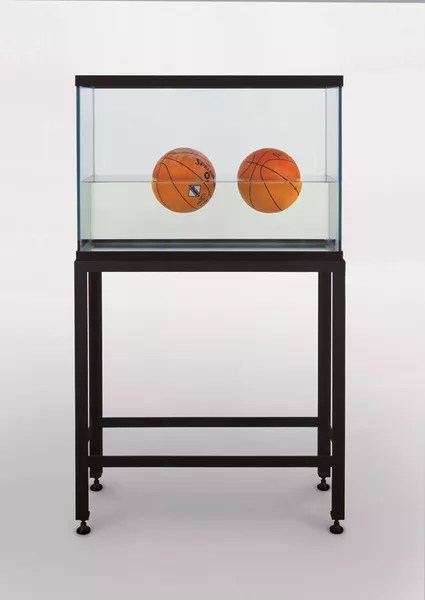
The `80s in downtown New York was a delirious decade, and the art itself feels like a party. Even Jeff Koons’ Two Ball 50/50 Tank may be seen as the aftermath of a wild spree. Paintings and sculptures were created to fit in small, artist-run galleries. The art is social, conversational. “Low” art—especially cartoons and comic books—influenced painters. The audience was friends, scenesters, people outside the “art world”—which, come to think of it, included me. Living in the East Village in 1988, I visited galleries, and found art I could believe in. This period of experimentation unleashed superstars of contemporary art: Damien Hirst, Robert Gober, Julian Schnabel, Richard Prince (all of whom appear in “Circa 1986”).
In the world before personal computers and cellphones, an artwork was still essentially a physical object. “Circa 1986” has a tactile feeling, as if the artists were smearing paint with their hands. Walter Dahn’s Trying to Look like a Flower shows a naked man—maybe a caveman?—bowing against a wall. We see the man’s motion, and also the impulses of Dahn’s brush. People use the word “expressionistic,” but a better word would be “grappling.” One feels the art being grappled with by the artists.
Painters learned from punk that art could be profound without being serious. The Ramones were great because they rejected the “skill” of rock. Hip-hop, similarly, evaded the solemnity of jazz. The word “transgressive” was often used to describe art of the 1980s. It referred to work that was radical, indelicate, shocking. This type of art could also be extremely funny. Rona Pondick’s Little Bathers is an installation of numerous flesh-colored balls, each equipped with a set of teeth. Eventually, this movement erupted in political struggle, when the Corcoran Gallery of Art refused Robert Mapplethorpe’s exhibit in 1989. Mapplethorpe is represented in “Circa 1986” by a self-portrait from 1988 of the photographer already emaciated from AIDS, clutching a cane with a skull handle. Another theme was “appropriation”: taking an image from another source. Richard Prince cut out a picture from a Marlboro ad, entitled it Untitled (Cowboy) and deemed it a work of art. Sherrie Levine’s Untitled (After Walker Evans Negative #9) is a photograph of a Walker Evans picture from a catalog. This movement is now called the Pictures Generation.
A number of the artists in the show, who were living in New York City in the `80s, have since moved to the Hudson Valley: Rick Prol to Beacon, Richard Artschwager to Hudson, Nancy Dwyer to New Paltz, Jenny Holzer to Hoosick Falls. Welcome to the East Village diaspora!
“Circa 1986” will appear at the Hudson Valley Center for Contemporary Art in Peekskill until July, 2012. (914) 788-0100; www.hvcca.org.
This article appears in October 2011.


