









Five decades ago, an ambitious young man from a small Nigerian village put the handwritten manuscript of his first novel into a brown paper parcel and shipped it to a typing service in London. Months went by without word; the package, it seemed, had been lost. In desperation, the author begged an English colleague at the Nigerian Broadcasting company to stop by the typing service when she went to London on leave. She found the package languishing on a back shelf and got it contents typed posthaste. The book was called Things Fall Apart.
Since its first publication in 1958, Chinua Achebe’s masterpiece has sold over 12 million copies worldwide; it’s been translated into over 50 languages. Achebe, whose other novels include No Longer at Ease, Arrow of God, A Man of the People, and Anthills of the Savannah, has received over 30 honorary degrees and a cornucopia of literary awards, including the 2007 Man Booker International Prize. He is widely considered, in Lewis Nkosi’s words, “Africa’s greatest indigenous novelist.”
Given this kind of acclaim, it’s startling to visit Achebe’s home on the Bard College campus. The world-renowned novelist lives in a nondescript ranch house on a sleet-streaked back road, so easy to miss that the publicity office offers a driving escort. Achebe answers the door himself. He has used a wheelchair since 1990, when a car accident left him paralyzed from the waist down; his presence imparts it with the majesty of a throne. He moves to the dining room, turns, and says simply, “Here.”
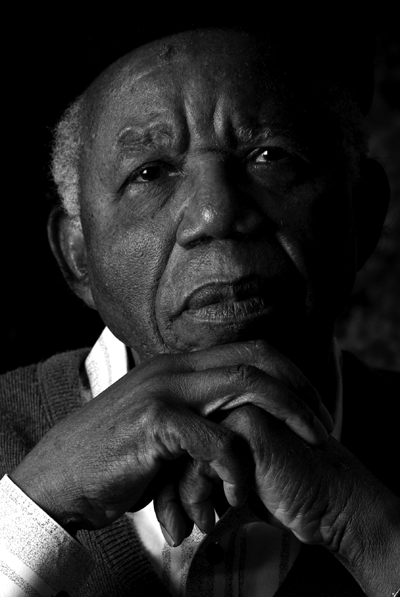
Achebe has a powerful face, with an unswerving gaze and deeply carved lines around a strong mouth. He’s wearing a striped broadcloth shirt, a coffee-toned vest, and dark trousers, with a black beret at a rakish angle that recalls a resistance leader. He speaks with a quiet authority, sometimes so softly one needs to lean forward. His hands are long-fingered and graceful; they dance as he talks, kneading the air. His dignity is palpable, but there’s nothing austere or pompous in him—it’s as easy to picture him grinning at his four grandchildren as mesmerizing an international audience.
The house is decorated in earth tones, with dark leather club chairs and vases of dried flowers. There’s a sideboard covered with family photos, and numerous African carvings and masks collected by Achebe’s wife Christi, a psychology professor at Bard.
For years, the author turned down nearly every request for an interview. Then he changed his mind. “What is this business of writing?” he asks. “Obviously, there is something I want to communicate with people. That’s what the writing is about, to hold conversations with people, with your culture, with yourself.”
Though Achebe doesn’t remember exactly when he last read Things Fall Apart, his respect for his freshman effort remains intact. “I look at it now and again. It is still a marvel, it’s still a surprise,” he says, smiling. “I had no experience of that kind of thing. I had scribbled a few short stories in college.” The stories, like his groundbreaking novel, were written in English.
Achebe explains, “English was the language of education in British colonies, which we were…” He trails off. “The fact that it is a foreigner that arrived in my home and seized power struck me at a certain point. At other times, I’ve taken the view that this is a language with which I had no quarrel. A language doesn’t really fight with you, unless you want it to.” The language of Achebe’s village, Ogidi, was Igbo—one of Nigeria’s three principal tongues—but school was always in English.
Achebe’s father was Ogidi’s first convert to the Church Missionary Society, a devout evangelical Protestant who baptized all six of his children. But young Albert Chinualumogu Achebe was also drawn to his “heathen” uncle’s ancestral traditions. In his autobiographical essay, “Named for Victoria, Queen of England,” Achebe (who dropped the “Albert” in college) writes that he was born “at a crossroads of cultures.” His family “sang hymns and read the Bible night and day,” while his uncle’s family “blinded by heathenism, offered food to idols. That is how it was supposed to be anyway. But I knew without knowing why that was too simple a way to describe what was going on. Those idols and that food had a strange pull on me in spite of my being such a thorough little Christian.”
Achebe loved books as a child, especially such “African romances” as Mister Cary and Prester John. Years later, he gained a different perspective on these colonial narratives. “You look at something you thought was fascinating and realize there was something more, that your people were put down very badly in these stories. These were some of the ideas floating around when I sat down to write Things Fall Apart. I had to write a different kind of book.”
Things Fall Apart tells the story of Okonkwo, a villager whose unbending strength sets him at odds with his tribal culture and on a collision course with the first wave of white missionaries. Achebe wanted his book to bear witness, but knew it must also be “pleasurable. Stories have to be this way to make any impact; they have to be good stories. That was my task: How do you write good stories about your community, your people, and in what language? My education, my literary language, is English, but what I’m writing about is happening in Igbo.”
The solution was to capture the flavor of Igbo speech. “As a child I knew a number of very eloquent people. That eloquence was what I had to convey. I attempted to convey the spirit of that language in English. I had to invent a language. It doesn’t appear in any book before it.” In his essay “The African Writer and the English Language,” Achebe dubbed this creation, “African English…a new voice coming out of Africa, speaking of African experience in a world-wide language.”
As snow swirls past his window, Achebe continues. “The way I look at literature—it’s something you do with a big community in your view. It’s not a private concern. Especially an ex-colonial like me, who just managed to catch a glimpse of my past before it disappeared altogether.”
Nigerians of his generation hold a unique place in history. “We are the last people who know what our past was. Our parents knew the past, but they didn’t know the present. Our children don’t know the past, except what we tell them in stories,” he notes, stressing the importance of “making sure the story does not disappear. The manuscript of Things Fall Apart very nearly disappeared. That shows you just how fragile, how tricky our situation in the world is. There are so many things we have to make sure are not gone forever.”
Achebe gets letters from readers on every continent, including American high school students (Okonkwo’s righteousness thrills inner-city teen boys). He’s also received occasional letters from Native Americans who connect his work to westward expansion and the erasure of their traditional culture by European colonials.
Literature, for Achebe, is inextricably political. His widely read essay “An Image of Africa: Racism in Conrad’s Heart of Darkness” confronts Joseph Conrad’s vision of Africa as “the antithesis of Europe and therefore of civilization, a place where man’s vaunted intelligence and refinement are finally mocked by triumphant bestiality.” When he first presented this lecture as a visiting professor at the University of Massachusetts in the 1970s, many academics were scandalized; one huffed in his face, “How dare you?”
Multiculturalism has made some inroads—Achebe reports that his current Bard students are more conversant with non-Western authors than those he taught a generation ago—but there is much to be done. “The story of the world has not yet gained the momentum it needs. A different account in many instances needs to be created. The reason it’s not there yet is that we tend to leave issues of justice and fair play to those who have been hurt,” he asserts, noting that gender issues are usually left to women, and issues of race to minority writers. “When those who did the hurting see it as their responsibility…to find that injustice and expose it, even if it’s late in the day, then we can take the steps necessary to live as one people.”
The afternoon sky is darkening, and Achebe sounds tired. Perhaps his long exile is making him weary. When he was invited to teach at Bard in 1990, he assumed he would stay for a year or two; he’s renewed his contract 17 times.
“I am a resident but not a citizen, and there’s a difference, especially because things are not working well in my country. That’s one reason I feel my absence more acutely,” he says. In 2004, Achebe turned down the honorary title of Commander of the Federal Republic in protest over the state of affairs in Nigeria. Would he do the same today? “Absolutely, without question. Though I don’t think they would make the mistake of offering it to me again,” he laughs.
In spite of political setbacks and healthcare issues, Achebe still dreams of moving back home. He wants to translate his novels from English into Igbo, “which I think would more or less round up my career.” He’s currently working with his son Ikechukwu, the only one of his children who lives in Nigeria, on an Igbo dictionary. Achebe’s other three children and all four grandchildren live in various parts of the US, from Red Hook to Michigan. “We’re all accidental exiles,” he says ruefully.
Eight years ago, Chinua Achebe told a New York Times interviewer, “There’s a reason we were planted in a certain place. Our people have a saying: The whole essence of travel is to go back home.” To that end, he’s working long-distance with an architect to modify a house in Ogidi for wheelchair access. I hope I’ll be able to go home soon,” he says, gazing out at the snowdrifts. “There’s so much to do.”
Local celebrations of Things Fall Apart’s 50th anniversary include events at Bard College, SUNY Ulster, and at locations in Poughkeepsie and Kingston.
Visit www.chronogram.com for more information.
This article appears in March 2008.


