









It’s one of the most surreal and mysterious albums ever recorded. The striking, Afro-delic cover by painter Abul Mati Klarwein hints at the imagery of the music inside: an endless, nebulous alien landscape of wafting fumarole vapors and burbling thermal pools; a flickering DayGlo dream spiked with ghostly electric piano, throbbing bass, searing fuzz guitar. Horns that erupt and recoil back into the mist. Beats that flutter, turn, and skitter like frightened insects. Today it’s hailed as the revolutionary masterpiece that popularized jazz-rock fusion, but at the time, many jazz aficionados, especially the purists, believed their beloved, shark-suited, cool-blowing hero had turned into a funky, bad-ass Antichrist more intent on making noise than music. That it so divided the jazz world and still became one of the best-selling and most influential recordings of all time is one of music’s most savory ironies. Though conjured a generation ago, its otherworldly spell has never waned; even now it sounds like it’s drifting in from some future galaxy. It exists on a plane where it makes its own time and yet there is no time.
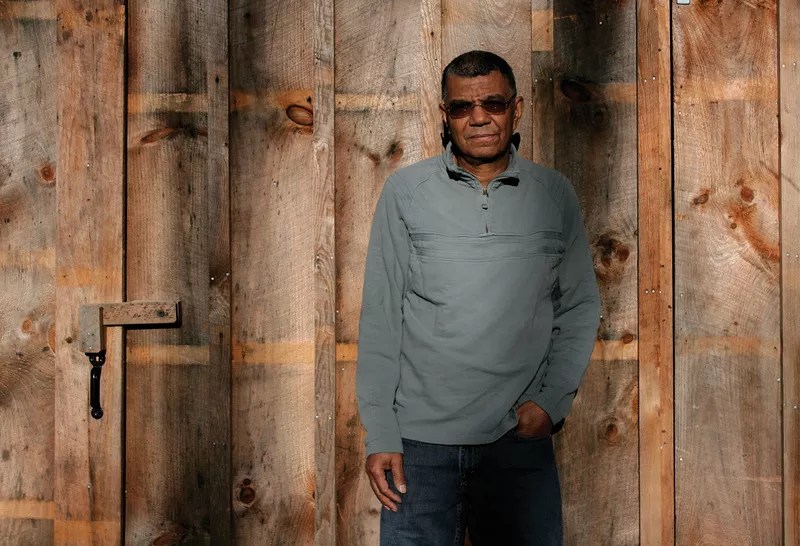
The album in question is Miles Davis’s sprawling 1970 double LP Bitches Brew, which Columbia Records recently honored with a lavish 40th-anniversary Legacy Edition. And one of this landmark’s key creators is Woodstock’s Jack DeJohnette, one of jazz’s greatest living drummers.
“What Jack DeJohnette has that lots of drummers don’t is the almost unlimited color in his playing,” says New York Times music critic Ben Ratliff via e-mail. “It’s a lot to do with cymbals—what he uses and how he uses them—but also just the breadth that’s in his sound as a whole, all the little decisions and changes of direction he makes at hundreds of different points inside a tune.” DeJohnette has been on the planet for 68 years, and he’s been a musician for nearly all of them. His gifts as a drummer frequently overshadow the fact that he started out in his native Chicago as a pianist, beginning lessons at age four with a friend of his grandmother who taught him to read and play pieces from the classical canon. “As a kid I always liked music and lyrics,” he recalls. “My family had a crank-up Victrola and lots of 78s by Louis Armstrong, Tommy Dorsey, Count Basie—most of the big bands. We also loved gospel music: Clara Ward, the Soul Stirrers. Thomas A. Dorsey [called the father of black gospel music] lived right down the street.” But he credits an uncle who worked as a radio announcer and jazz DJ with introducing him to the stage.
“When I was about eight he took me to the Persian Lounge [the future haunt of pianist Ahmad Jamal, another early influence] to see [blues guitarist] T-Bone Walker,” says DeJohnette. “I had this kazoo that looked like a little saxophone. T-Bone saw it and asked me up to play with the band. So I started to toot out some R&B instrumental hit, I don’t remember what song, and all of sudden the band came in behind me. It really freaked me out. I was, like, ‘Wow, how do they all know the song?’” (According to DeJohnette, his mother, Eva Jeanette Johnson, a poet, wrote and sold to Walker the lyrics for the bluesman’s immortal “Stormy Monday Blues.”) By high school he was a percussionist in the marching band, but came to play proper drums “by accident, really.”
“I had a little jazz combo that used to rehearse in the basement of my grandma’s house and the drummer left his kit there, so I used to play around on it,” he says. “When my grandma died she left me some money, so I bought my own kit and started to play along to my uncle’s records. I realized I had a natural affinity for the drums.”
While studying at the American Conservatory of Music, the young musician immersed himself further in the local jazz scene, alternating on piano and drums. “Chicago was great for jazz back in the mid 1950s and early 1960s,” says DeJohnette. “It was a midway point for a lot of musicians who would move up from smaller cities, like St. Louis, before they went on to New York. One day [saxophonist] Eddie Harris told me, ‘You play good piano, but you play drums better. If you stick with the drums you’ll go far.’ So I did. And he was right.” Another mentor was pianist Mulhal Richard Abrams, who headed the pivotal Association for the Advancement of Creative Musicians (AACM), an avant-garde collective that birthed the Art Ensemble of Chicago and included young firebrands like saxophonists Roscoe Mitchell and Anthony Braxton and trumpeter Wadada Leo Smith. In addition to working with various AACM members, DeJohnette briefly played with bandleader Sun Ra, while another life-changing guest spot came when he sat in with the John Coltrane Quartet. “The band was booked to do four sets that night and [drummer] Elvin [Jones] didn’t show up for the last one, so Trane asked me to play,” recounts a still-awed DeJohnette, who describes the experience as “awesome. Completely amazing.”
In 1964 DeJohnette came to New York with “$27 in my pocket and a set of drums.” He crashed at the Sloane YMCA on 34th Street and began hitting the jam sessions at Harlem’s legendary bebop crucible, Minton’s Playhouse. After first scoring a regular gig with organist Big John Patton he landed a higher-profile slot with saxophonist Jackie McLean. But he got his big break during the years 1966 to 1968 as a member of saxophonist Charles Lloyd’s quartet, a group that also featured another future Miles man, pianist Keith Jarrett. The group made several hot-selling LPs for Atlantic and proved a crossover hit on the burgeoning hippie-rock concert circuit. The drummer debuted as a leader with The Jack DeJohnette Complex (Milestone Records) in 1969.
And it was that year that the jazz king came calling. “It’s funny,” DeJohnette says. “Miles used to come and check me out back when I was with Jackie McLean, and one night Jackie said to me, ‘Miles is gonna hire you someday, man. He and I have the same taste.’ And it was true: [Drummer] Tony Williams had been with Jackie before he was with Miles. When he left, Miles asked me to replace him. By then I’d subbed for Tony a few times, so I’d played with Miles a bit. But it was still incredibly exciting. I’d grown up in Chicago listening to this legend, never thinking I’d get to be in his band. But there I was.”
There he was. In the middle of the Bitches Brew sessions, which saw the trumpeter building on the radical new “directions” he’d begun with 1968’s Filles de Kilimanjaro and ’69’s In a Silent Way (both Columbia Records) and taking the amorphous music even farther afield. Epics like the title track and “Miles Runs the Voodoo Down” incorporate the pulsing funk and fiery acid rock of contemporaries like Sly Stone and Jimi Hendrix; the set’s experimental sound is further defined by the work of producer Teo Macero, who, long before Pro Tools or digital sampling existed, used razor blades and adhesive to splice together snippets of tape from various jams and takes, running many of the tracks and sections through spacey reverb and other psychedelic effects. And the performances themselves, by a band that also includes guitarist John McLaughlin, drummer Lenny White, keyboardists Joe Zawinul and Chick Corea, saxophonist Wayne Shorter, clarinetist Bennie Maupin, and bassists Dave Holland and Harvey Brooks—often playing tunes utilizing two basses, keyboards, and drum sets simultaneously—are as bold and inspired as the leader’s vision.
“I was very happy when Jack joined Miles’s band,” says Holland, a long-time Saugerties resident. “Jack has great musical instincts and a tremendous ability to hear the music and interact with the other musicians. I met him in London in 1967. He was there to perform with the Charles Lloyd Quartet and I was in the audience. We met again later that night at a jam session. I was playing with some friends when Jack came up in the middle of a piece and took over on the drums. It felt great and we had an immediate connection and compatibility that continues to this day.”
DeJohnette left Davis in 1972, after contributing to that year’s On the Corner, another adventurous game changer, and the heavy touring that also produced a trio of monumental live LPs for Columbia. By then he and his UK-born wife, Lydia, were ensconced in Woodstock, after being introduced to the town by friends in the Paul Butterfield Blues Band. “We just fell in love with [the area],” says DeJohnette. “And there were already a lot of music people we knew up here—Charles Mingus, [ex-Davis drummer] Jimmy Cobb, [pianist] Warren Bernhardt.”
Since the move DeJohnette has led his own bands (the fusion groups Compost, Directions, and New Directions and the straight-ahead Special Edition), co-led the underrated trio Gateway with Holland and guitarist John Abercrombie, and served as a sideman to guitarist Pat Metheny, pop musician Bruce Hornsby, and others. In addition to his long-standing gig in Keith Jarrett’s “standards” trio, the Down Beat poll-winning drummer has performed with guitarist John Scofield and organist Larry Goldings in Trio Beyond and continues to tour with the five-piece Jack DeJohnette Group.
As is the trend these days DeJohnette has started a label to release his music, Golden Beams Productions. One of the imprint’s acclaimed releases is 2009’s Music We Are, a CD/DVD package featuring a documentary that premiered at the Woodstock Film Festival. Along with ear-opening collaborations with guitarist Bill Frisell and kora master Foday Musa Suso, the label is also home to two releases reflecting the percussionist’s newfound interest in New Age/meditation sounds, the Grammy-nominated Music in the Key of Om (2006) and the Grammy-winning Peace Time (2007).
“We live in uncertain, stressful times and people need to be able to relax, especially with all of this political bullshit going on,” DeJohnette says, the day after November’s Congressional elections. “I’ve always had a very spiritual outlook with music, which is also something I experienced with Trane and Mulhal. It’s good to do something that really focuses on the healing properties music has.” Building on this philosophy, he and Lydia have also worked with Kingston and Benedictine hospitals to set up a closed-circuit-TV program broadcasting the two albums’ calming music and nature images by New Paltz photographer G. Steve Jordan to patients. “It seems to be especially helpful for people in hospice care, and we’d love to see it spread to other hospitals,” says DeJohnette. Additionally, each year Lydia organizes benefit concerts by DeJohnette and others for social-assistance organizations Family of Woodstock and the Queens Galley; earlier this year, DeJohnette, bassist Larry Grenadier, saxophonist Joe Lovano, and guitarists John Scofield and Larry Coryell raised $10,000 for the Queens Galley.
As he prepares to leave for another tour, how does all of the hubbub surrounding Bitches Brew’s big 4-0 hit him? “It’s been a long time [since the release], but to me there’s really no sense of that,” says the tall percussionist, squinting against the sun that fills his wood-lined living room. “Miles isn’t here anymore, but we still have the music. It’s imprinted into the ether, in what I call the ‘Cosmic Library of Consciousness.’ It’s in the air like the radio, and we can just tap into it whenever we want to, forever.
“When I stop to think about it, though, it’s just unfathomable, that it’s been 40 years. I think, ‘Was it really that long ago?’ Because, you know, there’s only this moment. There’s only right here and now.”
The 40th anniversary Legacy Edition of Bitches Brew is out now on Columbia/Legacy Recordings. www.legacyrecordings.com; www.jackdejohnette.com.
This article appears in December 2010.


