









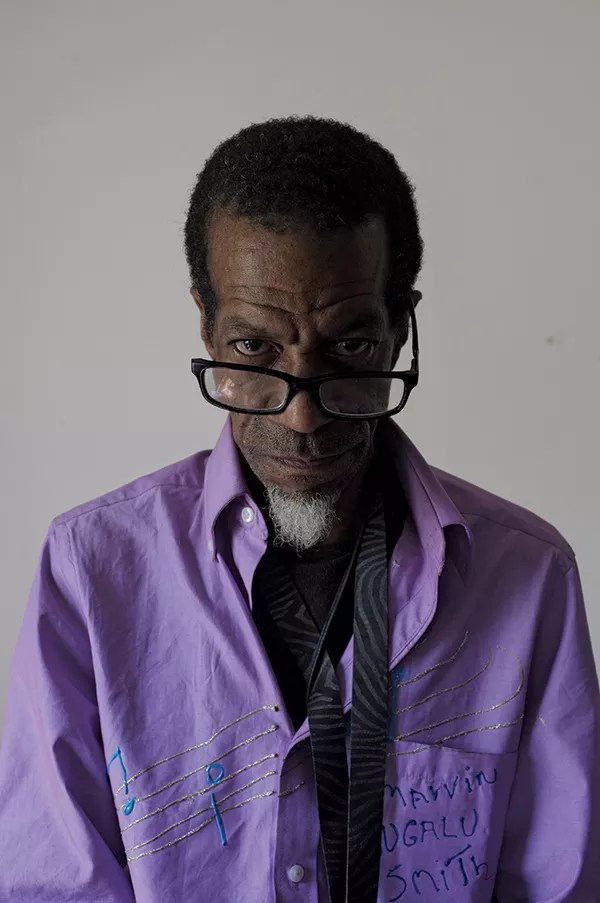
There is little that will prepare you for Marvin “Bugalu” Smith.
“Oh yeah, I’m the man,” proclaims the wiry, raspy-voiced drummer. “When I come onto the stage the whole place changes, and everybody knows it—I’m the man who swings the band!”
And swinging the band—his own as well as those of Sun Ra, Chet Baker, Archie Shepp, Charles Mingus, and many others—is exactly what the animated, colorfully eccentric Smith has been doing for the majority of his 63 years. “Everybody loves playing with me, but at the same time it scares some people,” he says. “They say, ‘Gee, the room was regular, but then Bugalu come in and it just filled up with all this energy.’ How do I explain that? I don’t know. Nobody knows. That’s just me, man.”
“[Smith] is one of the greatest drummers in jazz, and in the ’80s he played with some of the biggest names,” says saxophonist Rob Scheps, a longtime collaborator. “He’s a master, a hidden treasure who should be much, much better known. But he’s just tucked away in Poughkeepsie. So the question is: What happened?”
We’ll get to that. But first: Smith (who shouldn’t be confused with Marvin “Smitty” Smith, another jazz drummer) made his initial earthly entrance in 1948 in Englewood, New Jersey. His older brother and first influence was Earl “Buster” Smith, a drummer best known for his years with saxophonist and composer Eric Dolphy. “Buster was 18 years older than me, I remember standing underneath his hi-hat and watching his foot work the pedal,” says the younger Smith, who himself sports a wispy, graying, and very Dolphy-esque soul patch. “I started playing when I was two. Buster listened to jazz every day, so the first music I heard was big band and bebop music.” Despite his brother’s tutelage, however, it became clear early on that the younger drummer would be forced by nature to make his own way.
“I have a lot of good qualities, but I was born dyslexic,” Smith explains. “So a lot of stuff looks completely backwards to me. Being dyslexic…you don’t ever get rid of it, but you eventually get used to it. It affected me in other ways. Like, I would go down in the basement to practice in the wintertime and I would come out and it would be all sunny and warm outside. And I’d ask my brother, ‘Hey, what happened? When I started practicing down there, there was all this snow everywhere and it was really cold outside, and now I come out and it’s all warm and nice?’ And he’d just look at me and say, ‘Man, what’s wrong with you? You’re crazy—you been in the house for four months!’ Four months! Nobody else does it like that, they’d be burnt out. But I’d be down there playing for days, man. And I just never looked at whatever else was going on. I wasn’t bad in school, I tried, but I just couldn’t get it. So I put all my eggs in the basket of the drums.”
Englewood has historically been one of Manhattan’s most active satellite communities when it comes to jazz, R&B, and other strains of black American music. When he was 16, Smith got a gig at the local Town Sound Recording studio, cited as the first black-operated studio in the US not connected with a parent record label. “I told myself I was gonna get a job in that studio somehow,” recalls the percussionist. “Didn’t matter if I had to be the hamburger man, switchboard operator, whatever, as long as I could get in there. Fortunately, the owner found out I played the drums and he started using me on sessions.” By day, at $25 a shot (“a lot of money to a 16-year-old back then”), Smith played on recordings by such clients as James Brown, Sam and Dave, and Lola Falana (who he would later perform with at the Sands Casino in Las Vegas), and by night played in funk band the Knights of Soul.
In 1969 his life and career took a dramatic turn when his neighbor, trombonist Tyree Glenn, got him into the backing band of singer Rocky Roberts. Though born in America, Roberts was popular in Italy, where his records sold in the millions (Roberts’s hit theme for the 1966 spaghetti western Django was reused by Quentin Tarantino for 2012’s Django Unchained). Thus, it was to Italy that the wide-eyed young drummer went, and it was there that he acquired his quirky nickname. “I was about to play this gig with Rocky at this huge theater and I peeked out through the curtains and there was maybe 1,500 or 2,000 people out there!” he says. “I saw all these beautiful Italian women in the audience. I didn’t speak the language then [Smith is fluent now], so I just said ‘Man, look at all that fine bugalu out there!’ Tyree laughed and said, ‘Hey, man, that’s a good name for you.'” Smith would remain in Europe for almost 25 years, performing with Roberts and visiting US jazz greats like Baker, Mingus, Art Farmer, and Mal Waldron.
His next pivotal position came in 1982, when trailblazing saxophonist Archie Shepp asked him to join his band. Smith toured the world with Shepp, and both the music and the money were good. “[Shepp] would hand us a roll every week and it’d be, like, $1,200,” he remembers. “Man, back then that was crazy money.” Despite the lucrative slot, however, after five years Smith and Shepp parted ways, and the drummer, who was for a time married to a European woman, moved back to the New York area. One night in 1987, while watching a friend play at a venue on Seventh Avenue, between sets Smith wandered across the street to Sweet Basil, where Sun Ra was performing. “I’d just seen Sun Ra play in Italy, and I was talking to [Sun Ra saxophonist] John Gilmore and he said, ‘Man, you gotta do a tune with us!'” says Smith. “So I sat in for a tune and after the gig, in the dressing room, Ra comes over to me and says, ‘Hey, Bugalu, I got something for you, man,’ and he hands me a bill. Back then, when you sat in for one tune a bandleader would sometimes give you a $20 bill, just being nice, you know? So I just thanked him and stuck it in my pocket without looking at it. And he says, ‘You didn’t look at, did ya?’ So I reach my hand back in my pocket and take it out—and it’s a $100 bill! Ra just looks at me and smiles and says, ‘I’ll see you tomorrow, man.'” And so it was that Smith joined Sun Ra and his Arkestra, drumming with the legendary band until 1992, the year before its iconic leader left the planet.
Smith made his solo debut with 1992’s Be Impartial to Yourself (Independent), a live set featuring pianist Kirk Lightsey and bassist Cecil McBee, and not long after landed in the Hudson Valley, where his dynamic playing and persona made an immediate splash as he began to move away from touring and concentrate more on leading and sitting in at jam sessions. “I can still go to Europe and make top money, but I don’t go as much now,” says Smith, who currently runs a Thursday-night session in the Bronx. “You get tired of living in and out of suitcases all the time.”
“Before the Beatles came along, jazz was the biggest music,” the musician says, shaking his head acrimoniously. “Now it’s all rock and hip-hop. Charlie Watts, to me he ain’t that great. But just because he’s in the Rolling Stones they give him the Grammy and he gets a million dollars. And meanwhile, Elvin Jones don’t get nothin’. Man, I just don’t understand that.” To punctuate his point, Smith hops behind his drum kit, which sits, pride of place, in the center of his apartment, a chaos of clutter swirling metaphorically around it. He plays a plodding, dead-simple, four-four rock beat and then stops. “How on Earth could something like that be better than something like this?” he says, before launching into a syncopated, dazzlingly intricate pattern colored with nuanced, caressing taps on his opening and closing hi-hat cymbals. He stops and shakes his head again. “You know what I mean? I just don’t get it.”
Smith’s other main move of the last few years has been into teaching, which, besides covering bricks-and-mortar drumming techniques, sees him focusing on more abstract concepts like “the Timing of the Drum,” a philosophy based on the idea that, according to his press bio, “rhythm in music follows the universal rhythms of life.” One of Smith’s current students is 22-year-old Josephine Cuevas, who commutes from Queens to study with him and has toured Europe with the musician/instructor as well. “Studying with Bugalu has been amazing,” she says. “I first met him when he was running jam sessions in Poughkeepsie two years ago. My boyfriend at the time had been to a couple of them and was always telling me, ‘You gotta go and see this guy!’ So I went, and it was crazy but very inspirational. [Smith] asked me if I wanted to study with him and I said yes. It’s been a real spiritual journey, learning about Buddhism and about being connected to the universe through the drums.”
Recently, Smith released Majestic (Independent), a studio quintet date that includes Scheps. “I didn’t meet Marvin until 2005, but I already knew about him from seeing him with Sun Ra,” says the saxophonist. “Being able to hang with him on stage demands a high level of musicianship. There’s a real volume and intensity there, but at the same time he just swings his ass off. You need to bring all your strengths and be on your toes, because playing with him is like falling into a chasm without a parachute—you never know what to expect. He’s studied all the great drummers—Art Blakey, Kenny Clarke, Philly Joe Jones—and he can play their stuff. He’s finally starting to play out again more lately, which is great, because for years he was like an ivory-billed woodpecker; the only place to catch a glimpse of him was in his natural habitat.”
And on this particular afternoon that’s where Smith is found, pontificating with zeal about music, life, and higher truths from the chair in front of his home studio’s mixing board, his head framed by tacked-up Xeroxes of old Jack Kirby comic art. As Cuevas prepares to leave, however, the veteran artist turns reflective. “I spent my life climbing the mountain, but at this point I’m coming down the mountain,” says the drummer, whose now modest income comes mainly from the occasional pickup gig and his increasingly rarer European jaunts (he’s preparing to visit the continent again this year). “Having Josie here is so great, she helps with the [financial assistance] paperwork and stuff like that,” he says, admittedly tearing up as she goes. “It gets lonely in here, man, you know? But it keeps me going, that she really wants to learn the drums, ‘cuz it makes me feel good that I can help that by taking everything I’ve learned my whole life and throwing it at her. So when I’m not here, the music will live on. As a musician, my skills don’t belong to me. They belong to the universe. I’m just the guardian.”
Majestic is available at Cdbaby.com.
This article appears in July 2013.


