








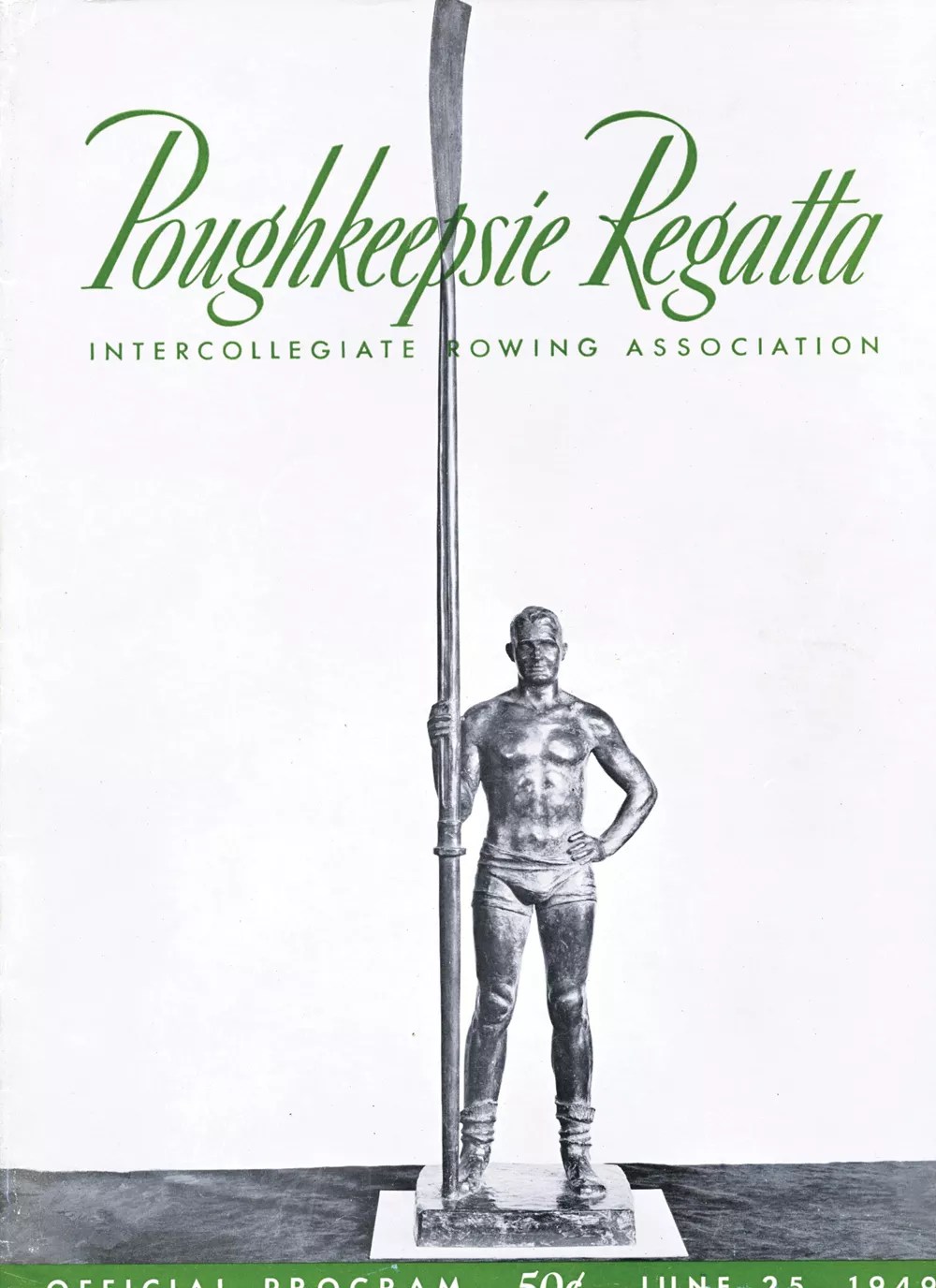
For more than 50 years, tens of thousands of spectators crowded the banks of the Hudson River to witness the annual Poughkeepsie Regatta, a national collegiate rowing competition. People parked their cars atop the cliffs and boats lined the river’s edge; some rode specialty trains that moved along the river banks and kept pace with the boats as the race progressed. Many winning teams of the Poughkeepsie Regatta went on to compete in the Olympics afterward, such as that of the University of Washington, which after winning the 1936 regatta won the 1936 Olympics in Berlin against Hitler’s favored German crew.
The Poughkeepsie Regatta began as the Intercollegiate Rowing Association Regatta, an annual competition between Columbia University, Cornell University, and the University of Pennsylvania. The schools chose a four-mile stretch of the Hudson River between Poughkeepsie and Highland for its relative straightness, easy spectating, and its location as a neutral ground for rowing teams. Other collegiate institutions joined over time from all areas of the country, such as the United States Naval Academy, Stanford, MIT, Princeton, University of California, Berkeley, and University of Washington. Over time, the Hudson River became known as the rowing capital of the world.
The competition drew nationwide reporting at the time but has since been largely forgotten. For the past three decades, researchers at Marist College have been collecting and documenting materials related to the Poughkeepsie Regatta, a collection of 1,900 objects including programs, photos, documents, medals, trophies, and train tickets.
The archive can be accessed at Exhibits.archives.marist.edu and will be a permanent part of Marist College’s digital archives.
This article appears in June 2021.


