










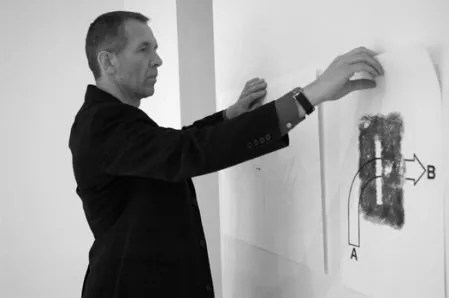
Machell teaches at SUNY Ulster and is currently serving as president of the Ulster County Arts Council.
Machell’s drawings are part of a group exhibit by members of SUNY Ulster Visual Arts department, “Faculty Works,” which will be shown at the Muroff Kotler Gallery at SUNY Ulster in Stone Ridge through December 22. (845) 687-5113. Portfolio at NeoImages. —Brian K. Mahoney
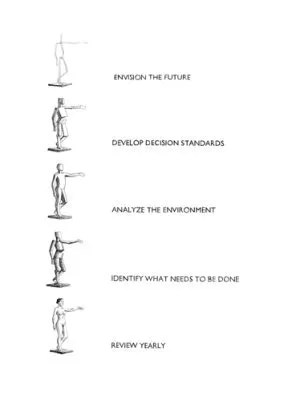
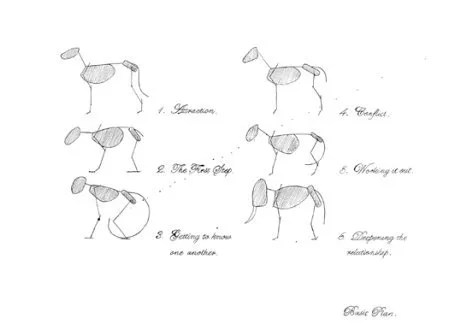
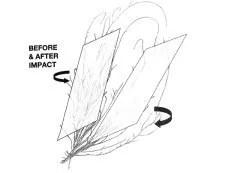
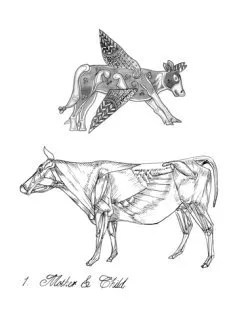
ain Machell on his work:Smashing Together A lot of what happens in my drawings is the smashing together of two seemingly different things. In one of my series, the texts and diagrams are all from warfare, bombing maps, Homeland Security iconography, some are directly from photographs of aircraft, some are from security manuals, and smashing them together with really elegant images from the Book of Kells and different religions and mythologies. I put them together and see what happens. Two languages are smashing together—the verbal language telling you one thing and the visual language telling you another.
With the drawings, what’s going on is this deliberate bringing together of disparate elements to create a tension to reflect some form of uneasiness, anxiety, tension. If there’s an overall theme to the work, it’s “Anxiety: Wake Up! These Are Anxious Times. Don’t Pretend They’re Not.” This is an attempt to deal with my own feelings about that, but also a communication that this stuff is scary and it’s all around us.
Audience Awareness I’m aware of the audience. There’s one stage when you’re in the studio and you’re trying to keep yourself happy about the work and how you feel about it. And then there’s another stage, where you know it’s going to go to an audience. You’re thinking of it as communication—it’s going to end up on a wall somewhere, someone’s going to see it and you’re going to want some feedback. That gets to be an interesting test: “How will someone else see this?” Because you’re alone in your studio and you might not always have that opportunity for someone to give you feedback, and they might not be honest when they do, especially friends.
Never-to-Be-Completed Work I like to have enough space to work in so work just goes straight up on the wall, or on the floor or whatever, and I’ll just leave it out and look for new connections between them all. Sometimes I’ll see different things and sometimes I’ll look at it and think, “That’s the only bit I like,” and I’ll cut it out and put it in something else.
Every artist I know has a couple of pieces that they keep pulling out and working them some more and then putting them away and it never gets done. It’s this never-to-be-completed work that’s a big mystery.
Common Ground I want to have an elegant visual idea right off the bat. It has to be exactly “what you see is what you get.” When you look at it, it has to have a certain well made strong idea that gets you engaged visually. I have a natural tendency toward a good finished product. There’s a craft element that I’m looking for, that it has to reach a certain degree of technical skill to convey the idea. Then there’s another, conceptual level. But I don’t enjoy work that you need to be deeply involved in theory to understand. There has to be a good common ground, and that’s in the visual idea.
Viewer’s Work A hard thing to learn the more you work is what to leave out. There’s a strong tendency to overexplain things, to make it too easy. And sometimes you dumb it down. You want to make sure people get the message so you make it too simple. But I tend to go in the opposite direction, pulling things away, so there’s much more mystery. I like the viewer to do some work. I don’t like passive viewers.
Landscape Landscape is a very strong style in the Hudson Valley. I am trying to engage in that but ina critical way, sort of like a dark mirror, looking at that school of thought and just thinking, well, this is beautiful, this is a little paradise and everyone’s doing these really nice, aesthetically pleasing landscapes, but look again. I just find it hard to put together the fact that you could be living in the mountains and enjoying this incredible scenery and pick up the newspaper and read about these dire emergencies.
This article appears in December 2006.


