









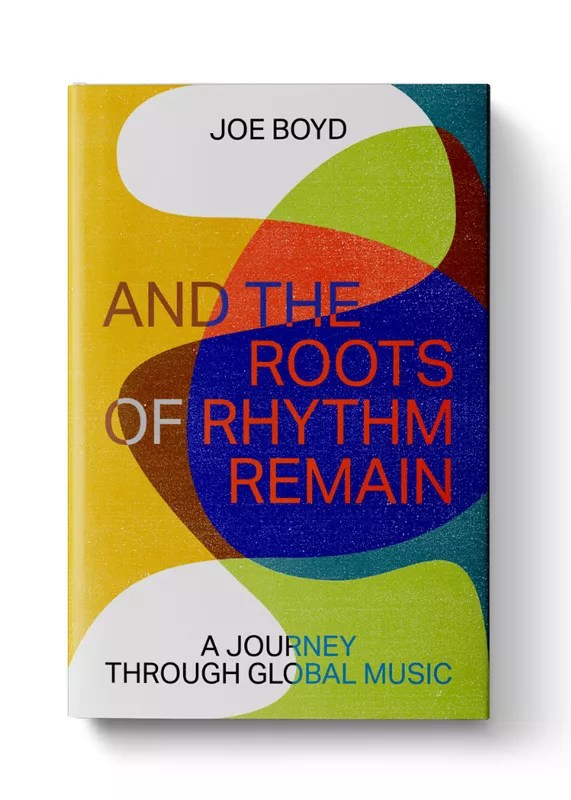
If you threw it hard enough, you could probably stop a tank with a copy of Joe Boyd’s new book about music from around the planet, And the Roots of Rhythm Remain. At over 900 pages, the epic volume, subtitled “A Journey Through Global Music,” has some serious heft. But, of course, tossing the weighty tome would mean letting go of it. And as it’s utterly fascinating throughout—the book’s pages are alive with the riveting stories of exotic, colorful musics and their makers—the mere thought of doing that would be a nonstarter for most curious music lovers.
To discuss the volume and its subjects, the author—one of modernity’s most legendary record producers, musical explorers, and respected raconteurs—will pay a rare visit to the Hudson Valley to host a multimedia presentation at the Local on March 18 at 7pm. Admission is free.
“Writing the book took a lot longer than I thought it would,” says the Boston-born Boyd, whose preceding book, 2011’s acclaimed White Bicycles, is a memoir of his years as a prime mover in the eye of the music-driven, Technicolor cultural hurricane of the 1960s. “I wanted to write about world music because most other world music books are too academic. Ninety-five percent of the people who listen to music want it to be the soundtrack to their lives—they want the music they hear to reflect them. It’s mainly been us ‘decadent cosmopolitans’ who are open to hearing music from other cultures. [Laughs.] But thankfully that’s been changing because of the internet; more people are getting exposed to music from other parts of the world.”
There was certainly no internet in 1964, when Boyd, a Harvard grad, got a job with renowned music promoter George Wein, who took him along to Europe to help with tours there by Muddy Waters, Coleman Hawkins, Sister Rosetta Tharpe, and other blues and jazz greats. While under Wein’s wing he assisted with the live sound at the 1965 Newport Folk Festival, which was famously the occasion of Bob Dylan’s epochal “electric” set. What did Boyd think of his depiction during that heated scene in the recent Dylan biopic A Complete Unknown? “I thought the movie was fantastic,” he says via Zoom. “Although they credited me as ‘sound engineer’ when it was actually [future Doors and Janis Joplin producer] Paul Rothchild who was running the sound. Really, I just moved some microphones around on stage.”
By 1966 Boyd was based in London and had cofounded pivotal psychedelic venue the UFO Club, where the house bands were Pink Floyd and Soft Machine, two acts whose earliest recordings he produced. As a producer he went on to work with Nick Drake, Fairport Convention, the Incredible String Band, John Martyn, Vashti Bunyan, and others, while as a soundtrack collaborator he worked with Stanley Kubrick on 1971’s A Clockwork Orange and supervised the recording of “Dueling Banjos” for 1972’s Deliverance. He also produced and codirected the 1973 documentary Jimi Hendrix, and his further music production credits include records by R.E.M., Maria Muldaur, Kate and Ann McGarrigle, 10,000 Maniacs, and Billy Bragg.
Throughout it all has been Boyd’s undying obsession with music from outside the Anglo-American axis, and in a sense the sprawling And the Roots of Rhythm Remain—called “the War and Peace of world music” by MOJO magazine, who rated it five out of five stars—is the culmination of his life’s work in that realm. Diving into the rich tapestry of indigenous and more recent strains of ethnic styles from such diverse regions as Africa, Cuba, South America, the Caribbean, Eastern and Western Europe, Southeast Asia, Russia, and elsewhere around the globe, the book is compelling not just for its discussions of the music itself and the history that shaped it, but also for its tales of the unique personalities of its architects.”[Fela Kuti drummer] Tony Allen, who I got to know here in England, is one of my favorites,” Boyd enthuses. “He told me about how he heard [American jazz drummer] Max Roach and was influenced by him to incorporate the high-hat cymbals into his own playing, which basically led to the Afrobeat drum style. Another is [Brazilian guitarist, singer, and composer] Joao Gilberto, who created bossa nova by developing a new, softer way of playing and singing by practicing in his sister’s tiled bathroom.”
In these dark times of isolationism, perhaps the book can serve as an antidote. “I hope people enjoy it and that it gets them more interested in different cultures and their history,” says Boyd. “And that it opens up their listening habits and they’re more able to appreciate all of this other wonderful music.”

The Local
This article appears in March 2025.


