








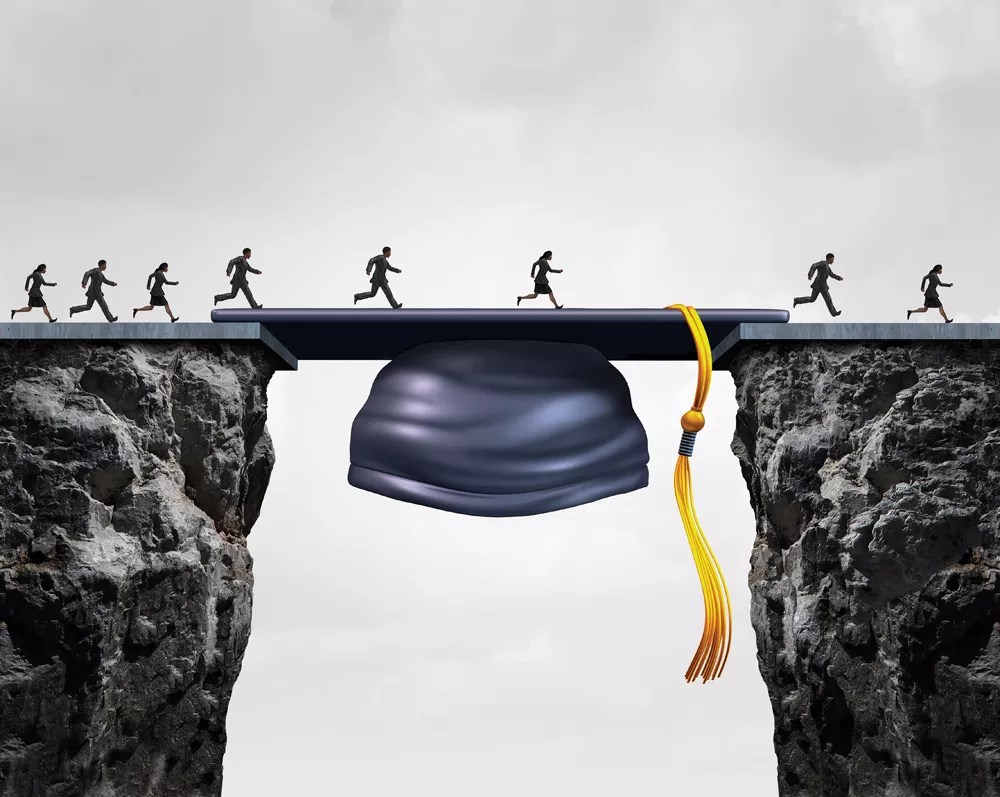
Collectively and individually, surviving and thriving depends on education that equips a person to find a rewarding niche. Throughout the 20th century, “higher education” generally meant at least a four-year degree in the liberal arts or sciences, undertaken immediately following high school.
That paradigm is seriously frayed. About 40 percent of students who enroll in college never graduate. And public confidence in the benefits of higher education has slipped, with Pew Research poll finding that 38 percent feel that colleges and universities have a negative effect on how things are going, up 12 percentage points in just seven years. Meanwhile, a flawed student loan system has fueled rising tuition costs and saddled individuals with massive debt that can’t be discharged even in bankruptcy.
Hudson Valley educators administrators are acutely aware of the crisis and have been taking steps to address its component parts. That was the impetus for “Rethinking College,” a virtual conference hosted last month by Bard Early College that saw two high school age dual-track students from New York moderating a discussion with Roberto J. Rodriguez, assistant secretary of planning, evaluation, and policy development at the Department of Education, and Kevin Carey, vice president for education policy and knowledge management at the think tank New America. What emerged was that fledgling adults are far more capable than the old paradigm gives them credit for—but that they are in dire need of opportunity girded with support.
Head Start
Bard’s Early College Program, begun with the founding of a private residential outpost in 1979 and more fully articulated in president Leon Botstein’s 1997 book Jefferson’s Children: Education and the Promise of American Culture, took a quantum leap at the turn of the century, when the school embarked on the creation of a public multisite early college network.
Two decades later, there are seven tuition-free satellite campuses co-located with high schools in Manhattan, Queens, Newark, New Orleans, Cleveland, Baltimore, and Washington, DC. Students—most of them low-income, about 75 percent students of color, and about half the first in their family to attend college—can graduate with 60 college credits and an AA degree. A related program, the Bard Sequence, partners with 14 districts through local Boards of Cooperative Educational Services (BOCES) to offer tailored opportunities for college-level learning and credits.
Traditional colleges need to do a better job at supporting students as they transition into adult learning, says Carey. “The industry tends to be focused on throughput and enrollment and not accountable for the quality of education or successful graduation into careers. Some go to college and end up worse off. We need to refocus on what students need, which is almost as varied as the human condition.”
Educators agree that an opportunity to pursue college or other career-focused options should be offered in the mid-teens or even earlier, and that connectivity between secondary and post-secondary education is lacking. In the traditional US system, Carey notes, the two levels are “funded and governed in completely different ways and beyond that there is a completely different collective perspective about the balance of responsibilities between student and institution—it’s created a chasm with a rickety bridge between what should really be close together,” says Carey.
Life Prep
Other private colleges in the Hudson Valley are actively involved in trying to replace that rickety bridge with a smooth, well-paved span. Marist offers an award-winning summer pre-college in which high schoolers can delve into one of 13 courses for three weeks, earning early credits while getting a taste of what the experience entails. Vassar offers the Exploring College program, in which high school students—most of them from neighboring public schools in Poughkeepsie—can access readiness workshops, tutoring, and community-building activities, along with a three-week summer intensive.
“We’re lucky to have a lot of great transitional programming, and Exploring College offers students a chance to see what studying with a professor is like and get motivated, see a pathway,” says Vassar College President Elizabeth Bradley. “But the whole concept of preparing for life needs to begin much earlier, with secondary and even childhood educators introducing a panoply of ways for students to enhance their well-being and eventual livelihood. Boot camps, vocational programs—a great diversity of offerings helps decrease high school dropout rates along with better preparing learners for the next stage of life.”
BOCES has been offering teenagers a chance to dive into the waters of career preparation for over 70 years, offering shared services to school districts to help meet educational and financial goals that would be difficult alone. “We offer 26 career and technical concentrations at our Port Ewen center, everything from aviation and computer tech to animal science and fashion design, and our goal is to inspire and train employable, good people, as well as to become an economic engine so that grads have a direct, reliable pipeline to skilled trades and jobs that are actually available,” says Peter Harris, Director of learning and design for the Career Pathways Programs of Ulster County BOCES. “Right now we have a group of six kids—we call them young professionals—making very strong salaries installing split heat pumps, using what they’ve learned in our HVAC and electrical programs. Oh, and they’re employed by a program graduate.”
Harris says that career and technical education programs still meet with some resistance, even though it’s clear that getting excited about the future can help keep a student around long enough to earn a Regents diploma that will allow them to pursue whatever option they may ultimately explore. “We want to make sure kids have relevant internships and externships; with our capstone program, no student finishes senior year without having had some industry exposure,” he says. “You would think that would be standard everywhere, but educators tend to hold classroom time as sacred. We’re trying to break that mold and get them out there, where they can grab onto something.”
Like Bradley, Harris would like to see hands-on preparation for the real world start a lot younger. “In sixth grade home and careers classes, we give kids a vocational interest survey—I think my child’s results were artist and surgeon,” he says. “But then they spend years of classroom time unable to explore what their results might actually mean. Kids are capable of so much more than they are allowed to do, and I believe much earlier exposure to career and technical education would be very productive.”
Student Support Is Crucial
Soft skills—personal basics that make it possible to function no matter what path they choose—can be a natural byproduct of earlier exposure to the chance to delve into one’s passion, be it academic or technical or both. That side effect, combined with greater awareness of social and emotional learning needs, makes the rickety bridge easier to traverse. As things stand now, many students enter college lacking crucial skills like time management.
“Colleges do a great job of recruiting, but not so well in terms of scaffolding support,” Rodriguez told the Bard conference, saying that although he’d been lucky enough to be well prepared, his classmates at the University of Michigan often floundered when exposed to large lecture courses, unsupervised study routines, and the need to make curriculum choices all at once. “Student support needs to be prioritized not just in earning credits but in maintaining day-to-day mental and psychosocial health.”
Almost 40 percent of those who drop out of college do so for financial reasons. Programs offering dual credit address part of the problem, but needs-based Pell grants, which covered over 75 percent of the cost of public college attendance in the 1970s, now cover less than 30 percent. The guaranteed student loan industry, intended as a supplement to work-study, grants and scholarships, has been stricken with the illness of predatory capitalism. Private colleges are battling the affordability issue on a number of fronts at once.
In an email, Marist College President Kevin Weinman outlined a strategy of commitment to need-based support: managing funding allocations to address that commitment, finding diverse and robust funding sources, and managing costs; that support, he points out, needs to cover expenses for study abroad, internships, tutoring and other vital components. Weinman and his wife just announced their own $250,000 gift to the school, earmarked for access and equity initiatives.
But no one family or institution can fix the mess alone and make higher education what it should be: a broad highway to fulfillment and self-sufficiency with an on-ramp for everyone. “We need to remember that our public education system was designed by a committee of 10 people in the 1890s, with the goal of US dominance in economics and warfare,” says Harris, “and a lot of rote learning built in. Today’s teens are likely to change what they do seven times during their working lives, and we desperately need vibrant, viable options that enhance their process of becoming who they are.”
This article appears in January 2022.


