










Farm-to-table eating is the latest term for the art of eating locally—an activity wonderfully well suited to the farm-endowed Hudson Valley and Catskill region. Interest in local foods and supporting local farmers in their endeavors to produce pure, organic, cruelty-free, and natural foods has developed over the last 10 years morphed from something on the foodie, hippie, naturalist fringe to more mainstream American demographics. Michelle Obama introduced America to the term hoop house. Rising oil prices’ effect on formerly cheap industrial food prices combined with inopportune (or perhaps, propitious) food-borne epidemics prompted whole new folds of citizens to utter local and organic. Thing is, up until the turn of the last century but disappearing in earnest after the two world wars, farm-to-table eating was the standard food model.
Chemicals, insecticides, herbicides, fungicides, genetically modified seeds, preservatives, and cheap oil relegated local and farm fresh to the dusty, outmoded bin. In 2010, farm-to-table eating is important all over again—advancing even over organics because organic food has been co-opted by large-scale companies.
Farm-to-table means local food and eating with the seasons, essentially eating what is available at farm stands, in resurrected general stores, and at farm markets. Farm-to-table supports culinary creativity—an overabundance of garlic scapes right now means eating them raw like scallions, sautéing them, or pureeing them into pesto. Farm-to-table supports nutritious eating—nature grows seasonally what our bodies seasonally require—heavier, more fibrous foods (squash, potatoes) in winter and foods with higher water content (cucumbers, tomatoes, melons) in summer. Farm-to-table eating supports local economy, keeps farmers on farmland, and keeps the scenery pastoral. Farm-to-table eating is also a taste of place, a gastronomic tour de terroir.
No Fairy Tale
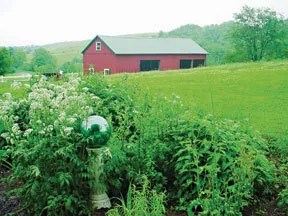
Fable at Stone and Thistle Farm in East Meredith combines farm and table and—romantic as it may sound—Fable is no fairy tale. Fourteen years ago, Tom and Denise Warren chose to raise animals on pasture because “we were broke and grass was free.” The Warrens raise cows, pigs, rabbits, lambs and goats, chickens and turkeys on organic meadows without pesticides or artificial fertilizers. The animals’ diets are supplemented with certified organic grain. No antibiotics or growth hormones are used. “We were a decade ahead of the grass-fed movement only because we were financially strapped,” says Denise. The reality at the core of Stone and Thistle Farm—the name is a play on Tom’s Irish optimism, “stones and thistles are two things farmers don’t want”—is also the beauty and importance of Fable.
Yes, the herbs—basil, sage, thyme, rosemary—are fresh snipped, onions freshly dug, ramps foraged, goat milk from the goats afield churned into goat milk ice cream, and basil transformed into syrup for drizzling over raspberry pavlovas—a meringue-based dessert named after Russian ballerina Anna Pavlova. All very gourmet in the back-to-the-land sort of way heralded today. Yet there exists the certain actuality that the goat milk for the ice cream (or the yogurt for the rhubarb yogurt cream cake) was milked by Tom the night before. There is also the fact that the roast loin of pork came from a pig that was slaughtered three days before a Fable’s weekly dinner on Saturday. “I do not fork food into my mouth without thinking about where it came from or what ingredients are in it,” says Denise.
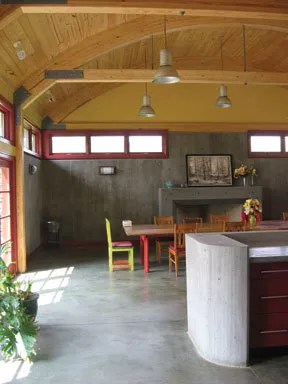
Fable embodies conscious eating. Guests are dining at a working farm in Delaware County and are reminded via panes of floor-to-ceiling windows framing views of cows, pigs, chickens, and sheep that are, for today, in the field. The aforementioned pig that supplied the roast loin of pork (served with rhubarb-orange-mint chutney) also comprised part of the pâté de Campagne appetizer presented with a side of dandelion jelly and a pickle. The week prior, several chickens were harvested and served up—roasted with herbs, dandelion preserves, and spring turnips with browned butter. Livers from those chickens were set aside and made into the chicken liver mousse appetizer for the next week’s dinner. Snout-to-tail eating for the Warrens is customary—they’ve been eating the ears and head and neck and trotters and livers for years. While ingesting the unusual bits of pigs and cows is au currant for foodies, it is intimidating for everyone else. This year, Fable will offer a snout-to-tail dinner with the intent of demystifying the off-bits of animals.
A Serendipitous Error
In 2007 an architect’s error of scale transformed the kitchen of the Warrens’ 1860 Greek Revival farmhouse from modest cooking space to soaring aerie. Years of recipe inquiries from friends and neighbors helped prompt the Warrens to take the step from farmers to chefs. “We collect old agriculture books and especially enjoy the manuscripts on agriculture from Thomas Jefferson.” Denise proffers her copy of Hugh Fearnley Whittingstall’s tome The River Cottage Cookbook Meat Book, where she finds inspiration for many of her dinners. “I feel like I’m reading my life,” she says, due to the combination of farm stories with recipes for offal and other off-cuts.
Wild forageables are frequently featured on the menu—ubiquitous perennial plants like lambs quarters, sorrel, and dandelion. Nasturtiums and borage regularly grace salads. Lemon balm and lemon verbena re-create the citrus flavor of decidedly unlocal lemons and oranges. An orange-scented mint was used in the aforementioned rhubarb-orange-mint chutney. Honey ricotta cheesecake arrives with a lemon balm coulis one night. Another night, lemon verbena panna cotta is the featured dessert. Fable is a reflection of the Warrens’ personal eating habits—seasonal and local—with the few exceptions of coffee, olive oil, and sugar. “If we can’t eat local, organic food, we choose local over organic food,” Denise says. “We have relationships with the local farmers and can have conversations about the how the asparagus is raised or how the strawberries are raised. We always choose a local nonorganic strawberry over an organic strawberry from California.”
Fable dinners are überlocal—“If we do not raise the food served at Fable, it is sourced from less than 20 miles away,” says Denise. There is one exception: The unsalted butter from Evan’s Farmhouse Creamery in Norwich, west of Oneonta—something so creamy and delicious, it requires two slices of bread to fully appreciate it. Every Saturday Denise bakes the no-knead bread based on a venerable New York Times recipe. Fable entrees are always meat culled from animals on their farm so fish is not an option. For 2010, Denise added rabbit to the menu after she began working with New Zealand and California rabbits this year. “For homesteaders or back-to-the-land people, they are the easiest animal to raise,” says Denise. On busy nights, young ladies from local families help serve but usually the Warrens’ daughter Katey helps out. Adirondack water is served and local and organic beer and wine is available.
The menu for July 3 is titled A Catskill Barbecue and features victory vegetable skewer appetizer, a main meal of country pulled pork, mountain sausages, and Catskill sauced chicken with sides of sunset potato slaw and Delaware slaw, followed by Shandaken strawberry pie with goat milk strawberry ice cream and lemon verbena biscotti.
The personal ethos of local community extends to the Warrens’ farmers market choices of Oneonta Farmers Market on Main Street, Pakatakan Farmers Market at the Round Barn on Route 30, and Callicoon Farmers Market in Sullivan County. Asked if they’ve ever sold at any of the New York City Greenmarkets, Tom answers, “We never entertained the New York City markets. We like doing our small local farmer’s markets. One hour and twenty minutes is the farthest away.” The Warrens—like celebrated Virginia farmer Joel Salatin, featured in Michael Pollan’s The Omnivore’s Dilemma—do not ship products but ask that interested people contact them for a list of stores that distribute Stone and Thistle products. The recent farm revitalization with focus on local foods, made into a movement by author Pollan and Salatin, is perhaps threatening to lapse into a faddish trend, fueled by rising price points and fixation on boutique cuts of meat. The Warrens, like numerous other farmers, have been quietly farming for a decade in the way that Pollan and Salatin have made famous during the past three years.
Fable/Stone and Thistle Farm is not nationally known, but it is certainly recognized in the Catskills by the Watershed Agricultural Council-funded Pure Catskills and the grassroots organization Farm Catskills. In 2004 the Warrens were selected to be part of the Catskill delegation to Terra Madre—Slow Food’s yearly international meeting of food communities. In 2005, Stone and Thistle Farm was awarded a $27,500 Value Added Producers Grant from the United States Department of Agriculture to process and market grass-fed and certified-organic goat milk yogurt.
Meat products from animals raised on pasture in small batches is more expensive than industrial counterparts, something the Warrens are keenly aware of because “we are asking people to rethink food—to eat consciously—which means paying more,” says Denise. Selling directly to the consumer helps keep their price point down. The Warrens do supply products to Marlowe and Daughters butchers in Brooklyn, but adding the middleman raises prices higher. Tom refers to the recent Times article about boutique meats—some producers are asking $8 per pound for ground beef. Stone and Thistle charges $4.95 per pound for ground beef. To facilitate direct consumer relationships, Stone and Thistle has a farm store open seven days from 9am to 6pm, just steps from Fable. On Saturday nights, the store is open to departing guests to stock larders with frozen retail cuts of pig, cow, lamb, goat, and chicken, Kortright Creek Creamery goats’ milk, and goats milk yogurt and goat milk fudge with or without walnuts.
The Fable dining experience begins at 6:30 with an optional farm tour led by Farmer Tom. Once that’s completed, he deposits his muck boots by the entryway, cleans up in the Fable bathroom, and sits for a home-cooked meal with anywhere up to 24 strangers. He’s put in a full (usually, 14 hours) day of chores. Fable Saturday dinners don’t allow him a night off. On the contrary, his role as candid spokesman for farm life has just begun. At Fable, underneath the candles and crème fraiche—lies a fundamental truth about life, death, and the muddy boots in between.
Fable serves dinner every Saturday from Memorial Day to Thanksgiving. Prices for the five-course prix fixe dinner range from $48 to $52 depending on what is served, excluding tax and service. Organic and New York State wine and locally brewed beer are available by the glass or bottle. New York State Whites available: Lamoreaux Landing Chardonnay, Goose Watch Villard Blanc, Herman J. Weimer Frost Cuvée and Keuka Vignoles. New York State Reds served: Red Newt 2008 EFT, Brotherhood Merlot, Heron Hill Eclipse Red and Arrowhead Springs Red Meritage. There are two organic offerings—True Earth Red & True Earth Chardonnay. Beers available are from Cooperstown Brewing: Nine Man Ale and Old Slugger, and from Belgian-style Brewery Ommegang: Witte and Rare Vos. You are welcome to bring your own wine or beer. A $10 corkage fee is charged per wine bottle. By reservation only, via phone or e-mail. (607) 278-5800;
www.stoneandthistlefarm.com.
This article appears in July 2010.


