









In creating our experience, we had this classic Hudson Valley vision for a space that feels as though you’ve been transported, that’s also very distinctly of this region,” says Kristine Danks, general manager of Klocke Estate. “The same can be said about the brandy and vermouth we make.”
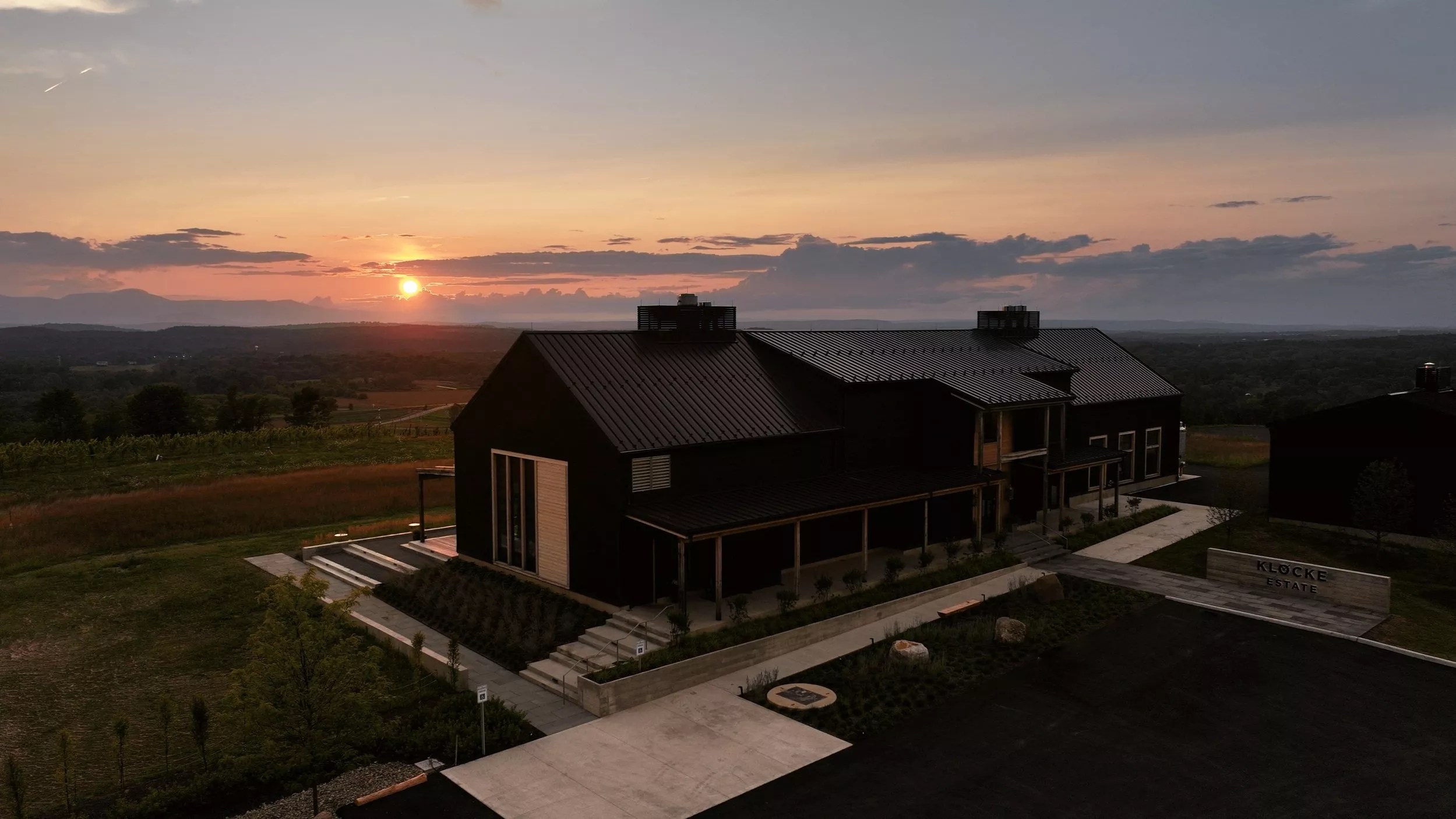
A visit to Klocke Estate, a new distillery with a farm-to-table restaurant in Claverack, begins as soon as you reach its front gates. A long winding driveway toward the main building’s hilltop setting takes guests through vineyards and orchards bearing fruit to be used for making brandy and vermouth. Once inside, a muraled entryway with hand-painted coffered ceilings offers a vibrant welcome to the restaurant’s bar, elegantly designed with a marble top and copper accents. Large windows overlook the Catskills, allowing nature to provide its own seasonally changing backsplash. You’ve only just arrived, but the wow factor doesn’t stop.

With a focus on spirits crafted in an old-world European style, but with fruit and botanicals grown on-site and in-state, CEO John Frishkopf’s goal was to combine both classic, traditional distilling methods and the modern design of a progressive farm-to-bottle operation. Although he purchased the property in 2018 and began planting in 2020, the $21 million farm, distillery, and restaurant opened to the public in July.
Most of the capital raised to fund Klocke Estate’s steep price tag came from equity provided by private investors. Loans were provided by Farm Credit East and by Walden Mutual. Grants were provided by Empire State Development, Market NY, National Grid, and the Office of Community Renewal. In addition, Klocke Estate joined an IDA/PILOT program from Columbia County IDA.
A Passion for Tradition
Originally from Boston, Frishkopf became fascinated with brandy-making while living in Europe for a decade. “I’d been making brandy for years and always wanted to create a place like this that’s focused on making high-quality spirits in a regenerative way that positively impacts the environment and community,” he says. “I chose the Hudson Valley for three main reasons: The beauty of the region, the acceptance and support for slow food and farm-to-table food and beverages, and the ability to grow fruit that’s ideal for making brandy. It took two years to prepare the land for farming before setting vines with cold-hardy grapes like vidal blanc and Ugni blanc—both of which are typically used in making brandy and cognac—and planting 43 varieties of cider apple trees.” (The cider they make is not bottled, but used as an ingredient.)

Frishkopf’s passion for tradition includes centuries-old distilling and aging methods. He had a traditional cognac still delivered from the Cognac region of France that took three weeks to construct with multiple teams. It takes 48 hours for a full batch to be distilled before being transferred to French oak barrels to age for a minimum of three years. The on-site barrel house was designed in the same fashion they were made 200 to 300 years ago in Europe: sunken into the ground, insulated with straw, and with a dirt floor to maintain ideal temperatures and humidity.
“We really leaned into the history of cognac, which was actually invented by the Dutch in the 1600s,” Frishkopf explains. “Claverack is also a Dutch name, which is all part of why we came up with our name, Klocke, Dutch for ‘clock’—it’s about an appreciation of patience and time, while acknowledging local history and the history of bringing brandy to the new world.”

Comfort with Panache
While classic methods are held sacred, the facility, designed by Barlis Wedlick Architects, is progressive in its design. Although not certified, the estate employs regenerative, organic farming practices including composting fruit remnants from stillage, low-till methods, no herbicides, and organic sprays to ensure a living soil. Heat produced from the stills is sent through a system that reuses the heat for the building, hot water, and floors; any leftover heat can be directed outside to melt icy sidewalks during snowy seasons.
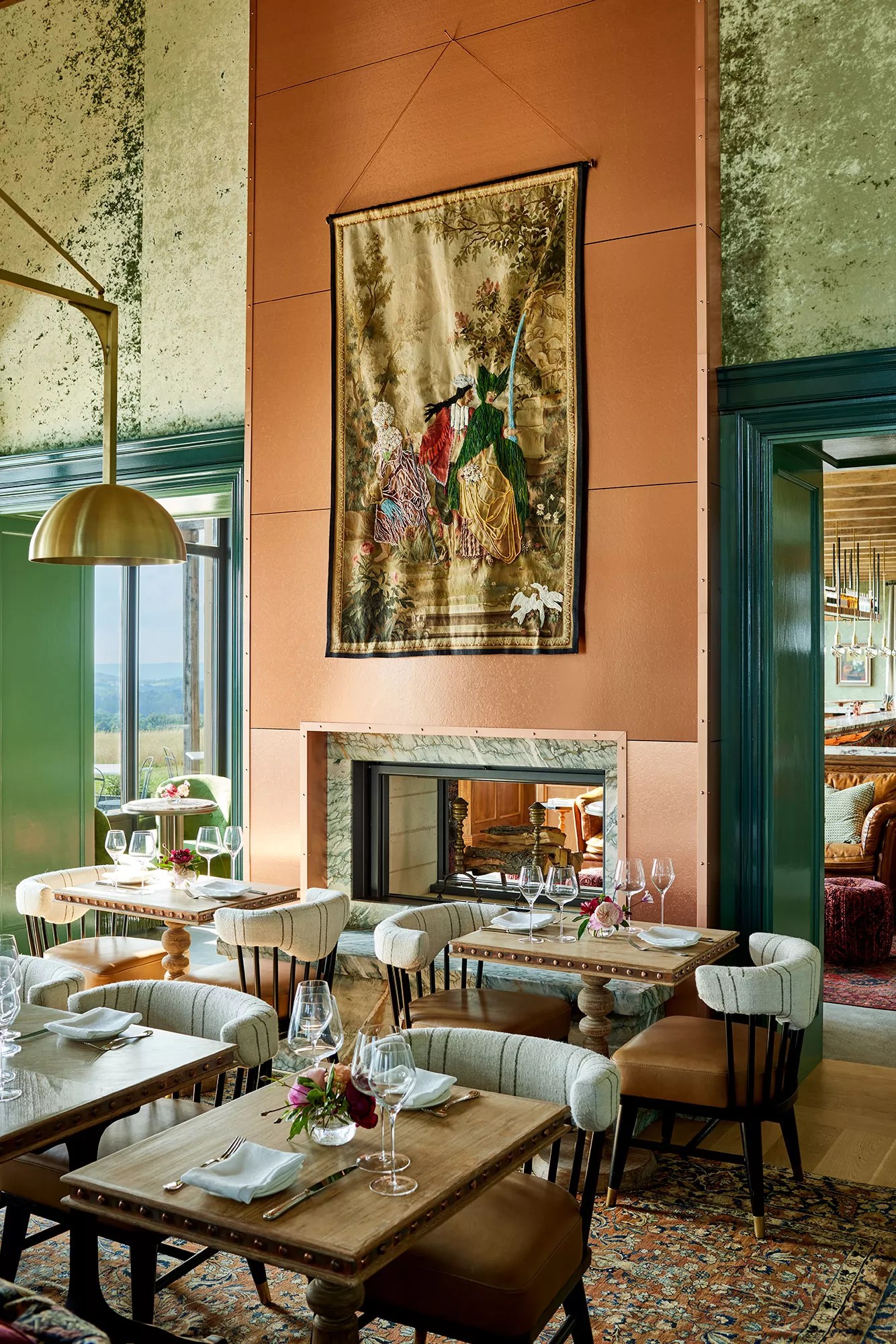
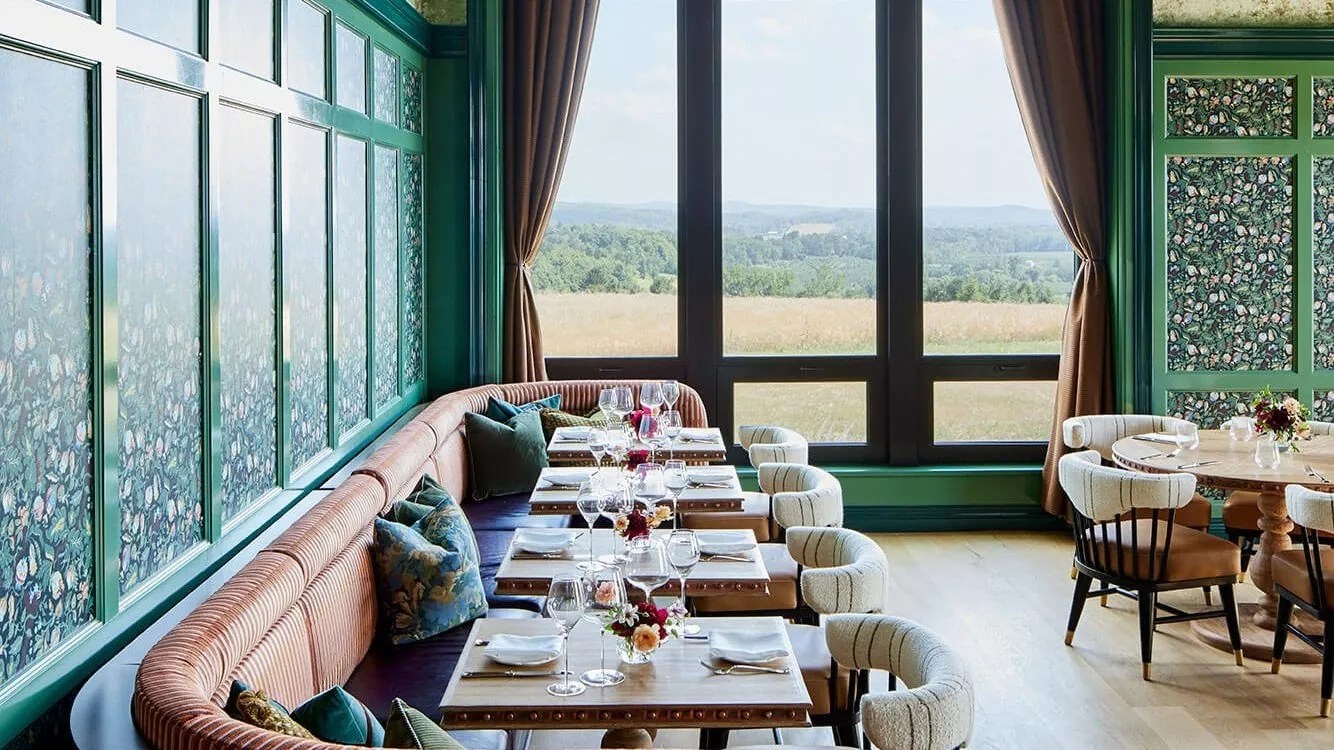
This and more can be learned during a tour, which includes a visit to the still bay, a walk through the learning garden, and a tasting within the restaurant’s tasting room. Those who stay for dinner can enjoy the same storied ambiance carried through to the dining room, where two antique chandeliers that are simultaneously massive yet unobtrusive in their farmhouse simplicity complement the jewel-toned, patterned wallpaper and cushy seats at farmhouse-style tables.
“Our designer Ken Fulk is known for creating these dimensional, textured spaces in which you feel at home, while still adding a level of panache,” Danks explains. “And although some people prefer to enjoy brandy or a cocktail in our fireplace lounge, you’ll see that it actually pairs well with a number of items on our dinner menu.”
“Nothing Ugly”
As expected, the vibrant and storied design carries through to the short yet alluring dinner menu, which adapts to changing seasons and farm availability. For instance, a savory beet and melon starter with mint labneh and pistachios ($15) evolves to a warm beet salad as the temperatures fall; this summer’s tender, rich scallop entree with sweet corn puree was as fleeting as the season felt. Knowing the limited nature of these dishes adds to the appeal.
Executive chef Becky Kempter—a California native who’s held previous local positions at Deer Mountain Inn and Cedar Lakes Estate—worked with a team to design what she calls American cuisine with European flavors using local ingredients as much as possible.
The artful plating aligns more with what you’d expect of a fine dining establishment, than one that’s technically a farm distillery. “We all eat with our eyes,” Kempter says. “In the past, I worked for people who’d say, ‘Nothing ugly on display,’ and that stayed with me, so I want things to look beautiful as much as I want them to taste good.”

Even the bread and butter is elevated; the warm crusted focaccia ($11) comes with a small dish of garlic confit and cultured butter with edible blue flowers placed atop. The bar is now raised on standard crudité, as the aioli sampler ($30 petit, $55 grand) makes an elegant presentation on a bronze serving plate with assorted vegetables, jumbo shrimp, and a farm egg, beside a trio of flavored aiolis. The vegetables, grown at Morningstar Farms just beyond the boundaries of the estate, are so satisfyingly snappy and fresh that they taste as though they were plucked from a garden right before arriving at the table. They might have still been growing. “I go to Morningstar at least twice a week, their produce is just beautiful,” she says.
Additional farms and purveyors include Bluestar Farm in Stuvesant, Rolling Hill Organic Farm in Catskill, and Grimaldi’s Farm Store around the corner where they procure limited selections of organic, grass-fed beef.

Entrees include flavor-rich takes on steak, poultry, and seafood, like duck breast ($42), from Crescent Farm in Long Island—a tender cut with a crisp crackling over caramel fennel, leek soubise, and a peach mostarda. “Our soubise is a small twist on a very simple sauce; we use leeks and fennel to impart more flavor,” Kempter says. “And the rest of the duck is used for other meals; the duck fat is used to confit the legs for our lunch menu, bones are used for broth—we try to utilize as much as possible to reduce waste throughout the kitchen. For example, we also use Ronnybrook milk and cream to make our own yogurt, butter, and ricotta, from which the byproducts go to crème fraîche, baked goods, and in cooking certain foods to impart more richness. We also compost all scraps, eggshells, and coffee grinds; the goal is to have a chef’s garden and make soil out of our cooking waste.”
While the entrees are not over-decadent, the desserts are rich treats, like the almond cake with armagnac, figs, mascarpone, and orange blossom honeyed almonds, or the chocolate semifreddo: espresso caramel, malted white chocolate, cacao nib crust (both $15). A selection of dessert brandies and coffees are available; try them both in a Vikings Don’t Cry cocktail (Dudognon ‘Reserve’ 10-year-old Cognac, vodka, aquavit, cold brew coffee, and cacao; $17).

The menu continues to evolve as harvests change. “I’d like to do a really sophisticated steak and potatoes dish and other comfort foods as the weather gets colder,” Kempter says. “Part of my vision for the menu is taking a classic, favorite dish then figuring out how to turn it around and make it something special.”
Beverage captain Brian Crocco says the cocktail programs were designed to support brandy offerings, but also the cuisine. You’ll find classics like the Klocke Estate Sidecar ($18) with cognac, Cointreau, and demerara; innovative flavors like the Draper’s Guild ($18) cognac, sweet vermouth, and Cointreau with a smoky touch of lapsang souchong; or a homegrown appletini ($24) made with limited-batch Klocke Estate apple brandy, honeycrisp apple, and Klocke Estate white vermouth. That same limited-batch apple brandy is available for purchase while available; only 1,000 bottles were made and it will never be produced again ($150/bottle). Red and white vermouth are also available at $45 each.

“We recognize that brandy is a little less explored, so we have something for everyone,” Crocco notes, “but we’re also interested in introducing people to quality brandy—not pushing it, but quietly waving a flag about how wonderful brandy can be.”
Klocke Estate
2554 County Route 27, Hudson, NY 12534
Lunch is served Friday, Saturday, and Sunday, 12 to 3pm. Dinner is served Wednesday through Sunday, 5 to 9pm.
Related Stories

This article appears in October 2024.


