









The child is parent to the adult, to paraphrase an old parable. In different ways, this idea is at the heart of both Joseph Gosler and Sheila Wolper’s work. Gosler, a writer and memoirist, was born in Nazi-occupied Holland during World War II to a Jewish family who placed him into hiding as an infant. His quest to make sense of that early, defining experience and make peace with his family’s story is detailed in his memoir, Searching for Home: The Impact of WWII on a Hidden Child (Amsterdam Publishers, 2020).
A Brooklyn native, Wolper founded a Reggio-based nursery school with Gosler in 1983 and served as the school’s director for 30 years before transitioning to become a full-time artist. Like her husband, Wolper’s creative work explores the complexity of childhood experience through the use of mixed media, photography, and collage techniques.

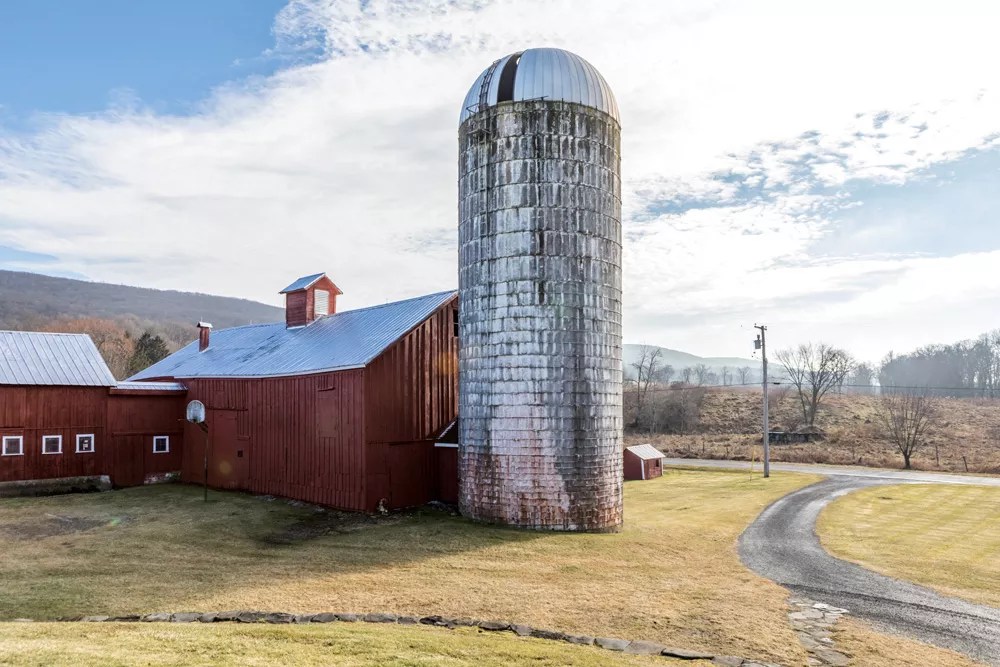
These days, the couple bide their time in a decidedly bucolic haven. Built in approximately 1850, their Greek Revival-style farmhouse features clapboard siding, eyebrow windows, and a wraparound porch. Part of a working farm until the 1970s, the home sits on an open knoll adjacent to two traditional red barns and a silo.
Surrounded by farms and Colombia Land Conservancy property, the 12-acre property includes fields planted with wildflowers, two wetlands, fruit orchards, memorial and vegetable gardens, and a heated inground pool. “We both love the open rolling hills and fields of Columbia County,” says Gosler. “The civility of it all—the cows grazing in pasture lands, corn fields everywhere, small forests, bogs, colorful birds, and the assortment of wild animals—lies in sharp contrast to the grit of city life we are accustomed to.”
The Long Trek Home
Gosler’s path to Columbia County was circuitous and his story bears testament to some of the worst chapters of the 20th century, but also the strength of community and the transcendent possibility of kindness. “My experience of World War II was vastly different from children who were adolescents or teenagers during the war,” he explains. “I’m not the second generation, but I’m not really the first either: There’s the coinage of generation one-and-a-half.”


For his and his parents’ safety, Gosler was given to the Dutch resistance at seven months of age and hidden with a Christian family who raised him as their own for the duration of the war. “I was quite lucky,” he explains. “I was placed with a family who truly loved me and I was able to stay with them the whole time.”
At the war’s end, after extensive searching, his parents found each other and, finally, him again. It was then that the trauma he had been insulated from began to hit. “I was three years old and I kept thinking, Who are these speakers who claim to be my parents?” he remembers. “All I wanted to do was return to the only family that I’d known. It led to disorientation, a sense of abandonment, not trusting my surroundings, and anger.”
His parents first attempted to return to their home in the Northern Netherlands, where they lived for four years. “They had so much pain on so many levels,” Gosler explains. “And there were ghosts and nightmares everywhere.” They decided to immigrate to Israel, where Gosler spent his adolescence living on a kibbutz—what turned out to be a liberating experience for him. “Life on the kibbutz saved me,” he explains. “Having that extra breath and space helped me immensely.”

Living apart from his parents but still nearby, in a dormitory with other children his age, gave him the room to process his early life and shape his own independent identity. “The best learning environment for children is amongst other children,” he says. “The experience really influenced my interest in community. My search for community has been part of my fundamental drive and what I seek in whatever work I do.”
Gosler’s family eventually immigrated to New York, where he became involved with the Quaker community as an adult. “If I wasn’t Jewish, I’d be a Quaker,” he says. “They call me a fellow traveler because so much of my way of thinking is similar to practicing Quakers.” Gosler served as the business manager of the Friends Seminary, a Quaker K-12 independent school in Manhattan, for 24 years and has been involved with the Quaker community for almost 40.
New Arcadia
The couple first happened on Columbia County during the early days of their marriage, while hitchhiking through the region on their way to Maine. Sheila Wolper had studied textile design, literature, and early childhood education in New York before becoming a full-time educator. Together, the couple became enamored with the area and bought the Ancramdale property as a weekend home in 1989. Over the ensuing 32 years, they transformed the rambling 4,000-square-foot home into a light, modern oasis that remains true to its historic roots.

Builder Michael C. Smith helped to update the home’s interior spaces and D. L. Schultz Enterprises worked with the couple to modernize the farmhouse’s plumbing and electrical systems. What was once the dirt floor basement space is now a self-contained apartment. To open the space, the couple removed the home’s 300-gallon fuel oil tank, replacing it with a new HVAC system and exterior propane tank, then raised the ceiling eight inches. They added radiant heat cement floors and expanded the plumbing to create a laundry, wet bar, and basement bathroom. Within the expanded basement area, they carved out two extra bedrooms, a home gym, and a wine cellar.
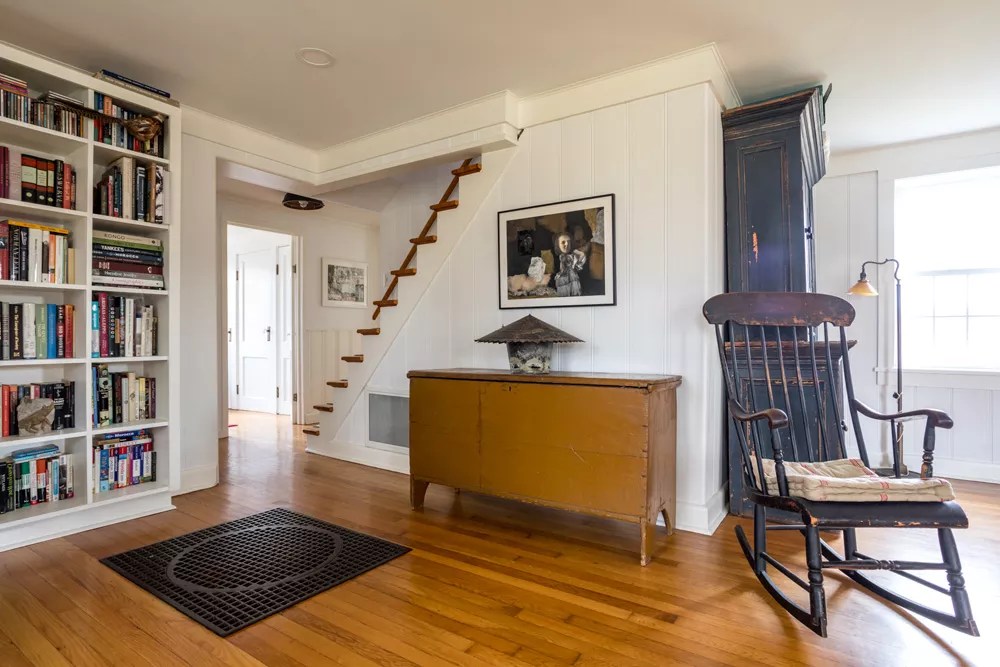
The couple were able to update the home’s first and second floor while remaining true to the farmhouse design. By removing cosmetic beams and a drop ceiling from the living room, they laid bare the original, notched, wood-beamed ceilings. They added a stone fireplace to the room, accentuating the country ambiance, and extensively updated the first-floor bathroom.
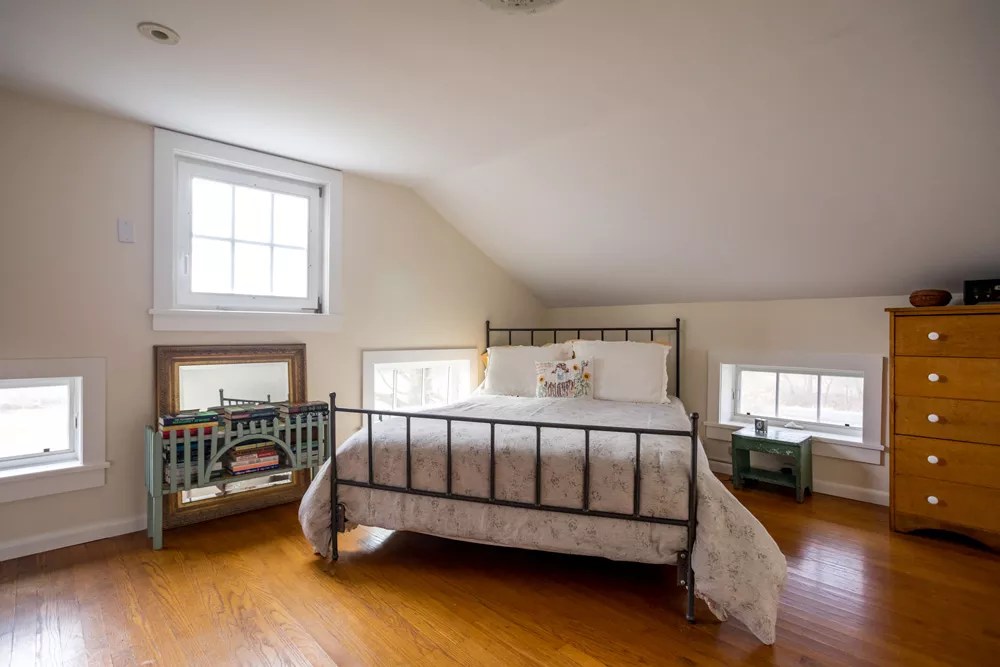
Upstairs, the primary bedroom features a second stone fireplace. By capturing space from a second-floor bedroom, they greatly expanded the second-floor bathroom. Additional upstairs bedrooms provide extra space for family and friends to stay. Within the walls of the three-level home, both Wolper and Gosler have carved out nooks for their respective creative practices. Gosler converted the first-floor study into his writing studio and a separate second-floor wing serves as a colorful studio space for Wolper’s mixed media works.

Extending the Family
At the center of the farmhouse is the open kitchen and dining room. With 14-foot-high ceilings and banks of windows in three directions, the space offers abundant views of the pastoral landscape and plenty of room to congregate. Both Wolper and Gosler agree: It’s become their favorite spot in the house. “Many people can gather to schmooze, help cook, and enjoy warm friendships and good food,” says Gosler. “Like many houses, this kitchen has really become the heart of our home,” agrees Wolper.

To create the multifunctional space, the couple expanded the original kitchen by knocking out a back wall and then incorporating the home’s covered porch into the interior area. They added new wide plank pine boards along the floors and accented the expanded space with raw wood beams and wall trim. In a corner of the room the renovated kitchen retains plentiful workspace for cooking. Black granite counters top double ovens as well as a suite of appliances; and black granite tops a kitchen island built from the home’s original plank floor boards.
Since recreating the room, the couple find that they and their guests spend most of their time there. Not only has it become a tradition to host their extended family on a regular basis, the couple also enjoys the company of friends they’ve made through all the disparate walks of their lives. “I consider myself not very religious, but very spiritual,” explains Gosler. “Everything we do on a spiritual level, we do from a family setting—or a friends-and-family setting. In life, friends often become family too.”
This article appears in February 2022.


