








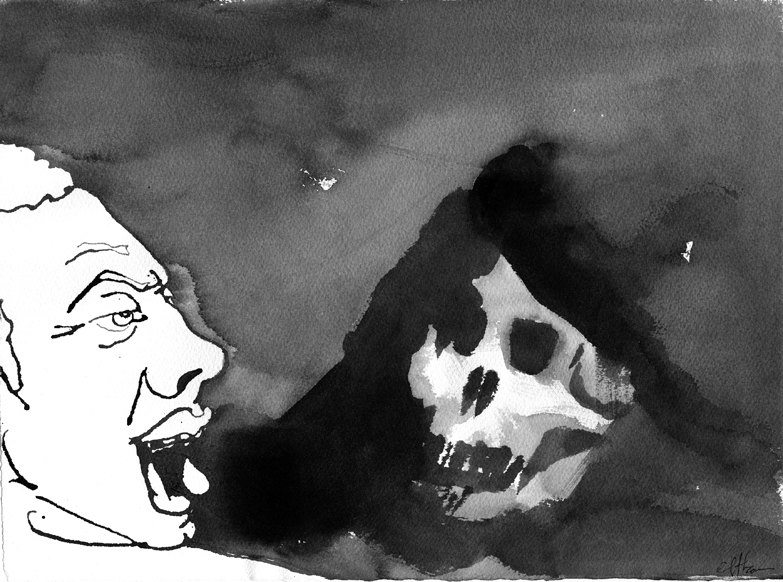
On Thursday, June 14, oil industry officials from around the world gathered at the GO EXPO (Gas and Oil Expo ‘07) in Calgary, Canada, and heard a presentation for an innovative, sustainable replacement for petroleum: a new technology called “Vivoleum.” The presenters represented themselves as executives from ExxonMobil and the National Petroleum Council (an industry organization) and were among the keynote speakers before 300 oil business leaders.
They proposed that the bodies of climate change victims, who they said now number about 150,000 a year, could be rendered into a burnable product, particularly as combustion of fossil fuels sped up ecological disasters. To demonstrate the efficacy of this, they distributed candles throughout the audience, which were allegedly made of the stuff. The candles were lit, and the oil execs passed the flame from one to another.
A presenter named “Shepard Wolff,” claiming to be an NPC representative, told the audience that current US and Canadian energy policies (notably the massive, carbon-intensive exploitation of Alberta’s oil sands, and the development of liquid coal), are increasing the chances of huge, global calamities. But he reassured the audience that in the worst-case scenario, the industry could “keep fuel flowing” by transforming the people who die into oil.
The “o” in the Vivoleum logo was a drop of blood.
“We need something like whales, but infinitely more abundant,” said “Wolff,” before describing the technology used to render human flesh into Vivoleum. Three-dimensional animations of the process brought it to life. The executives watched and listened attentively.
“Vivoleum works in perfect synergy with the continued expansion of fossil fuel production,” said “Florian Osenberg,” claiming to be an ExxonMobil representative. “With more fossil fuels comes a greater chance of disaster, but that means more feedstock for Vivoleum. Fuel will continue to flow for those of us left.”
The two then showed a video tribute to an ExxonMobil janitor, “Reginald Spanglehart Watts,” who had purportedly died of toxic exposure after a chemical incident at a company facility. Before passing away, the kindhearted worker had donated his body to be made into one of the candles, so that he could do some good and be useful to others after he died. “Osenberg” lit the candle made of Watts’s flesh and held it up.
The tear-jerking tribute to “Reggie Watts” (with “You Light Up My Life” sung out of tune by Reggie as its theme song, as he mopped and swept) finally pushed the presenters’ credulity a shade too far. At that point, realizing the presentation was a hoax, Simon Mellor, commercial and business development director for the company putting on the event, walked up and physically forced the two imposters from the podium. The police were called, but the pair could only be charged with trespassing.
Meet the Yes Men—Igor Vamos and Jacques Servin—most recently using the aliases Michael Bonnano and Andy Bichlbaum. They specialize in messing with the heads of capitalism and its leaders, often impersonating representatives of the World Trade Organization or some multinational company that it represents: McDonald’s, Dow Chemical, Halliburton, or ExxonMobil.
In a world where you often need a passport to rent a motel room and where some airports check your ticket before you can purchase a bottle of wine in the duty-free shop, the Yes Men exploit, indeed, they have discovered, a vast opening in reality: If you claim to represent a company or industry organization, then that must be true. It follows that no matter what you say, no matter how cruel, absurd or lacking any semblance of humanity or political correctness, most people (including the most educated) believe what you’re doing is real; “Suspension of disbelief,” as it’s called in literature, is facilitated by the profit motive. In other words, if something makes money, it’s not necessarily good; but it’s most definitely real.
In one presentation at SUNY Plattsburgh, they impersonated McDonald’s and the WTO, and proposed the recycling of hamburgers into what they called reBurgers. In particular, they proposed to a lecture hall full of economics students, that feces from Americans be rendered into food for developing countries, based on the scientific fact that people only absorb about 20 percent of their nutrition and excrete the rest. They presented a 3-D animation of sewage being stamped into patties and served in McDonald’s to people wearing turbans and other non-Western attire.
Some audience members objected to the concept, making intellectual arguments against it or objecting on humanitarian grounds. After more than an hour, some students started heckling the presenters. But for the most part, the concept was received as authentic, if immoral.
One of the signatures of the Yes Men is that they experiment with pushing absurdity as far as they can, revealing that the part of the mind that questions reality has been anaesthetized, even among students and the most educated people in society.
The Yes Men got their start in 1999, posting a parody of the George W. Bush website shortly before the “election” of 2000. When then-candidate Bush attempted to block them through the Federal Elections Commission, newspapers including the New York Times picked up on the threats. The duo became big news, and earned an international reputation as political pranksters.
From that publicity, someone who owned the domain GATT.org contacted them, and asked that they do a parody of the WTO, which was at the time becoming the focus of international activism. (GATT, or General Agreement on Tariffs and Trade, is the predecessor of the World Trade Organization.)
By posting a convincing parody that supposedly focused on free trade issues, people started to contact them through the website and invite them to conferences and events as speakers, even as the keynote speakers. Consistently, conference organizers failed to read the webpage or to look into their credentials or true identities, and ended up the unwitting targets of elaborate hoaxes.
In their most famous stunt to date, on December 3, 2004, Yes Man Jacques Servin was invited onto BBC World, the BBC’s international edition, as “Jude Finisterra,” purportedly as a spokesman for Dow Chemical Co. Dow had recently acquired Union Carbide, whose pesticide plant had infamously malfunctioned in Bhopal, India. It was the 20th anniversary of the disaster, where tens of thousands of people had been killed, sickened, and blinded by a massive toxic release—and more or less left to suffer in pain and poverty for the next two decades. The Yes Men had previously posted a website called DowEthics.org and were contacted via email through the site by journalists at BBC World to comment on the occasion of the 20th anniversary of the disaster.
Nobody checked to make sure they were for real; they just put “Finisterra” on live television and gave him free reign without interruption.
“Today is a great day for those of us at Dow, and for millions of people around the world as well,” “Finisterra” [his name means “end of the world” in Latin] began, speaking above the words BREAKING NEWS in bright red. “It’s been 20 years since the disaster, and today, I am very, very happy to announce that for the first time, Dow is accepting full responsibility for the Bhopal catastrophe. We have a $12 billion plan to finally, at long last, fully compensate the victims, including the 120,000 who may need medical care for the rest of their lives, and to fully and swiftly remediate the Bhopal plant site.”
For five and a half minutes on worldwide television, he presented a litany of promises and apologies on behalf of Dow and Union Carbide, the latter of which under the “plan” would be liquidated and the proceeds given to the disaster victims. He also offered free access to the safety records of any Dow product to “any interested researcher.” The hoax went off perfectly, without BBC reporters ever suspecting they had been pranked.
Then Dow, learning of the broadcast, demanded equal time on BBC World in order to retract “Finisterra’s” many promises on behalf of the company. This put Dow in the odd position of being forced to tell the truth: They were not offering medical expenses for the many people they had injured, they were not really taking responsibility for the deaths and sickness, their files would not be opened, they were not going to remediate the disaster site, and so on.
It’s what the Yes Men call “identity correction,” a kind of corporate identity theft done in order to fix the public record or establish or reveal the truth. “These things that are not presenting themselves honestly or that hide something about their nature—that’s really scary. We want to bring that out, we want to show that and demonstrate that,” Yes Man Igor Vamos explains in a documentary.
The two were also behind the Barbie Liberation Organization (BLO) prank several years ago, wherein the digital voice boxes in Barbie dolls and GI Joes were switched, and the dolls returned to store shelves right before Christmas. Newly unwrapped GI Joes were talking about new outfits and keeping house, and Barbie dolls were saying things like “Dead men tell no lies.” The prank made world news, raising consciousness of gender issues, sexism, and programming kids for violence.
In one of their most graphically outrageous stunts, they got listed on the bill at a WTO-sponsored textile manufacturers conference in Finland, purportedly as WTO representatives. The presentation before a room full of highly educated sweatshop owners proposed that the Civil War had been unnecessary and that traditional slavery would have been “sorted out by the market” and eventually modernized into something more efficient than an “involuntarily imported workforce.” Then Servin (using the alias Unruh Hank Hardy) said he was going to demonstrate technology that you could use to remotely supervise workers in your factories around the world. This was a “manager’s leisure suit,” which he wore beneath a breakaway business suit designed with Velcro releases. (The ensemble took several months to design and create.)
His business suit was pulled off in a single tug, and he was suddenly standing in a shiny gold leotard. A room full of textile manufacturers did not miss the tribute to their industry. Then he pulled a rip-cord and an inflatable three-foot long phallus emerged from the suit, at the end of which was a “video monitor” supposedly used to watch progress in remote factories and stay in contact with one’s business associates around the world.
Some people laughed nervously—but the most of the audience watched in earnest as he pranced around in front of the lecture hall in gold tights explaining that he could observe his workers through a TV at the end of a giant erect penis. They finished the presentation, they were thanked, hands shaken, and (as there were no questions from the audience) they left.
When we ask ourselves how it’s possible that someone who cannot speak coherently is president of the United States; how he got away with rigging two elections with nary a peep from the public; how the world fell for the fake WMDs in Iraq; how we have a vice president who recently said his office is not part of the executive branch; why the Democrats don’t seem to get anything done; why people think it’s a brilliant idea that we invade Iran; or how for that matter Borat gets away with it—the Yes Men make it perfectly clear: Hardly anyone is paying attention.
This article appears in August 2007.


