








Dear Friend and Reader:
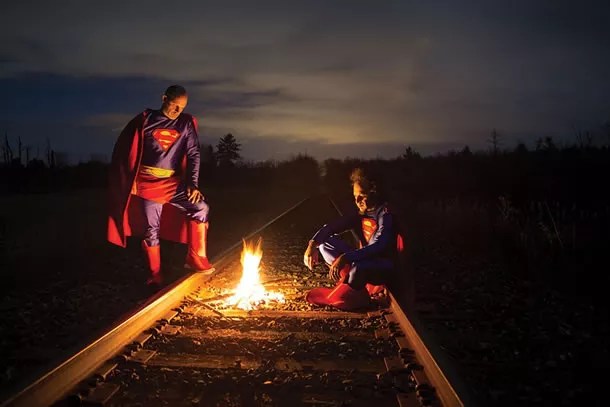
Last week the new edition of Chronogram came in. That’s the regional magazine I’ve written for every month since early 1996. Chronogram always has excellent covers which by design are unconnected to any specific article. But they are often timely comments. With one glance my jaw dropped: the artist had summed up the state of the nation in one image.
It’s called Hobo Supermans. The artist is Tim Davis.
What’s happening in this picture? It looks like the Supermans have given up. They’re homeless and unemployed. There are two of them, which is odd. And they’ve lit their fire on the train tracks, seemingly oblivious to the fact that a train could come careening at any moment. Maybe they think they can stop it with their bare hands when it does, which it will, sooner or later.
Since they’re obviously just regular guys in costumes, that probably won’t work too well.
I’ve always thought the Superman concept was truly strange, which is to say, the character and also people’s enduring obsession with it. This extends to all superheroes, who are aspects of the same archetype, though Superman is the central character.

He’s the idea that someone is going to come from the sky and save us, which is so old the expression is in Latin: Deus Ex Machina. Basically, he’s God in superhuman form, and somehow people find this reassuring. The concept is the American equivalent to some Nazi notion of the perfect man.
By 1938, when Superman first went into print, the German race was busy trying to purify itself with the help of gas chambers and crematoria.
Now, in 2016, a couple of these guys have thrown it in. They’re despondent, worn out and bored, even though there’s plenty of work to do. They’re not God—they are us. They’re our phony presidential candidates. They’re one answer to Elvis Costello’s question, “Where are the strong, and who are the trusted?”
I understand the anger and alienation that has led many people to think that Superman has secured the Republican nomination.
He’s going to save the economy and seal the borders and get rid of the pesky Mexican criminals and work with the blacks who love him so much and clean up all the corruption in Washington and punish all those lying journalists give us some fabulous health care and destroy Isis and we’ll all get a bottle of fancy wine every week and the best pastries and turn the White House, and your house, into New Versailles.
We, too, will be able to shoot anyone on Fifth Avenue and cherish women more than anyone, more than anyone. Believe me. Believe me.
He knows people are pissed off or they wouldn’t fall for this bullshit, so he plays into their anger and their ignorance. I saw a Trump campaign attack ad last night promising to go after everyone who contributed to the corrupt Clinton Foundation—which failed to mention that Trump himself donated and exploited the Clintons. That’s just what you do.
He has offended and alienated everyone, but like my father says to his students, “I know you’re not going to remember this because I said it five minutes ago.”
I understand the rage behind all of this, just like I get the anger of a child who wants adult privileges and has not earned them. So just leave the gun loaded and in reach. You paid for that gun and you have it by right, so why not?
Most Americans think that working hard entitles us to everything, and that having rights is a waiver from responsibility. Look where it’s getting us.
The missing piece is the personal one. It’s the part about the significant work of becoming human. We have human bodies and human DNA and all that, but actually evolving into one’s humanity is about the work of self-awareness and growth. This is challenging for people who admit that neither exist.
It’s about questioning one’s assumptions, which requires becoming aware of them. There’s also something about discernment: doing the work of deciding what is true and what is false; of deciding what is in accord with one’s values, which means knowing what they are.
Experiencing one’s inner being, what some call spirituality, is more perilous than deciding that abortion is wrong and thinking that makes one a superior person who has God’s favor. Most of what religion encourages people to do is to play God and avoid the issue of death. In the United States, that means Jesus as Superman.
We have another candidate who is coming off more like the average American, the working soccer mom, despite her having held high office and earning hundreds of millions of dollars a year, from selling books or her political influence. Her Superwoman status is conferred by all that she’s concealing about herself.
By those with old money she’s still a working stiff, but by our standards, she’s an aristocrat, fully qualified by having killed a lot and I do mean a lot of people.
The anger that those supporting Trump feel is, in my view, a reaction to the disparity between what Clinton is presenting and what she’s known to have been involved in. They know there’s something off about her. It’s just that the rebellion is the kind that would get you called out by your Boy Scout leader as inappropriate and immature.
I understand the impulse to rebel and to fall for the rhetoric of a supposed rebel. This is where discernment would come in. It takes some maturity to realize both candidates are a form of Trojan horse.
Anyone who is partisan in this election is unlikely to be looking at their own candidate honestly, or for that matter, themselves. Clinton and Trump are part of the same corporatist system. They work the same mechanisms in many of the same ways. Both have made it work rather well—for them.
How you evaluate them psychologically would depend either on your gut instinct or your knowledge of psychology.
The United States and the world have a lot of problems right now. None of them are being addressed. Methane is bubbling up from the Arctic slush, lower Manhattan recently flooded, refugees from American-sponsored wars are inundating the globe, and the planet is floating in space like a Roundup-tainted soap bubble of debt.
Politically, we are holding an election with the infected wounds of many past traumas left unattended. We still live like maggots on the rotting corpse of slavery—the plantation kind, or the iPhone factory kind. In fact our whole style of life would be impossible if not for slavery.
We live oblivious to the genocide of the First People who inhabited the land we live on, which continues to this day at Standing Rock.
Regarding the presidency, the JFK murder is an unresolved source of psychological torment, proof that any president who takes a real stand will end up on an autopsy table. Vietnam was in no way repented for. Watergate was never honestly addressed on the moral level, or the structural level of the president having too much power. Most people still think it was a two-bit burglary, as its apologists still describe it.
The misunderstood events of Sept. 11, 2001 are bleeding out our life force, and the false wars it was used to propagate are only getting worse. The United States has been at war in and around Iraq for 26 years—nearly three times longer than the seemingly endless Vietnam War and six times longer than we were involved in World War II.
But those global problems are made of individual problems. There is a reason people refuse to see or refuse to challenge these situations, and that’s because they’re in pain and carrying forms of the same infections internally.
If you’re still suffering from the abuse inflicted on you as a child, it’s nearly impossible to rise above that self-image and psychic state and challenge the political system. If your parents still run your life, as internal archetypes or as actual overlords, you’re not situated to challenge authority in any other form. If you don’t get along with your partners, you’re not in a position to be advancing the cause of world peace and probably will not even care.
All this emphasis that’s placed on the presidential election is, borrowing from Wilhelm Reich, about isolation, alienation, spiritual poverty, craving for authority, fear of responsibility, mystical longing, sexual misery, and neurotically impotent rebelliousness. We might add addiction to being entertained and expecting everyone to do everything for us, uncompensated.
The problem is that this is a normal state of mind, and state of affairs. And in that normal state we are subject to the kind of political infection we’re now experiencing—and paralyzed to do anything about it.
It may seem like we’re too damned busy to take care of ourselves, much less the world, but I don’t believe it. I’ve worked with too many people in their 20s through their 60s whose lives are still run by some phantom of their parents, even if their parents are now bones in a crypt.
Using denial as a means of dealing with all of this is like paying off debts with credit cards. And one might ask: what are we gonna do? What can we do?
Maybe we can have an honest conversation.
Or go back to watching Game of Thrones. I hear there’s gonna be a hot new rape scene in the next episode.
Sin cera,
Eric Francis
This article appears in November 2016.


