








“Our frontiers of today are economic, not geographic. Our enemies of today
are the forces of privilege and greed within our own borders.”
—Franklin D. Roosevelt, January 8, 1936
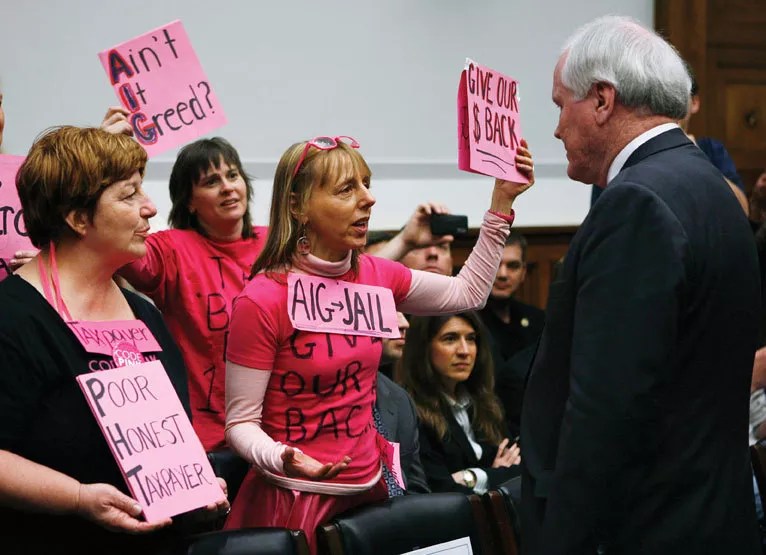
“Sold Out: How Wall Street and Washington Betrayed America,” a report issued by the Institute for Public Accuracy, begins with A Call to Arms that asks, “What caused this catastrophe?”—that is, the current economic disaster engulfing the US and international communities. The report gives a detailed accounting of whom, how, and why the very regulations that were created to stave off a crisis like this were slowly and purposely legislated away. It reveals a symbiotic relationships between fat cat lobbyists with enormous amounts of money to invest in elected officials and legislators who were more than willing to both ignore and jettison these protections. An ever-tightening ring of fire, “Sold Out” scalds readers’ sensibilities as it explains how the latest brotherly band of “forces of privilege” ripped off citizens and created today’s no-end-in-sight financial meltdown. It ends with 10 prescriptive actions that incensed Americans can and should take, because despite the exposure of these feckless inbreeders of greed, many continue to act with impunity, defend their actions, and/or attempt to sell Americans more lies amid woeful stories that it is not they, but nameless others, who are responsible for what economist Nouriel Roubini calls the, “Made-off Ponzi economy.” Dubbed “Dr. Doom” due to his dire (yet accurate) forecasts, Roubini predicts no economic relief will occur until 2010, if even then. Yet each and every Wall Street rally—at least six in the last year—is touted as proof that the crisis has bottomed out and recovery has arrived. Roubini calls these rallies “dead cat bounces”—a trader’s term that implies even dead cats bounce when dropped from great heights. Perhaps these are not lies, but protective musings put forth by the same folks who said that disclosure and transparency in speculative and predatory investing practices would “confuse investors.” Or perhaps the false positive of this talk of recovery is meant to sidetrack Americans from harsher realities—that the very people who created this crisis are lucratively being rewarded with gobs of taxpayer money. Richard Blumenthal, attorney general of Connecticut—home of insurance giant American International Group (AIG), the recipient of a $185.5 billion bailout despite fleecing investor’s savings—announced that subpoenaed records show AIG actually paid out $218 million—$53 million more than the reported $165 million—in bonuses with 73 executives receiving at least $1 million and 5 getting over $4 million. As more secret details are revealed, private security companies are being hired to protect executives’ homes and offices from demonstrators looking to vent their ire. The Connecticut Working Family’s party is planning a bus tour of these financiers’ homes to “give folks…who are struggling and losing their homes, jobs and health insurance an opportunity to see what kinds of lifestyle billions of dollars in credit-default swaps can buy.” Educational and informative, “Sold Out” will certainly not confuse. Senior editor, Lorna Tychostup interviewed its lead author, Robert Weissman by phone from his office in Washington, DC in late March.
The report begins by cataloging how the financial sector drowned political candidates in more than $1.7 billion in campaign contributions and another $3.3 billion on lobbyists, hired to press for deregulation. That’s a total of $5.2 billion spent on both Democrats and Republicans, and deregulation schemes that began with the Reagan administration. What did that money buy?
The crucial removals of regulatory restraints on Wall Street, commercial banks, and insurance companies that led them to build up the house of cards that has collapsed and destroyed, not only many of these leading firms and the financial sector, but the overall national economy and also the global economy is traceable in large part to policy decisions that were purchased in large part by that $5 billion.
Explain the Glass-Steagall Act of 1933 and the difference between commercial and investment banks.
The Glass-Steagall Act was adopted as a response to the financial misdeeds that contributed to the collapse of the stock market in 1929 and the Great Depression. It imposed a separation between commercial banks that offer savings and checking accounts and mortgages, and investment banks and Wall Street security firms that engage in a diverse array of speculative investment activities. Glass-Steagall was adopted to prevent the abuse by commercial banks that put depositors’ money at risk by putting it into risky investments that they had undisclosed interests in. The act was meant to keep investors’ money safe, prevent it from being used for speculative purposes, and to protect the commercial banking system, which is so important to the overall economy. It prohibited commercial banks from offering investment banking and insurance services, thus creating a “firewall” between commercial banks and high-risk activities of speculative securities firms.
Starting in the 1970s, there was a steady erosion of Glass-Steagall protections, and more exceptions were made enabling commercial banks to get involved in more speculative activity. This culminated in 1999 with the Financial Services Modernization Act, which formally repealed Glass-Steagall and related laws. The repeal was driven by the already-announced merger of Citibank and insurance giant Travelers Group—a merger not permissible under existing Glass-Steagall provisions. But they had a two-year window of review and went ahead with the merger, counting on their ability to get the law changed, which they achieved.
What about the role of lobbyists?
They swarmed the halls of Congress, poured money in, mobilized key CEOs to pound on members of Congress to convince them that Glass-Steagall was an outdated regulatory structure no longer relevant in the modern world. They wanted modernization so we could have the benefit of a single checking account and investment account. They talked of having the consumer benefits of a “financial supermarket”—certainly very modest at the time and now ridiculous looking, compared to the disaster that has been wrought.
Citigroup lobbying expenses totaled $88,460,000 between 1998 and 2008, almost twice that of JPMorgan Chase, the next largest financier.
Yes, Citigroup, along with Goldman Sachs, is the avatar of the influence-peddling financial firms. In the case of Citigroup, and to some extent Goldman Sachs, you have this peddling personified by Robert Rubin who was once the chair at Goldman Sachs, entered the Clinton administration, became the Treasury Secretary, was anointed by Time magazine as a member of the Committee to Save the World, left the position of Treasury Secretary, and is presently a private citizen. What people don’t know is that at the same the time he played a crucial and essential role in brokering the repeal of Glass-Steagall he was negotiating his next job, as an executive in the newly merged Citigroup. And he managed to come out of that, even as the financial crash was ensuing, and become a top adviser to the “wise men” surrounding the Obama transition team. Now his stock has fallen sharply. Disgraced by the performance of Citigroup and his claim that he didn’t know that the very aggressive speculative activity they were involved in would collapse, Rubin has faded from the scene. But a lot of his acolytes remain in top positions, including Larry Summers on the National Economic Council and Treasury Secretary Tim Geithner.
People are concerned that many “veterans of the money industry that hold elected officials in their deep pockets” are now getting key appointments to the Treasury, the Securities and Exchange Commission, and other agencies.
Yes. There is a gold-plated revolving door that goes between Wall Street and the financial regulatory agencies. Many of these top officials have come from Wall Street and then you see many of them going back to Wall Street. Looking at just 20 private firms, we found they hired 140 previously high-ranking members of former administrations, Congress, or Congressional staff as lobbyists.
The report states: “The repeal of Glass-Steagall contributed to the high-flying culture that led to this current disaster.”
After Glass-Steagall, we saw the rapid consolidation of the commercial and investment banks, primarily the commercial banks buying up the investment banks. More generally, we saw the giant mega-banks, moving increasingly to adopt the speculative, high-risk, gambling-intensive culture of Wall Street—exactly what Glass-Steagall was intended to stop. The incredible abuses of the 1920s came roaring back, engaging billions and billions of dollars of trade in derivatives, crafting mortgage-backed securities, and floating on the froth of a housing bubble that was certain to pop with disastrous consequences. But the short-term return was too great for them to resist.
Brilliant MIT or Cal Tech mathematicians “calculated half-mile-long algorithms” that no one understood that supposedly showed how secure mortgages (AAA) could be mixed together with high-risk mortgages and predatory loans, and somehow all would come out of the mix AAA-rated and ready for sale as secure investments?
They would take a big collection of mortgages that were mostly subprime, meaning relatively high risk and many of them predatory rip-off loans, pool them and then break them into tranches. The theory behind this was that if you pooled together enough of these loans you would spread the risk. There might be a problem in one neighborhood in Cleveland, but the problem would not be replicated elsewhere, and you could avoid the potential high-level risk by pooling together hundreds, thousands, or tens of thousands of these mortgages into a single “security.” That turned out to be completely and utterly wrong.
As early as 2002, Warren Buffet called mortgage-backed securities “weapons of mass financial destruction,” and yet such critics were ignored by the executive branch, Alan Greenspan, Robert Rubin, et al.
The short version of the story is that the financial sector got involved in ever more esoteric investments that they claimed were low risk but were not. They were able to do it with little to no regulatory controls because those controls had been removed, and attempts at new controls were defeated by Wall Street and its allies in government.
The report illuminates the conflict of interest between credit-rating firms and the financial institutions whose mortgage assets they rate and says it is like “referees being paid by the players.” Please explain.
Alchemy—an inexplicable process by which bad was pooled together with good and then 80 percent of it was suddenly rated AAA—was used to create these mortgage-backed securities. There are three credit-rating companies—called agencies to give the perception they are public entities, but they are not. They are for-profit corporations and hold the overwhelming share of the credit-rating business. They gave the AAA ratings to these very poor-quality bonds. They are paid by the entities that issue and sell the bonds to give them ratings. If the credit rating company gives a bad rating to a bond, there is a good chance that that issuer will not do business with them again. This is an absolute direct conflict of interest. We are finding more and more internal e-mail memoranda within these credit-rating companies acknowledging the conflicts and their awareness that they were rating poor-quality bonds very highly. Despite this, they kept doing it because they were being paid very well. Moody’s, the most prominent of these companies, had the single highest rate of return of any company in the Fortune 500 during much of the past decade. This became an incredibly profitable business. The AAA rating deceived investors into believing they were investing in safe and secure bonds at inexplicably high levels of return. A lot of pension funds and municipalities are not allowed to invest in bonds unless they are AAA or highly rated and rely on these credit-rating companies to be accurate. So the pension and government money flowed in and now these investors, both individual and institutional, are now finding they had been tricked into buying poor-quality investments they were told were gold.
Can you give me an example of a predatory loan scheme?
It’s a loan typically made to a relatively financially unsophisticated lower-income person that he or she can’t afford. Typically, the borrower is deceived as to the actual terms of his or her loan. People started making initial low payments with the sense that that amount was what they were going to owe on a monthly basis, but then after two years a new rate would kick in and they would owe much more than they were paying, and their mortgages became completely unaffordable. The worst of the predatory loans targeted minority and lower-income communities, but it became part of an expanded business model to use these abusive terms. The story told either implicitly or explicitly by mortgage brokers was: “Well, you can take a loan that’s got crazy terms but is at least reasonable for the first few years, because, due to the housing boom, you could just refinance and start all over again.” There is just no way that that could keep going on for eternity. It was based on the perpetual existence of a housing boom that was unsustainable and certain to pop.
Aren’t there laws to protect consumers against these schemes?
Some states adopted some very good anti-predatory loan rules and were very significantly able to reduce the scale of predatory lending at banks they were able to control. This is where the regulatory story gets so ugly. First, the federal agencies completely refused to enforce existing federal laws against predatory lending. So the Office of the Comptroller of Currency [OCC], which supervises 1,800 nationally chartered banks, took three consumer protection actions against predatory lenders in this decade. Second, they refused, despite the pleas of consumer and community groups, to address the nature of the evolving abusive terms of predatory lending. Third, the OCC, and its parallel entity, the Office of Thrift Supervision, both nullified the ability of states to enforce their own state predatory loan protection laws against federally chartered institutions. So federally charted banks were given the freedom to avoid any enforcement action under state consumer protection law.
Another element leading to the current financial crisis are “off-balance-sheet” accounting practices that hide the true financial health of banks. How do these practices work?
It’s pretty hard to explain because it sounds so contradictory to common sense. The purpose of a balance sheet is to explain the financial health of an entity. Corporations have this ability to hide money-losing assets and liabilities in something that is not revealed on the actual balance sheet shown to investors. A lot of the abuses surrounding Enron involved the extremely elaborate use of “off-balance-sheet” entities, often called “special purpose vehicles,” or SPVs. After Enron, efforts were made to limit the ability of companies to do this but banks maintained special rights to use them. Mortgage-backed securities were put into these off-balance- sheets with two benefits. First, there was always a chance the mortgage-backed securities would go bad and the bank should hold capital against the risk. Using an off-balance sheet, banks were able to avoid holding the extra capital. Second, when the mortgage-backed securities turned toxic, they didn’t appear on the bank’s balance sheet, so the extent of its losses were unclear.
So there is no transparency and no knowledge that your bank’s financial health is collapsing?
Yes. It is one of the major factors about the uncertainty over the state of the banks right now. You don’t know what they own, and even if you do know, it’s not clear what it is worth. These off-balance-sheet [assets] enabled banks to disguise their losses.
Derivatives—an estimated $683 trillion exist today—total more than 10 times the actual value of all the goods and services produced by the entire planet.
Mortgage-backed securities are actual collections of mortgages—so there is really something there. But derivatives are “derived” from actual assets. Derivatives are so very abstract and are piled upon other derivatives—abstractions upon abstractions—and these collections are completely unregulated. Efforts at potential reforms to regulate financial derivatives by the Commodity Futures Trading Commission were stopped by leaders in the Clinton administration, including Robert Rubin, Larry Summers, and Alan Greenspan. Retrospectively, these reforms would have avoided many of the problems that subsequently came. In 2000, the Congress, led by then Senator Phil Gramm, who went on to become an executive at the Swiss bank, UBS, by law prohibited the Commodity Futures Trading Commission from regulating financial derivatives—and that’s where we stand today.
In the absence of any regulation, or even monitoring, these derivatives spiraled completely out of control. So there are an estimated $683 trillion financial derivatives in the world. No one has any sense of who owes what to whom or on what conditions, because there is not even any sort of a central clearinghouse or exchange like the stock exchange. The result is enormous vulnerability in the financial system. AIG’s story is that it made a lot of terrible bets through derivatives. The reason why it is allegedly so important to bail out AIG is that those bets were made with so many other financial institutions—that if AIG cannot pay off, then many other institutions that were relying on AIG paying will collapse and we will have a cascade of institutional failure too devastating to permit. There was intentional creation over the last decade of financial instruments so complex that almost no one in these firms even knew what they were. Worse, they interconnected institutions in a complicated set of relationships that absolutely no one in the world understands because no bird’s-eye view was created because they were unregulated. The result has devastating real-world effects. A form of mass delusion that went on in Wall Street, the financial sector, and to some extent in the government sector that permitted these things to get so out of control. Not only did they heap all this harm on the rest of us, but they actually destroyed their own institutions.
Explain debt-to-net-capital ratio rules.
Debt-to-net-capital ratio rules apply to investment banks and securities firms. For a few decades the basic rule had been that the net capital ratio was 15 to 1, limiting how much borrowed money securities firms could use for investment. This is called “leverage.” An entity using borrowed money can increase the scale of its bets dramatically. Potential returns are much higher because firms invest not only their own money, but the borrowed money as well. The downside is if the bets go bad, they don’t have the capacity to pay off what they borrowed, which is why the SEC established the debt-to-net-capital ratio—to avoid volatility and speculation. In 2004, all five of the big Wall Street firms met with the SEC and persuaded it to remove the debt-to-net-capital ratio. The SEC then allowed them to set aside capital to offset potential losses based on their own internal-risk models—how risky they thought their bets were, not by some absolute standard developed by the SEC.
The lid was thrown off?
Yes. Firms then increased their leverage to 30 to 1, or in the case of Merril Lynch, 40 to 1. The leader of the band of persuaders was Henry Paulson, the chairman of Goldman Sachs, who then became Treasury Secretary under President Bush. The impact was this group was able to expand the scale of their bets, and when the bets went bad they were much less able to handle the losses, and this led to the firms going broke or being merged out of existence, and two of the firms taking big hits.
So these guys went to the party, got too drunk, put all their chips on the table, and lost. But because they are so big and important, the biggest financial speculators in the country get reimbursed by taxpayer money to the tune of $700 billion and Congress rebuffed any effort to provide any sort of accounting of how this taxpayer money should be spent?
That’s exactly what happened. The Bush bailout came in two bits—$350 billion first and then an additional $350 billion. There were no conditions on how the banks would use the money that they were given, no obligations for the banks to revise the mortgages they held to bring the principle down, no controls on executive pay, no incentives so that these institutions would behave differently in the future.
Economist Nouriel Roubini forecasts that the US is only halfway through a severe recession and that February’s stimulus package is not large enough to bring recovery until 2010. Greed and deception fueled this financial crisis. Speculators who made tremendous profits have been bailed out by taxpayer money. People are being hit incredibly hard. What can be done?
The stimulus package was not enough, and it is very important for there to be massive public support for another stimulus package at least as big. It is equally important that people understand that President Obama’s $800 billion stimulus package adopted in February is separate, completely unrelated to Bush’s November bank bailout bill. Hundreds of billions of dollars are being thrown around in both cases, and because the Republicans intentionally tried to confuse the issue there is some mixing in the public’s mind of the two. About 30 percent of the stimulus will be spent on tax cuts, but the rest represents government money spent on health care, education, and to some extent on green investments to “jump start” or invest in the economy, put people back to work. The two problems with the stimulus package was one, too much money went to tax cuts, which is an inefficient way to attempt to reenergize the economy, and, two, it was too small compared the size of the overall national economy in light of the extent of the economic slowdown. Getting the economy moving, getting people to work, using up the spare capacity in the economy is completely separate from how you handle the financial institutions and the bank bailout money—the $700 billion that was approved at the end of the Bush administration.
First: We need more stimulus.
Second: In the financial sector, we are almost certain to see the government taking over some of the big banks. As the government clears out and sells off the parts that are not functioning, the government will inevitably take on the losses and that will be a big hit to the taxpayers. There is really no feasible way around that. But some of the pain can be spread to the shareholders—the shareholders get nothing and some of the bondholders should be required to pay some of the costs. When the banks are then put back into the private sector—for example, Citigroup—they should be broken up into a lot of different component pieces so we don’t have the problem of the “too big to fail” bank. And the component pieces should be obligated toward serving social purposes and not engage in the abusive behavior the financial sector has been [engaging in].
[Editor’s note: Regulators, blinded by rising stock prices, did not challenge banks that grew large via mergers and acquisitions. By mid 2008, the top five banks held more than half of the assets controlled by the top 150 financial institutions and were considered “too big to fail”—implying they would be rescued by taxpayer money regardless of how much risk they took on and therefore could continue their unregulated, free-for-all investing.]
Third: We need dramatically stricter rules to regulate the way the financial sector works. There will be new financial regulatory laws passed in 2009. But what is up for grabs is how stringent the rules will be and whether they really act to prevent this kind of disaster from occurring again. Specifically, exotic securities should be prohibited altogether. They don’t serve a social purpose and are just too risky for society to tolerate. New securities should be registered in advance and shown to be safe and beneficial to the overall system before they are permitted on the market.
Fourth: Glass-Steagall-type barriers should be imposed.
Fifth: There needs to be new methods created for consumers to organize and band themselves together so they can monitor and act as a counterweight to the influence of the big financial institutions.
Sixth: There should be a financial transactions tax imposed on trade and all these exotic securities to slow down speculation, and, incidentally, raise a lot of money that will come almost overwhelmingly from the rich people who engage in all the speculative activity.
But we still have a very well-funded financial lobbying force in place, ready and able to continue to fight any and all attempts at regulating greed-inspired investing. These lobbyists have been filling the pockets of elected officials and others who not only ignored regulations already in place but worked to legislate regulations into oblivion.
The obvious moral of the story is, we need campaign finance reform, but we can’t wait around for that. Wall Street interests are still spending tons of money in Washington and remain very influential despite having brought such disaster down on the entire country. What’s different is that the public is really angry and keenly aware of the responsibility of the Wall Street firms. Members of Congress understand there is such intense public outrage. The balance of power has really shifted in the direction of the public interest, but what remains unclear as we get down to an actual legislative fight over financial regulations is, has it shifted enough to impose really serious controls over Wall Street and does the public have the ability to organize and the mechanisms to organize itself well enough to engage on very specific demands. Congress is very averse right now to the idea of more money for a bank bailout because there is such a visceral response from a public mobilized around that general issue. On financial regulatory issues we are going to have to have a comparable level of outrage and mobilization if we don’t want to be outsmarted by the lingering effects of the Wall Street money interests.
A young contractor asked me, “Is it really our fault? Do we just need to keep buying things?”
This business of blaming people is really awful. That individuals or we, the public, must take responsibility because we have been irresponsible is a sham, a misreading of history, and is an evil effort to divert responsibility from where it rests. The financial sector has been brought down by the leading institutions doing exactly what they wanted to do with no public controls whatsoever. They have no one else to blame but themselves. We can blame as well the government regulators who capitulated to their demands, but it is exactly clear who is responsible for this financial disaster—and it is not us.
This article appears in April 2009.


