









Several years ago, three parents in New Paltz, seeking to augment the nature-based summer camp prospects available for their children, decided to start their own. They took 20 kids into the woods for two weeks and taught them plant and tree identification, shelter construction, fire building, and other Native American skills.
That was the beginning of an organization called Red Fox Friends, which now offers year-round training in nature awareness and survival skills to about 150 youths. Most are ages 6 to 13, although there are also programs for kids 4 to 6 and for young adults 18 to 25. The programs usually meet one weekend day each month—some meet weekly—with occasional overnights. Over 100 kids are expected to attend this year’s summer camp.
“Our program is all about three things,” says David Brownstein, one of the original founders and currently treasurer of the board of trustees. “Connection to the Earth, connection to each other, and then connection to ourselves.”
While modeled on various national and international wilderness and survival programs, Red Fox Friends is also developing its own instructional philosophy and core teachings based on the needs of the community and young people it serves. Unlike the planned lessons of the traditional classroom, the “open schoolroom” of nature offers much less predictability, and thus a greater opportunity for children to interact with its wide variety of experiences.
“One thing we try to teach, almost in a meditative way, is being in the moment,” says Chris Victor, also an original founder and president of the board. “It’s one of the greatest teachings of nature. It’s the place where all animals are. We try to inspire that in the children, and we have to follow the same principle to be effective instructors.”
This approach requires instructional flexibility and changing plans when necessary. If fire making is scheduled but it’s too cold, the kids didn’t have enough breakfast, or they’re just not responding, the instructors then make a transition to other activities that will inspire passion and curiosity, which, says Victor, are two of the essential elements of the program.
“Inspiring their curiosity, inspiring their passion, are like gas in their gas tank,” he says. “We are constantly trying to facilitate that.”
And one of the methods the instructors use to reach that goal is the art of questioning, a philosophy of teaching that opens the field of learning by steering clear of providing direct answers.
Victor gives this example: A child comes across a tree that fascinates her and wants to know what it is. If Victor simply tells the child it’s a shagbark hickory, the conversation ends there. But if he uses that moment to see how far and in what directions the child can be drawn out, the possibilities of learning—not only about trees and the surrounding habitat but also about oneself—are greatly expanded.
So, instead of supplying answers, the instructor asks questions: Does this tree look like other trees? What does the bark look like? Does it seem to like shade?
Victor admits that the method can be frustrating with older kids, who are sometimes impatient for an answer, but if it’s done well it can stimulate curiosity, particularly with younger children.
“And as an instructor I don’t know where it’s going to go,” he says. “All I know is, I want to take that passion, kindle it like a little fire, and see what flourishes out of it.”
On a frigid Saturday in February, on a property along Clove Valley Road in the heart of the Shawangunks, groups of boys and girls gathered for their monthly day of instruction. They slid and slithered across a frozen parking lot with the ease and joy of seals. Later, the boys formed a circle and scrambled after a tossed ball, sometimes diving into the snow, as they answered a mix of questions—some easy, others more progressively difficult—called out by an instructor: Is a squirrel a mammal? How about a bat? What is a marsupial?
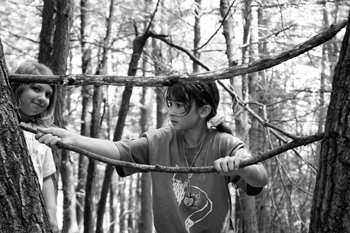
A short distance away, a group of girls formed a circle and shared their favorite kinds of sky: moonlit, snowing, streaked by dawn light. Then they began to climb a classic Shawangunk slope, scrambling under and over the boulders, leading the way for the adults. At one point a child discovered ice in a dark crevice, and the children gravitated toward the find, exchanging excited shouts as they climbed down to explore the tight space.
Many Red Fox activities involve what Chris Victor calls “the edge”—the point at which an activity is neither so easy that kids lose interest nor so difficult that it could turn them off or scare them. While safety is paramount in the program—the instructors are trained in First Aid and CPR, as well as survival skills—young people are appropriately challenged according to their age and capabilities.
Fire making, for example, is taught in different ways according to the age group. For the youngest kids, Victor says, it’s done in a playful and extremely safe way, with the adults making the fire and the kids cooking pizza dough on sticks. “Some kids,” says Victor, “have never sat by a fire or poked one.”
The older kids will make a fire using Native American friction methods, such as with a bow drill or the more difficult hand drill.
If an instructor is leading a group that is adequately competent with fire building, he or she may tell the group that a friend just fell into a pond and they have five minutes, timed by stopwatch, to get a fire going to warm him.
Dyami Nason-Regan, 21, began volunteering as an instructor in the Red Fox home school program last year. One day a week, 20 7-to-12 year olds are taught a variety of nature awareness and survival skills, including primitive cooking and nature journaling, which includes both sketching and writing. “We’re making it fun,” Nason-Regan says, “by incorporating song and games into our day.”
Nason-Regan recalls the impact of the program on one young girl. When she came the first time, the group was playing a game of walking silently in the forest, to match the forest’s rhythms. Nason-Regan recalls how the girl was able to demonstrate this activity for the others with great skill, how “her entire body and presence just captured this way of being in the forest.”
Another goal of Red Fox Friends is to help kids feel safe in nature by addressing hazards in a healthy, comfortable way. They teach kids how to identify poisonous plants, deal with being lost, and know the signs of hypothermia or frostbite. Through knowledge, kids gain a sense of security in the outdoors.
“If you don’t know what poison ivy looks like, you’re going to be kind of timid going out into the woods,” says Victor. “But if you know it and can identify it, you can feel safe.”
Youth are taught to identify wild edibles in a careful way (mushrooms are never harvested, and nothing is harvested without adult supervision). With younger children, the adults harvest and the children taste.
A large part of the program, Victor says, is instilling in the children—not directly, but by the example of staff—a sense of gratitude, whether it’s for harvesting a wild edible or building a structure. Each day begins with a gathering, a game, and a moment of thanks.
Red Fox Friends works with more than the individual young person—the organization stresses the importance and centrality of community. David Brownstein notes that communities were once responsible for much of what Red Fox Friends offers.
“We’ve gone into a very nuclear family culture,” he says. “The mentoring culture has left us, and that’s what we’re trying to reestablish. I can’t teach my son everything that he’s interested in. But if I help mentor three or four kids in things that I can teach them, and if I can send my kid to the neighbor next door who does woodworking—that makes my son more whole. And it fulfills people who want to teach. We all want to teach what our gifts are, and kids want to receive a lot of different teachings. That’s what we’re reintroducing here as well.”
As an example of tapping the wider community, local craftspeople, through Red Fox Friends, will be offering a course in canoe building for children and their parents.
Brownstein also speaks of the community’s once central role in helping young people fulfill rites of passage. While Red Fox Friends doesn’t formally offer that type of activity, Brownstein says the organization wants to encourage and support such rituals, to “help bring into the community conscience that these kids need this and want this.” He gave as an example a 13-year-old boy keeping a fire going for 24 hours, with family members spending the night in the woods nearby.
Most kids who come to Red Fox Friends attend the Waldorf schools in New Paltz and Spring Valley, which emphasize experiential education and discourage exposure to electronic media, and therefore they arrive with a certain comfort in nature.
“When we do encounter kids who don’t feel comfortable in nature,” Brownstein notes, “it’s surprising how fast they are totally turned on by what’s available for free. Hanging by the stream and fishing and just making a dam are the most pleasurable things a child can do.”
For more information, visit www.redfoxfriends.com.


This article appears in March 2007.


