









Neal Jorgensen’s mistake was taking the government at its word.
After he reported hazards at his job with a plastics recycling firm in Preston, Idaho, two things happened right away. OSHA (Occupational Health and Safety Administration) cited the plant for multiple violations, and Jorgensen was fired.
It’s illegal to terminate a worker for blowing the whistle on safety violations. Jorgensen complained that he had been fired for exercising his rights, and an OSHA investigation substantiated the claim. At that point, Jorgensen’s employer could have settled for a modest amount of back wages, but refused.
The OSHA law tells what should have happened next. It directs the Secretary of Labor to sue employers who discriminate against workers for reporting job-related hazards. However, when OSHA referred Jorgensen’s case to lawyers for the Department of Labor in December, 2004, they refused to pursue it. “My employer got away with firing me without any consequences,” Jorgensen, 58, said.
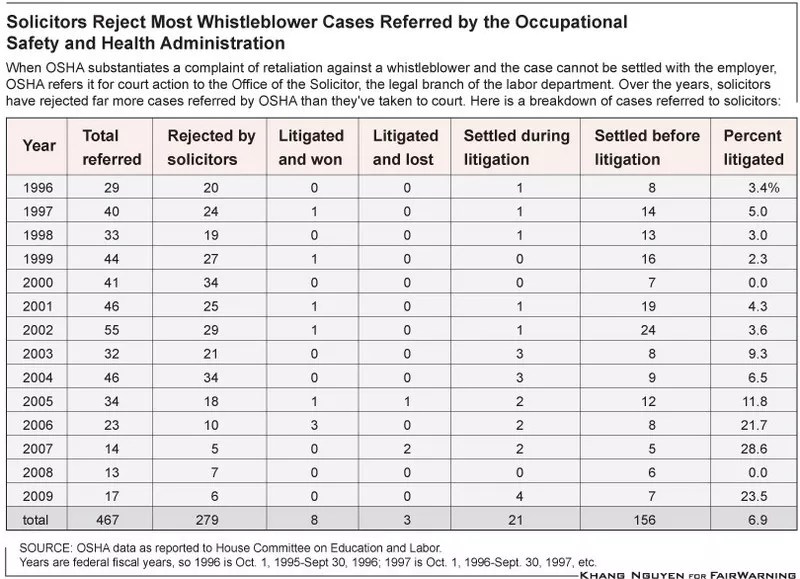
It was not an isolated case. Over the years, scores of whistleblowers have seen their cases fall into a black hole because the Office of the Solicitor, the legal arm of the labor department, wouldn’t pursue them in court, undermining protections in the OSHA law. No matter that OSHA found the workers had been illegally demoted or fired; they were left with nowhere to turn. The situation has spurred calls for stronger protections for whistleblowers, which critics say are grossly inadequate.
From 1995-2009, regional solicitors filed 32 whistleblower lawsuits, while rejecting 279 other cases referred to them by OSHA, or almost nine times as many, according to government figures.
Workers whose cases are abandoned are not the only losers. According to current and former OSHA investigators, it’s harder to settle many other whistleblower complaints because employers know they won’t be sued. “They [the solicitors] want cases that are slam dunks,’’ said a frustrated OSHA investigator who, like several others, spoke on condition of anonymity. “They don’t want a case that we could possibly lose. That’s just a ridiculous standard.’’
Another investigator told of being laughed at when he asked the lawyer for an employer to produce a company document in a whistleblower case. “What are you going to do, take us to court?” he recalled the lawyer asking. “And we both laughed,” the investigator said, “because the odds of the solicitor taking the case to court are slim to none.’’
The solicitor’s office declined interview requests, but in an e-mail response said its record is better than critics say. Noting that along with 32 lawsuits, settlements were reached in 156 other cases referred by OSHA, the statement said solicitors litigated or settled about 40 percent of referrals over the 14 years, and more than 50 percent over the last five years. “These are not numbers that should cause employers to feel comfortable engaging in safety-based retaliation,” the statement said.
OSHA and the solicitor’s office are backing legislation in Congress to allow workers to pursue retaliation complaints on their own if government lawyers won’t. “We are enormously frustrated when we find merit in a case and the solicitors decide not to take that forward,” said Jordan Barab, deputy assistant Secretary of Labor for OSHA. “We also understand that the solicitors have the same resource issues that we have,’’ he said, “and that’s why we need a change in the law.”
Citing other serious problems—inadequate staffing, bulging caseloads, and long delays in completing investigations—some critics say the whistleblower program is broken and will not be fixed by a tweak in the law.
A Staggering Caseload
OSHA is spread so thin that, by one estimate, inspectors would need 137 years to check each workplace under the agency’s jurisdiction once. To encourage workers to serve as extra eyes and ears, Congress included whistleblower protections in the Occupational Safety and Health Act of 1970, making it illegal to fire, demote, or harass them for reporting safety violations.
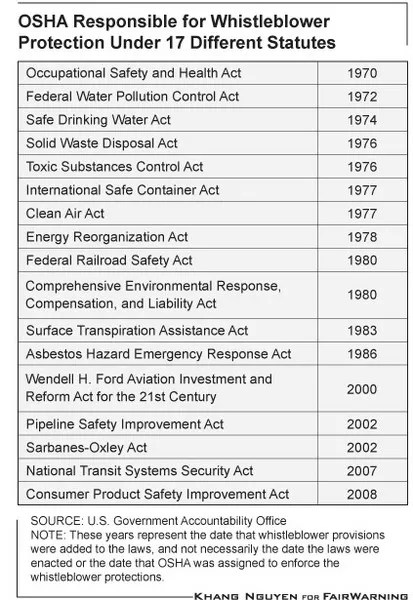
It seemed like such a good idea that Congress later added whistleblower protections to a wide array of regulatory measures—on air and water quality, airline and trucking safety, even accounting fraud. With its prior experience investigating retaliation complaints OSHA’s portfolio grew, taking on a rising tide of new laws in a kind of unfunded mandate.
Today, OSHA’s Whistleblower Protection Program is responsible for enforcing anti-retaliation provisions of 17 different laws, most having nothing to do with its core mission of reducing workplace injuries and deaths. At an agency that has long struggled with austere budgets, the whistleblower program has never been a priority, and is described by some critics as OSHA’s unwanted stepchild.
Anxious for results of their complaints, employees are left hanging for months because the thin corps of investigators is overwhelmed by the number of cases. Citing chronic shortages of manpower, training and equipment, demoralized whistleblower staff have become whistleblowers themselves, venting their frustrations to congressional aides and others.
Advocacy groups have weighed in too. Saying OSHA has been “resource-starved even for its primary activities,” the Government Accountability Project has described whistleblower protection as “a mission conflict” for the agency. Jeff Ruch, executive director of Public Employees for Environmental Responsibility, recently charged that “whistleblower protection at OSHA is not just on the back burner, it has fallen off the stove.”
OSHA officials say funding constrains all agency activities, without exception. “We try to do the best we can, given what we have to deal with,” said Jordan Barab, deputy assistant Secretary of Labor for OSHA, “but we have a lot to deal with.”
While piling on new statutes, Congress and OSHA have rarely boosted staff, resulting in bloated caseloads and long delays in resolving complaints, documents and interviews show.
Pressure to close investigations to keep up with heavy caseloads can lead to a subtle bias in the employer’s favor, some investigators said, because it is faster and easier to dismiss a complaint than to marshal the evidence needed for a merit finding.
While the various statutes differ on filing deadlines, available damages and other details, training for investigators has often lagged far behind assignment of new laws. For example, two of the most complex statutes — the Sarbanes-Oxley Act to combat accounting fraud and the Aviation Investment and Reform Act—were enacted in 2002 and 2000, respectively. Yet in 2008, when the Government Accountability Office surveyed whistleblower investigators throughout the US, one third to one half said that they had yet to receive specific training in these laws.
“When people really look at the down and dirty of how the program works, the resources don’t match what we say—how much we respect whistleblowers,’’ said Celeste Monforton, a former OSHA official and now assistant research professor of occupational health at George Washington University.
The whistleblower program has its own corps of investigators, distinct from the larger force of OSHA inspectors who check jobs sites for compliance with health and safety rules. Over the past decade, the number of investigators hovered between 70 and 75 even as new laws were being assigned. At least twice in recent years funds meant for hiring new investigators were instead used to plug shortfalls in other OSHA enforcement activities.
Workers Languishing
But help is on the way. Earlier this year, OSHA began the process of hiring 25 new investigators in what Barab called “the first semisignificant expansion in many, many years.’’
Critics say there is much ground to make up.
Many investigators struggle with three or four times more cases than they can effectively manage. An investigator can best handle six to eight cases at a time, an OSHA spokesperson said. But in several regions of the US, investigators average 20 or more open cases, and in one region the average is 32. Recently, the largest caseload for a single investigator was 69, according to data obtained under the Freedom of Information Act.
Investigations often stretch far past the 30-to-90-day deadlines set by the various laws. Over the last seven months, the average time to close a case was 174 days, according to OSHA.
Delay is usually tougher on the ousted worker than the employer. When “we’re not able to get to their case in a timely fashion, then that person is just kind of left out there in limbo trying to survive on their own,” an investigator said. “Complainants are upset because they’re not getting their cases investigated, and they have a right to be.”
“The deck is stacked against the whistleblower,” another investigator said. “You’ve got an agency that’s under-resourced and takes a real long time to do the investigation. All of that puts the whistleblower at a serious financial disadvantage.”
“Some of them just can’t wait that long,” he continued. “They lose their houses. They end up getting divorced over the financial woes. And, of course, their wife doesn’t understand why they didn’t keep their… mouth shut and keep their job—why they had to blow the whistle in the first place.”
About 2,000 complaints are filed per year under the various statutes. About 80 percent of cases are dismissed by OSHA or withdrawn. OSHA refers to the other 20 percent as “merit’’ cases, though most of them are settled with the employer and relatively few result in a finding in the complainant’s favor.
Employers invariably claim they had a valid reason to act against a worker, and firings often occur under ambiguous circumstances. But advocates for whistleblowers say investigators tend to take the employer’s explanation at face value, even refusing to share his statements with the complainant so he has a chance to refute them.
Jason Zuckerman, a Washington, DC lawyer who represents whistleblowers, charged in a letter last year to OSHA officials that some investigators “look for any reason they can find to dismiss a complainant’s claims. This is often done by questioning every factual assertion a complainant makes while unquestioningly accepting the employer’s justifications.’’
Under laws of some states, a whistleblower can file a wrongful termination case in court rather than trust the OSHA process. But as a practical matter, the modest damages available in most cases would make it hard to find a lawyer to file a lawsuit.
In one critical area, the newer laws administered by OSHA provide greater protection for whistleblowers than the 40-year-old OSHA statute. Under the more modern laws, if a complaint is dismissed by OSHA, the employee can take the case to an administrative law judge, a forum where complainants generally have had more success than with OSHA.
Under the OSHA law, however, there is no independent right of appeal. If the case can’t be settled, OSHA finds it lacks merit, or solicitors won’t take it to court, the worker is out of options. That is what’s behind the proposed change in the law.
Footdragging at OSHA
In April 2004, after a fellow worker at Plastic Industries, Inc., was cut by a bandsaw, Neal Jorgensen co-signed a complaint to the OSHA office in Boise. OSHA did an inspection and issued several citations, including “serious’’ ones for lack of a guard on the bandsaw and inoperative safety features on other machinery.
With the plant buzzing about who called OSHA, suspicion quickly focused on Jorgensen. When he reported for work a few days after the inspection, he was abruptly sent home. The explanation: The baling machine he would have operated had been found in violation by OSHA and was not available for use. It turned out that other workers did run the baler the same day though the violation had not been fixed, according to the OSHA investigation.
The next day, Jorgensen was informed he was being fired for poor performance. However, OSHA found that company managers made inconsistent statements about the reasons for the firing, and altered at least one document in the course of the investigation. When an investigator showed a letter critical of Jorgensen to the foreman who supposedly wrote it, the foreman said he had been asked to write it and that the original included positive statements about Jorgensen that were removed when the letter was faxed to OSHA. “In conclusion,’’ the investigation found, “there is a preponderance of evidence that a prima facie complaint of discrimination has been established.”
It wouldn’t have cost much to settle the case. OSHA calculated that Jorgensen was due $2,911.57 in lost pay from the day he was fired until he started a new job soon after. However, the company balked, and OSHA referred the case to the regional solicitor in Seattle.
Jorgensen got the bad news in an April 2005 letter. The letter said “the case was deemed unsuitable for litigation” due to “insufficient evidence.”
A cruder explanation emerged a few weeks ago when Jorgensen told his story to Congress. In testimony before the House Subcommittee on Workforce Protections on April 28, Jorgensen read from an internal memo from the regional solicitor’s office that discussed his case. “We believe we have an approximate 25 percent chance of success,” the memo said. “There are two US District Court judges in Idaho, one of whom routinely is not well disposed towards the government cases, and the other who can go either way.’”
“I thought I did the right thing,” Jorgensen told the panel, “but the system did not work for me.”
The bill under consideration, dubbed the Protecting America’s Workers Act, would bring whistleblower provisions of the OSHA law more in line with the modern statutes. Introduced by Rep. Lynn Woolsey (D-CA) with more than 80 co-sponsors, it would provide a right of appeal to an administrative judge if OSHA rejects a case or the solicitor won’t pursue it. In addition, it would extend the current deadline for filing a complaint from 30 to 180 days. Similar legislation is pending in the Senate.
“There’s a lot of accidents that could be prevented if workers weren’t afraid to call the situation to the attention of somebody above their bosses if their bosses won’t pay attention,” Woolsey said in an interview. “But they’re afraid for their jobs.”
Lloyd B. Chinn, an attorney with Proskauer Rose LLP who specializes in defending companies in employment matters, said that diverting cases from regional solicitors to administrative judges could mean routing them from one overworked, understaffed bureaucracy to another. “I’m not sure there is proof that the system doesn’t work,” Chinn said, “and if it doesn’t work, I’m not sure this fixes it.’’
For his part, Jorgensen said that as things now stand, he would not advise anyone to file a whistleblower complaint. “Absolutely not,’’ he said. “The way the law is written—no chance.’’
This article originally appeared on FairWarning.org, a nonprofit investigative publication focused on safety, health, and related issues of government and corporate accountability.

This article appears in August 2010.


